

16
2 1D Models of Ekman Layers
where (X, Y ) is the location of a float, and (u, v) is horizontal velocity at the depth
horizon of this float.
2.3.2 Results
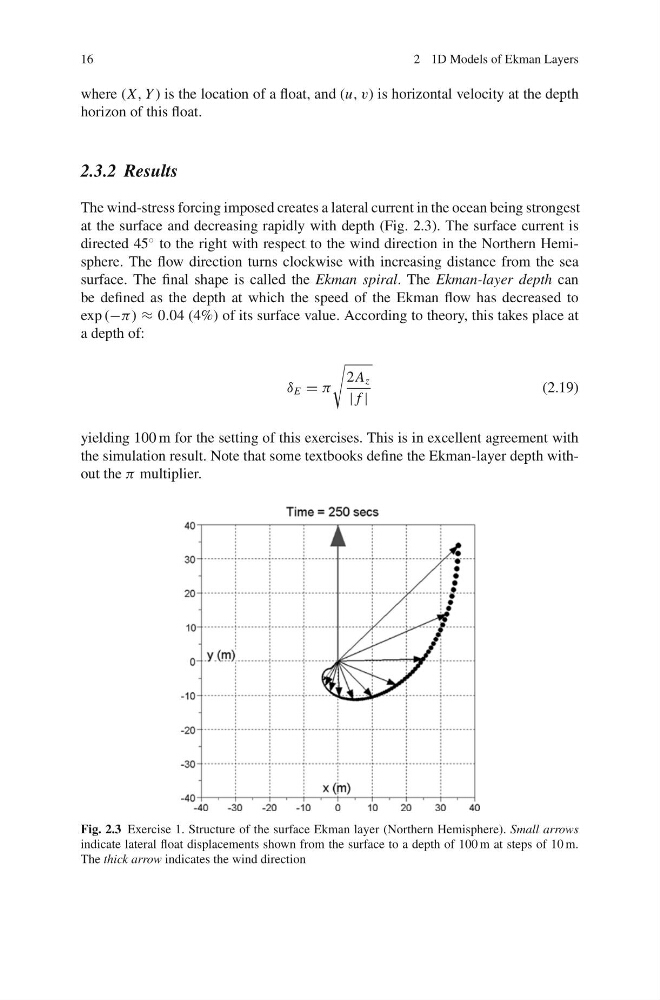
The wind-stress forcing imposed creates a lateral current in the ocean being strongest
at the surface and decreasing rapidly with depth (Fig. 2.3). The surface current is
directed 45
◦ to the right with respect to the wind direction in the Northern Hemisphere. The flow direction turns clockwise with increasing distance from the sea
surface. The final shape is called the Ekman spiral. The Ekman-layer depth can
be defined as the depth at which the speed of the Ekman flow has decreased to
exp (−π ) ≈ 0.04 (4%) of its surface value. According to theory, this takes place at
a depth of:
δ E = π
2A z
| f |
(2.19)
yielding 100 m for the setting of this exercises. This is in excellent agreement with
the simulation result. Note that some textbooks define the Ekman-layer depth without the π multiplier.
Fig. 2.3 Exercise 1. Structure of the surface Ekman layer (Northern Hemisphere). Small arrows
indicate lateral float displacements shown from the surface to a depth of 100 m at steps of 10 m.
The thick arrow indicates the wind direction
2 1D Models of Ekman Layers
where (X, Y ) is the location of a float, and (u, v) is horizontal velocity at the depth
horizon of this float.
2.3.2 Results
The wind-stress forcing imposed creates a lateral current in the ocean being strongest
at the surface and decreasing rapidly with depth (Fig. 2.3). The surface current is
directed 45
◦ to the right with respect to the wind direction in the Northern Hemisphere. The flow direction turns clockwise with increasing distance from the sea
surface. The final shape is called the Ekman spiral. The Ekman-layer depth can
be defined as the depth at which the speed of the Ekman flow has decreased to
exp (−π ) ≈ 0.04 (4%) of its surface value. According to theory, this takes place at
a depth of:
δ E = π
2A z
| f |
(2.19)
yielding 100 m for the setting of this exercises. This is in excellent agreement with
the simulation result. Note that some textbooks define the Ekman-layer depth without the π multiplier.
Fig. 2.3 Exercise 1. Structure of the surface Ekman layer (Northern Hemisphere). Small arrows
indicate lateral float displacements shown from the surface to a depth of 100 m at steps of 10 m.
The thick arrow indicates the wind direction