

2.2 The Surface Ekman Layer
13
Consequently, surface Ekman layers in the ocean are limited in their vertical
extent. Typical thicknesses are 50–150 m with increasing values toward the equator.
2.2.4 Solutions of the Boundary-Layer Equations
The analytical solutions of the boundary-layer equations are derived and discussed
in many textbooks (e.g. Cushman-Roisin, 1994). These solutions are a first benchmark for verification of a one-dimensional finite-difference water-column model
being constructed in the next section. This approach also gives us the opportunity
to explore situations of nonuniform values of vertical eddy viscosity for which
analytical solutions are more difficult to derive.
2.2.5 Finite-Difference Equations
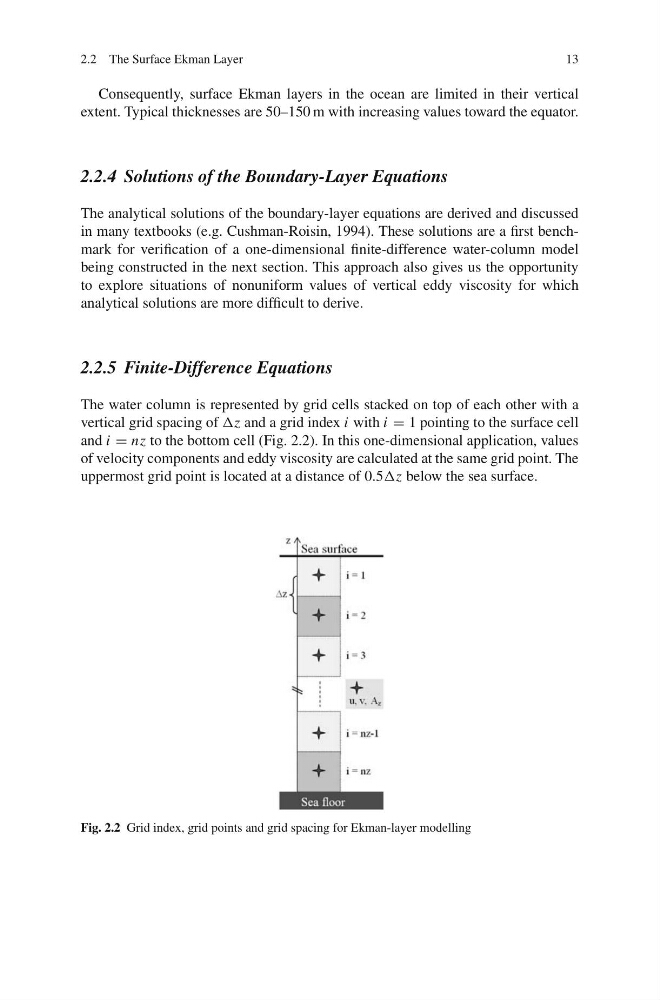
The water column is represented by grid cells stacked on top of each other with a
vertical grid spacing of Δz and a grid index i with i = 1 pointing to the surface cell
and i = nz to the bottom cell (Fig. 2.2). In this one-dimensional application, values
of velocity components and eddy viscosity are calculated at the same grid point. The
uppermost grid point is located at a distance of 0.5Δz below the sea surface.
Fig. 2.2 Grid index, grid points and grid spacing for Ekman-layer modelling
13
Consequently, surface Ekman layers in the ocean are limited in their vertical
extent. Typical thicknesses are 50–150 m with increasing values toward the equator.
2.2.4 Solutions of the Boundary-Layer Equations
The analytical solutions of the boundary-layer equations are derived and discussed
in many textbooks (e.g. Cushman-Roisin, 1994). These solutions are a first benchmark for verification of a one-dimensional finite-difference water-column model
being constructed in the next section. This approach also gives us the opportunity
to explore situations of nonuniform values of vertical eddy viscosity for which
analytical solutions are more difficult to derive.
2.2.5 Finite-Difference Equations
The water column is represented by grid cells stacked on top of each other with a
vertical grid spacing of Δz and a grid index i with i = 1 pointing to the surface cell
and i = nz to the bottom cell (Fig. 2.2). In this one-dimensional application, values
of velocity components and eddy viscosity are calculated at the same grid point. The
uppermost grid point is located at a distance of 0.5Δz below the sea surface.
Fig. 2.2 Grid index, grid points and grid spacing for Ekman-layer modelling