

12
2 1D Models of Ekman Layers
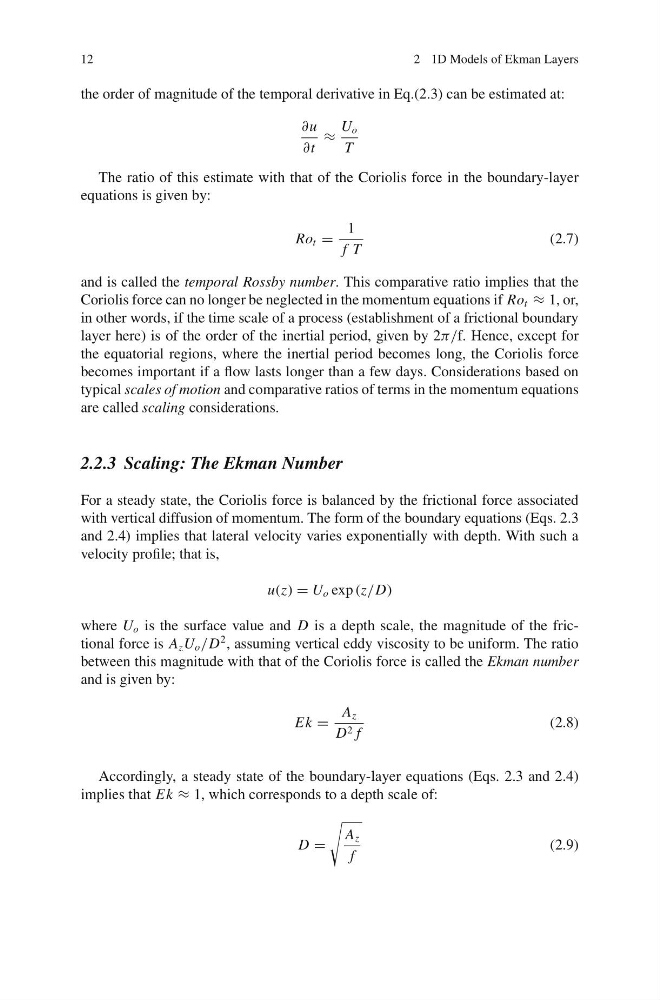
the order of magnitude of the temporal derivative in Eq.(2.3) can be estimated at:
∂u
∂t
≈
U o
T
The ratio of this estimate with that of the Coriolis force in the boundary-layer
equations is given by:
Ro t =
1
f T
(2.7)
and is called the temporal Rossby number. This comparative ratio implies that the
Coriolis force can no longer be neglected in the momentum equations if Ro t ≈ 1, or,
in other words, if the time scale of a process (establishment of a frictional boundary
layer here) is of the order of the inertial period, given by 2π/f. Hence, except for
the equatorial regions, where the inertial period becomes long, the Coriolis force
becomes important if a flow lasts longer than a few days. Considerations based on
typical scales of motion and comparative ratios of terms in the momentum equations
are called scaling considerations.
2.2.3 Scaling: The Ekman Number
For a steady state, the Coriolis force is balanced by the frictional force associated
with vertical diffusion of momentum. The form of the boundary equations (Eqs. 2.3
and 2.4) implies that lateral velocity varies exponentially with depth. With such a
velocity profile; that is,
u(z) = U o exp (z/D)
where U o is the surface value and D is a depth scale, the magnitude of the frictional force is A z U o /D
2 , assuming vertical eddy viscosity to be uniform. The ratio
between this magnitude with that of the Coriolis force is called the Ekman number
and is given by:
Ek =
A z
D 2 f
(2.8)
Accordingly, a steady state of the boundary-layer equations (Eqs. 2.3 and 2.4)
implies that Ek ≈ 1, which corresponds to a depth scale of:
D =
A z
f
(2.9)
2 1D Models of Ekman Layers
the order of magnitude of the temporal derivative in Eq.(2.3) can be estimated at:
∂u
∂t
≈
U o
T
The ratio of this estimate with that of the Coriolis force in the boundary-layer
equations is given by:
Ro t =
1
f T
(2.7)
and is called the temporal Rossby number. This comparative ratio implies that the
Coriolis force can no longer be neglected in the momentum equations if Ro t ≈ 1, or,
in other words, if the time scale of a process (establishment of a frictional boundary
layer here) is of the order of the inertial period, given by 2π/f. Hence, except for
the equatorial regions, where the inertial period becomes long, the Coriolis force
becomes important if a flow lasts longer than a few days. Considerations based on
typical scales of motion and comparative ratios of terms in the momentum equations
are called scaling considerations.
2.2.3 Scaling: The Ekman Number
For a steady state, the Coriolis force is balanced by the frictional force associated
with vertical diffusion of momentum. The form of the boundary equations (Eqs. 2.3
and 2.4) implies that lateral velocity varies exponentially with depth. With such a
velocity profile; that is,
u(z) = U o exp (z/D)
where U o is the surface value and D is a depth scale, the magnitude of the frictional force is A z U o /D
2 , assuming vertical eddy viscosity to be uniform. The ratio
between this magnitude with that of the Coriolis force is called the Ekman number
and is given by:
Ek =
A z
D 2 f
(2.8)
Accordingly, a steady state of the boundary-layer equations (Eqs. 2.3 and 2.4)
implies that Ek ≈ 1, which corresponds to a depth scale of:
D =
A z
f
(2.9)