

164
5 3D Level Modelling
5,000 Lagrangian floats are initialised at random locations of the model domain. The
total simulation time is 50 days with data outputs at 12-hrs intervals. The pressure
accuracy of the S.O.R. iteration is set to = 0.01 Pa.
5.12.3 The Smagorinsky Turbulence Closure Scheme
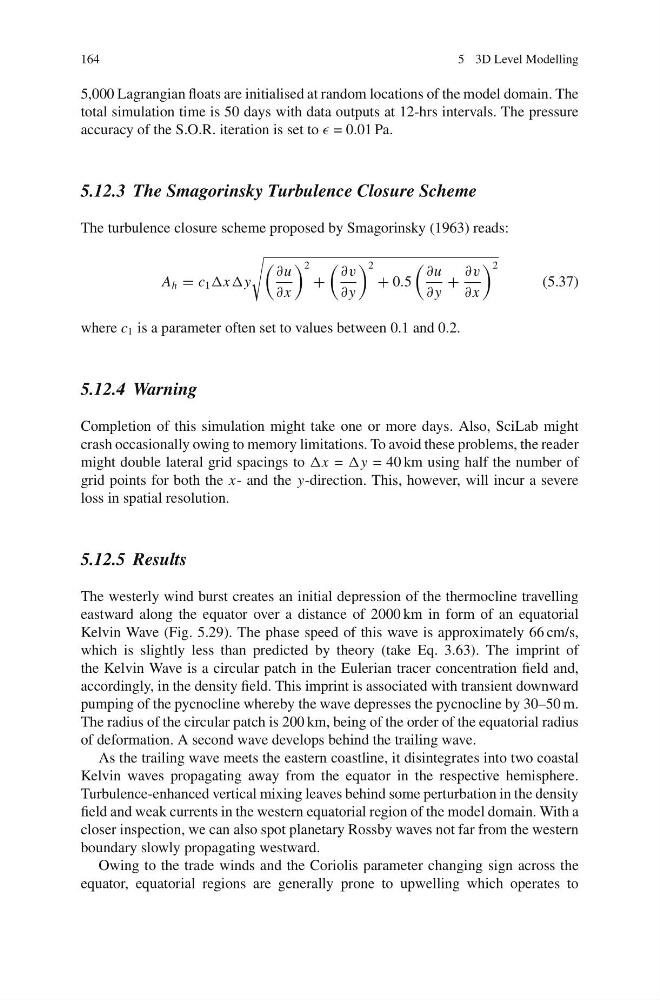
The turbulence closure scheme proposed by Smagorinsky (1963) reads:
A h = c 1 ΔxΔy
∂u
∂ x
2
+
∂v
∂ y
2
+ 0.5
∂u
∂ y
+
∂v
∂ x
2
(5.37)
where c 1 is a parameter often set to values between 0.1 and 0.2.
5.12.4 Warning
Completion of this simulation might take one or more days. Also, SciLab might
crash occasionally owing to memory limitations. To avoid these problems, the reader
might double lateral grid spacings to Δx = Δy = 40 km using half the number of
grid points for both the x- and the y-direction. This, however, will incur a severe
loss in spatial resolution.
5.12.5 Results
The westerly wind burst creates an initial depression of the thermocline travelling
eastward along the equator over a distance of 2000 km in form of an equatorial
Kelvin Wave (Fig. 5.29). The phase speed of this wave is approximately 66 cm/s,
which is slightly less than predicted by theory (take Eq. 3.63). The imprint of
the Kelvin Wave is a circular patch in the Eulerian tracer concentration field and,
accordingly, in the density field. This imprint is associated with transient downward
pumping of the pycnocline whereby the wave depresses the pycnocline by 30–50 m.
The radius of the circular patch is 200 km, being of the order of the equatorial radius
of deformation. A second wave develops behind the trailing wave.
As the trailing wave meets the eastern coastline, it disintegrates into two coastal
Kelvin waves propagating away from the equator in the respective hemisphere.
Turbulence-enhanced vertical mixing leaves behind some perturbation in the density
field and weak currents in the western equatorial region of the model domain. With a
closer inspection, we can also spot planetary Rossby waves not far from the western
boundary slowly propagating westward.
Owing to the trade winds and the Coriolis parameter changing sign across the
equator, equatorial regions are generally prone to upwelling which operates to
5 3D Level Modelling
5,000 Lagrangian floats are initialised at random locations of the model domain. The
total simulation time is 50 days with data outputs at 12-hrs intervals. The pressure
accuracy of the S.O.R. iteration is set to = 0.01 Pa.
5.12.3 The Smagorinsky Turbulence Closure Scheme
The turbulence closure scheme proposed by Smagorinsky (1963) reads:
A h = c 1 ΔxΔy
∂u
∂ x
2
+
∂v
∂ y
2
+ 0.5
∂u
∂ y
+
∂v
∂ x
2
(5.37)
where c 1 is a parameter often set to values between 0.1 and 0.2.
5.12.4 Warning
Completion of this simulation might take one or more days. Also, SciLab might
crash occasionally owing to memory limitations. To avoid these problems, the reader
might double lateral grid spacings to Δx = Δy = 40 km using half the number of
grid points for both the x- and the y-direction. This, however, will incur a severe
loss in spatial resolution.
5.12.5 Results
The westerly wind burst creates an initial depression of the thermocline travelling
eastward along the equator over a distance of 2000 km in form of an equatorial
Kelvin Wave (Fig. 5.29). The phase speed of this wave is approximately 66 cm/s,
which is slightly less than predicted by theory (take Eq. 3.63). The imprint of
the Kelvin Wave is a circular patch in the Eulerian tracer concentration field and,
accordingly, in the density field. This imprint is associated with transient downward
pumping of the pycnocline whereby the wave depresses the pycnocline by 30–50 m.
The radius of the circular patch is 200 km, being of the order of the equatorial radius
of deformation. A second wave develops behind the trailing wave.
As the trailing wave meets the eastern coastline, it disintegrates into two coastal
Kelvin waves propagating away from the equator in the respective hemisphere.
Turbulence-enhanced vertical mixing leaves behind some perturbation in the density
field and weak currents in the western equatorial region of the model domain. With a
closer inspection, we can also spot planetary Rossby waves not far from the western
boundary slowly propagating westward.
Owing to the trade winds and the Coriolis parameter changing sign across the
equator, equatorial regions are generally prone to upwelling which operates to