

5.12 Exercise 25: Simulation of an El-Ni˜ no Event
163
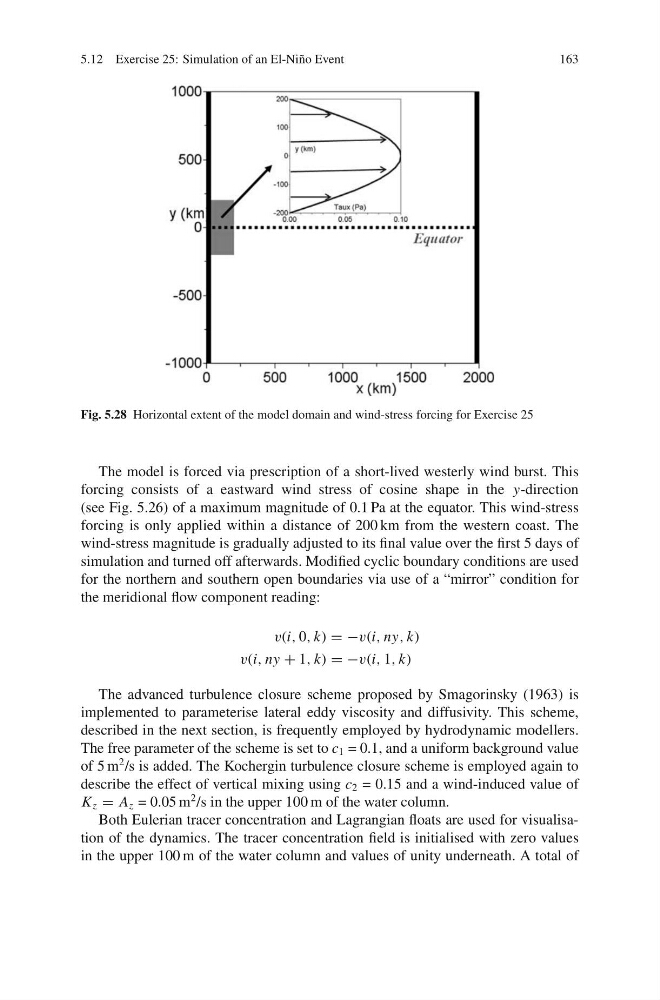
Fig. 5.28 Horizontal extent of the model domain and wind-stress forcing for Exercise 25
The model is forced via prescription of a short-lived westerly wind burst. This
forcing consists of a eastward wind stress of cosine shape in the y-direction
(see Fig. 5.26) of a maximum magnitude of 0.1 Pa at the equator. This wind-stress
forcing is only applied within a distance of 200 km from the western coast. The
wind-stress magnitude is gradually adjusted to its final value over the first 5 days of
simulation and turned off afterwards. Modified cyclic boundary conditions are used
for the northern and southern open boundaries via use of a “mirror” condition for
the meridional flow component reading:
v(i, 0, k) = −v(i, ny, k)
v(i, ny + 1, k) = −v(i, 1, k)
The advanced turbulence closure scheme proposed by Smagorinsky (1963) is
implemented to parameterise lateral eddy viscosity and diffusivity. This scheme,
described in the next section, is frequently employed by hydrodynamic modellers.
The free parameter of the scheme is set to c 1 = 0.1, and a uniform background value
of 5 m
2 /s is added. The Kochergin turbulence closure scheme is employed again to
describe the effect of vertical mixing using c 2 = 0.15 and a wind-induced value of
K z = A z = 0.05 m
2 /s in the upper 100 m of the water column.
Both Eulerian tracer concentration and Lagrangian floats are used for visualisation of the dynamics. The tracer concentration field is initialised with zero values
in the upper 100 m of the water column and values of unity underneath. A total of
163
Fig. 5.28 Horizontal extent of the model domain and wind-stress forcing for Exercise 25
The model is forced via prescription of a short-lived westerly wind burst. This
forcing consists of a eastward wind stress of cosine shape in the y-direction
(see Fig. 5.26) of a maximum magnitude of 0.1 Pa at the equator. This wind-stress
forcing is only applied within a distance of 200 km from the western coast. The
wind-stress magnitude is gradually adjusted to its final value over the first 5 days of
simulation and turned off afterwards. Modified cyclic boundary conditions are used
for the northern and southern open boundaries via use of a “mirror” condition for
the meridional flow component reading:
v(i, 0, k) = −v(i, ny, k)
v(i, ny + 1, k) = −v(i, 1, k)
The advanced turbulence closure scheme proposed by Smagorinsky (1963) is
implemented to parameterise lateral eddy viscosity and diffusivity. This scheme,
described in the next section, is frequently employed by hydrodynamic modellers.
The free parameter of the scheme is set to c 1 = 0.1, and a uniform background value
of 5 m
2 /s is added. The Kochergin turbulence closure scheme is employed again to
describe the effect of vertical mixing using c 2 = 0.15 and a wind-induced value of
K z = A z = 0.05 m
2 /s in the upper 100 m of the water column.
Both Eulerian tracer concentration and Lagrangian floats are used for visualisation of the dynamics. The tracer concentration field is initialised with zero values
in the upper 100 m of the water column and values of unity underneath. A total of