

5.10 Equatorial Waves
159
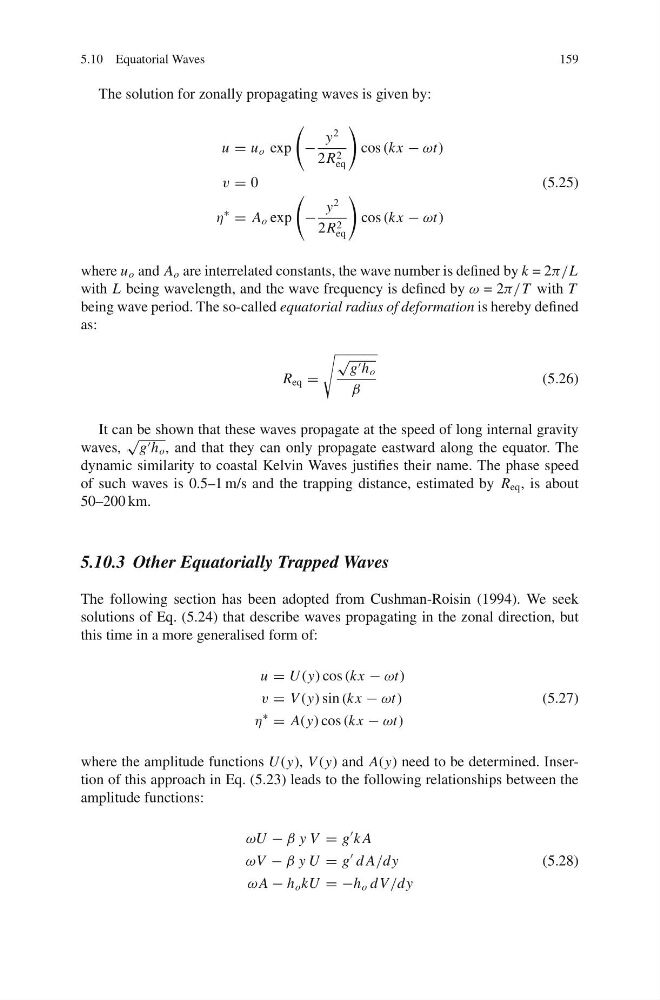
The solution for zonally propagating waves is given by:
u = u o exp
−
y
2
2R 2
eq
cos (kx − ωt)
v = 0
(5.25)
η
∗
= A o exp
−
y
2
2R 2
eq
cos (kx − ωt)
where u o and A o are interrelated constants, the wave number is defined by k = 2π/L
with L being wavelength, and the wave frequency is defined by ω = 2π/T with T
being wave period. The so-called equatorial radius of deformation is hereby defined
as:
R eq =
√
g h o
β
(5.26)
It can be shown that these waves propagate at the speed of long internal gravity
waves,
√
g h o , and that they can only propagate eastward along the equator. The
dynamic similarity to coastal Kelvin Waves justifies their name. The phase speed
of such waves is 0.5–1 m/s and the trapping distance, estimated by R eq , is about
50–200 km.
5.10.3 Other Equatorially Trapped Waves
The following section has been adopted from Cushman-Roisin (1994). We seek
solutions of Eq. (5.24) that describe waves propagating in the zonal direction, but
this time in a more generalised form of:
u = U (y) cos (kx − ωt)
v = V (y) sin (kx − ωt)
(5.27)
η
∗
= A(y) cos (kx − ωt)
where the amplitude functions U (y), V (y) and A(y) need to be determined. Insertion of this approach in Eq. (5.23) leads to the following relationships between the
amplitude functions:
ωU − β y V = g
k A
ωV − β y U = g
d A/dy
(5.28)
ω A − h o kU = −h o dV /dy
159
The solution for zonally propagating waves is given by:
u = u o exp
−
y
2
2R 2
eq
cos (kx − ωt)
v = 0
(5.25)
η
∗
= A o exp
−
y
2
2R 2
eq
cos (kx − ωt)
where u o and A o are interrelated constants, the wave number is defined by k = 2π/L
with L being wavelength, and the wave frequency is defined by ω = 2π/T with T
being wave period. The so-called equatorial radius of deformation is hereby defined
as:
R eq =
√
g h o
β
(5.26)
It can be shown that these waves propagate at the speed of long internal gravity
waves,
√
g h o , and that they can only propagate eastward along the equator. The
dynamic similarity to coastal Kelvin Waves justifies their name. The phase speed
of such waves is 0.5–1 m/s and the trapping distance, estimated by R eq , is about
50–200 km.
5.10.3 Other Equatorially Trapped Waves
The following section has been adopted from Cushman-Roisin (1994). We seek
solutions of Eq. (5.24) that describe waves propagating in the zonal direction, but
this time in a more generalised form of:
u = U (y) cos (kx − ωt)
v = V (y) sin (kx − ωt)
(5.27)
η
∗
= A(y) cos (kx − ωt)
where the amplitude functions U (y), V (y) and A(y) need to be determined. Insertion of this approach in Eq. (5.23) leads to the following relationships between the
amplitude functions:
ωU − β y V = g
k A
ωV − β y U = g
d A/dy
(5.28)
ω A − h o kU = −h o dV /dy