

2
1 Introduction
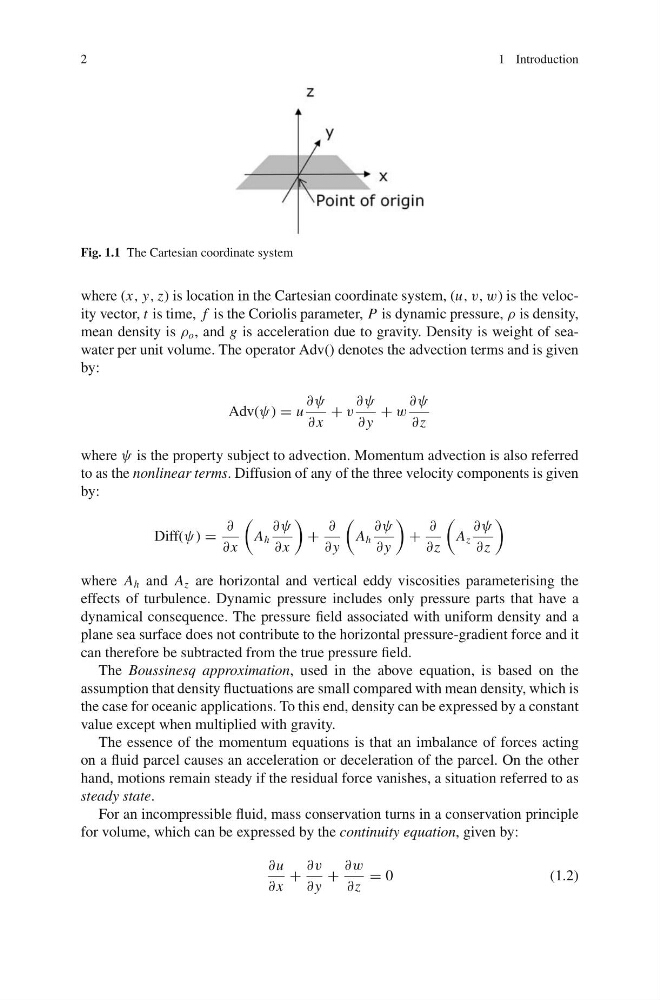
Fig. 1.1 The Cartesian coordinate system
where (x, y, z) is location in the Cartesian coordinate system, (u, v, w) is the velocity vector, t is time, f is the Coriolis parameter, P is dynamic pressure, ρ is density,
mean density is ρ o , and g is acceleration due to gravity. Density is weight of seawater per unit volume. The operator Adv() denotes the advection terms and is given
by:
Adv(ψ) = u
∂ψ
∂ x
+ v
∂ψ
∂ y
+ w
∂ψ
∂z
where ψ is the property subject to advection. Momentum advection is also referred
to as the nonlinear terms. Diffusion of any of the three velocity components is given
by:
Diff(ψ) =
∂
∂ x
A h
∂ψ
∂ x
+
∂
∂ y
A h
∂ψ
∂ y
+
∂
∂z
A z
∂ψ
∂z
where A h and A z are horizontal and vertical eddy viscosities parameterising the
effects of turbulence. Dynamic pressure includes only pressure parts that have a
dynamical consequence. The pressure field associated with uniform density and a
plane sea surface does not contribute to the horizontal pressure-gradient force and it
can therefore be subtracted from the true pressure field.
The Boussinesq approximation, used in the above equation, is based on the
assumption that density fluctuations are small compared with mean density, which is
the case for oceanic applications. To this end, density can be expressed by a constant
value except when multiplied with gravity.
The essence of the momentum equations is that an imbalance of forces acting
on a fluid parcel causes an acceleration or deceleration of the parcel. On the other
hand, motions remain steady if the residual force vanishes, a situation referred to as
steady state.
For an incompressible fluid, mass conservation turns in a conservation principle
for volume, which can be expressed by the continuity equation, given by:
∂u
∂ x
+
∂v
∂ y
+
∂w
∂z
= 0
(1.2)
1 Introduction
Fig. 1.1 The Cartesian coordinate system
where (x, y, z) is location in the Cartesian coordinate system, (u, v, w) is the velocity vector, t is time, f is the Coriolis parameter, P is dynamic pressure, ρ is density,
mean density is ρ o , and g is acceleration due to gravity. Density is weight of seawater per unit volume. The operator Adv() denotes the advection terms and is given
by:
Adv(ψ) = u
∂ψ
∂ x
+ v
∂ψ
∂ y
+ w
∂ψ
∂z
where ψ is the property subject to advection. Momentum advection is also referred
to as the nonlinear terms. Diffusion of any of the three velocity components is given
by:
Diff(ψ) =
∂
∂ x
A h
∂ψ
∂ x
+
∂
∂ y
A h
∂ψ
∂ y
+
∂
∂z
A z
∂ψ
∂z
where A h and A z are horizontal and vertical eddy viscosities parameterising the
effects of turbulence. Dynamic pressure includes only pressure parts that have a
dynamical consequence. The pressure field associated with uniform density and a
plane sea surface does not contribute to the horizontal pressure-gradient force and it
can therefore be subtracted from the true pressure field.
The Boussinesq approximation, used in the above equation, is based on the
assumption that density fluctuations are small compared with mean density, which is
the case for oceanic applications. To this end, density can be expressed by a constant
value except when multiplied with gravity.
The essence of the momentum equations is that an imbalance of forces acting
on a fluid parcel causes an acceleration or deceleration of the parcel. On the other
hand, motions remain steady if the residual force vanishes, a situation referred to as
steady state.
For an incompressible fluid, mass conservation turns in a conservation principle
for volume, which can be expressed by the continuity equation, given by:
∂u
∂ x
+
∂v
∂ y
+
∂w
∂z
= 0
(1.2)