

1.1 Fundamental Physical Laws
3
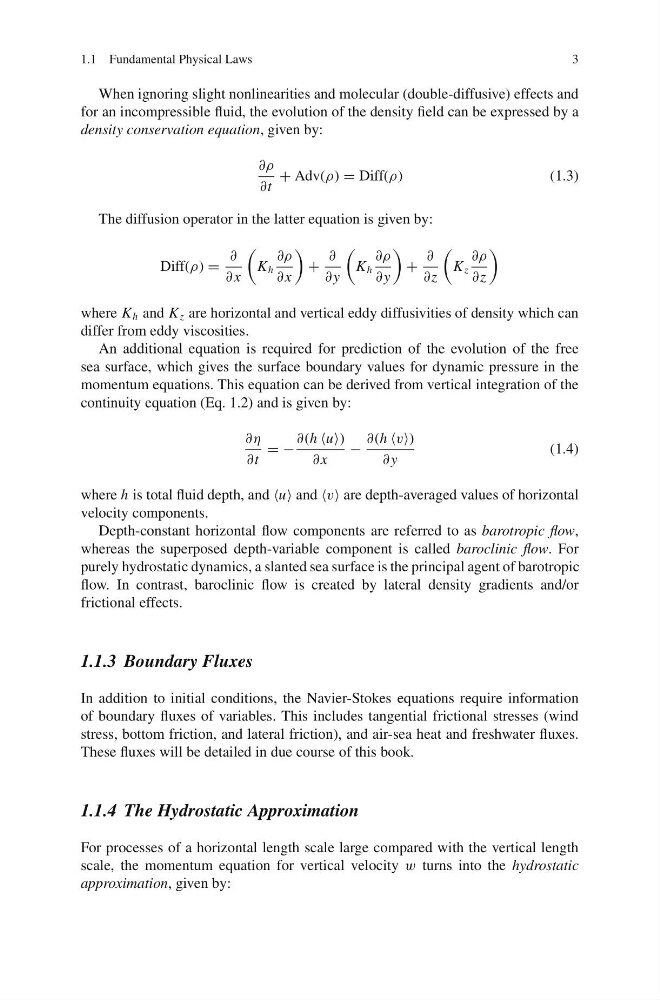
When ignoring slight nonlinearities and molecular (double-diffusive) effects and
for an incompressible fluid, the evolution of the density field can be expressed by a
density conservation equation, given by:
∂ρ
∂t
+ Adv(ρ) = Diff(ρ)
(1.3)
The diffusion operator in the latter equation is given by:
Diff(ρ) =
∂
∂ x
K h
∂ρ
∂ x
+
∂
∂ y
K h
∂ρ
∂ y
+
∂
∂z
K z
∂ρ
∂z
where K h and K z are horizontal and vertical eddy diffusivities of density which can
differ from eddy viscosities.
An additional equation is required for prediction of the evolution of the free
sea surface, which gives the surface boundary values for dynamic pressure in the
momentum equations. This equation can be derived from vertical integration of the
continuity equation (Eq. 1.2) and is given by:
∂η
∂t
= −
∂(h u)
∂ x
−
∂(h v)
∂ y
(1.4)
where h is total fluid depth, and u and v are depth-averaged values of horizontal
velocity components.
Depth-constant horizontal flow components are referred to as barotropic flow,
whereas the superposed depth-variable component is called baroclinic flow. For
purely hydrostatic dynamics, a slanted sea surface is the principal agent of barotropic
flow. In contrast, baroclinic flow is created by lateral density gradients and/or
frictional effects.
1.1.3 Boundary Fluxes
In addition to initial conditions, the Navier-Stokes equations require information
of boundary fluxes of variables. This includes tangential frictional stresses (wind
stress, bottom friction, and lateral friction), and air-sea heat and freshwater fluxes.
These fluxes will be detailed in due course of this book.
1.1.4 The Hydrostatic Approximation
For processes of a horizontal length scale large compared with the vertical length
scale, the momentum equation for vertical velocity w turns into the hydrostatic
approximation, given by:
3
When ignoring slight nonlinearities and molecular (double-diffusive) effects and
for an incompressible fluid, the evolution of the density field can be expressed by a
density conservation equation, given by:
∂ρ
∂t
+ Adv(ρ) = Diff(ρ)
(1.3)
The diffusion operator in the latter equation is given by:
Diff(ρ) =
∂
∂ x
K h
∂ρ
∂ x
+
∂
∂ y
K h
∂ρ
∂ y
+
∂
∂z
K z
∂ρ
∂z
where K h and K z are horizontal and vertical eddy diffusivities of density which can
differ from eddy viscosities.
An additional equation is required for prediction of the evolution of the free
sea surface, which gives the surface boundary values for dynamic pressure in the
momentum equations. This equation can be derived from vertical integration of the
continuity equation (Eq. 1.2) and is given by:
∂η
∂t
= −
∂(h u)
∂ x
−
∂(h v)
∂ y
(1.4)
where h is total fluid depth, and u and v are depth-averaged values of horizontal
velocity components.
Depth-constant horizontal flow components are referred to as barotropic flow,
whereas the superposed depth-variable component is called baroclinic flow. For
purely hydrostatic dynamics, a slanted sea surface is the principal agent of barotropic
flow. In contrast, baroclinic flow is created by lateral density gradients and/or
frictional effects.
1.1.3 Boundary Fluxes
In addition to initial conditions, the Navier-Stokes equations require information
of boundary fluxes of variables. This includes tangential frictional stresses (wind
stress, bottom friction, and lateral friction), and air-sea heat and freshwater fluxes.
These fluxes will be detailed in due course of this book.
1.1.4 The Hydrostatic Approximation
For processes of a horizontal length scale large compared with the vertical length
scale, the momentum equation for vertical velocity w turns into the hydrostatic
approximation, given by: