

104
4 2.5D Vertical Slice Modelling
4.2.3 Results
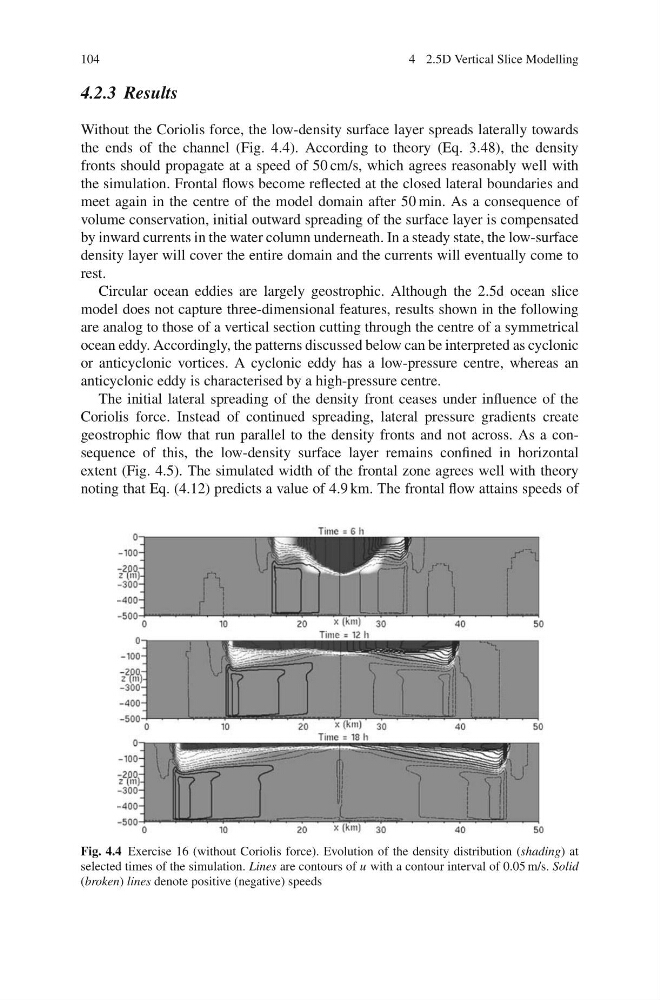
Without the Coriolis force, the low-density surface layer spreads laterally towards
the ends of the channel (Fig. 4.4). According to theory (Eq. 3.48), the density
fronts should propagate at a speed of 50 cm/s, which agrees reasonably well with
the simulation. Frontal flows become reflected at the closed lateral boundaries and
meet again in the centre of the model domain after 50 min. As a consequence of
volume conservation, initial outward spreading of the surface layer is compensated
by inward currents in the water column underneath. In a steady state, the low-surface
density layer will cover the entire domain and the currents will eventually come to
rest.
Circular ocean eddies are largely geostrophic. Although the 2.5d ocean slice
model does not capture three-dimensional features, results shown in the following
are analog to those of a vertical section cutting through the centre of a symmetrical
ocean eddy. Accordingly, the patterns discussed below can be interpreted as cyclonic
or anticyclonic vortices. A cyclonic eddy has a low-pressure centre, whereas an
anticyclonic eddy is characterised by a high-pressure centre.
The initial lateral spreading of the density front ceases under influence of the
Coriolis force. Instead of continued spreading, lateral pressure gradients create
geostrophic flow that run parallel to the density fronts and not across. As a consequence of this, the low-density surface layer remains confined in horizontal
extent (Fig. 4.5). The simulated width of the frontal zone agrees well with theory
noting that Eq. (4.12) predicts a value of 4.9 km. The frontal flow attains speeds of
Fig. 4.4 Exercise 16 (without Coriolis force). Evolution of the density distribution (shading) at
selected times of the simulation. Lines are contours of u with a contour interval of 0.05 m/s. Solid
(broken) lines denote positive (negative) speeds
4 2.5D Vertical Slice Modelling
4.2.3 Results
Without the Coriolis force, the low-density surface layer spreads laterally towards
the ends of the channel (Fig. 4.4). According to theory (Eq. 3.48), the density
fronts should propagate at a speed of 50 cm/s, which agrees reasonably well with
the simulation. Frontal flows become reflected at the closed lateral boundaries and
meet again in the centre of the model domain after 50 min. As a consequence of
volume conservation, initial outward spreading of the surface layer is compensated
by inward currents in the water column underneath. In a steady state, the low-surface
density layer will cover the entire domain and the currents will eventually come to
rest.
Circular ocean eddies are largely geostrophic. Although the 2.5d ocean slice
model does not capture three-dimensional features, results shown in the following
are analog to those of a vertical section cutting through the centre of a symmetrical
ocean eddy. Accordingly, the patterns discussed below can be interpreted as cyclonic
or anticyclonic vortices. A cyclonic eddy has a low-pressure centre, whereas an
anticyclonic eddy is characterised by a high-pressure centre.
The initial lateral spreading of the density front ceases under influence of the
Coriolis force. Instead of continued spreading, lateral pressure gradients create
geostrophic flow that run parallel to the density fronts and not across. As a consequence of this, the low-density surface layer remains confined in horizontal
extent (Fig. 4.5). The simulated width of the frontal zone agrees well with theory
noting that Eq. (4.12) predicts a value of 4.9 km. The frontal flow attains speeds of
Fig. 4.4 Exercise 16 (without Coriolis force). Evolution of the density distribution (shading) at
selected times of the simulation. Lines are contours of u with a contour interval of 0.05 m/s. Solid
(broken) lines denote positive (negative) speeds