

3.24 Exercise 14: Positive Estuaries
89
where A is grid-averaged age, Adv(A) and Diff(A) denote the advection and diffusion terms, and the constant unity represents ageing. In a semi-enclosed body of
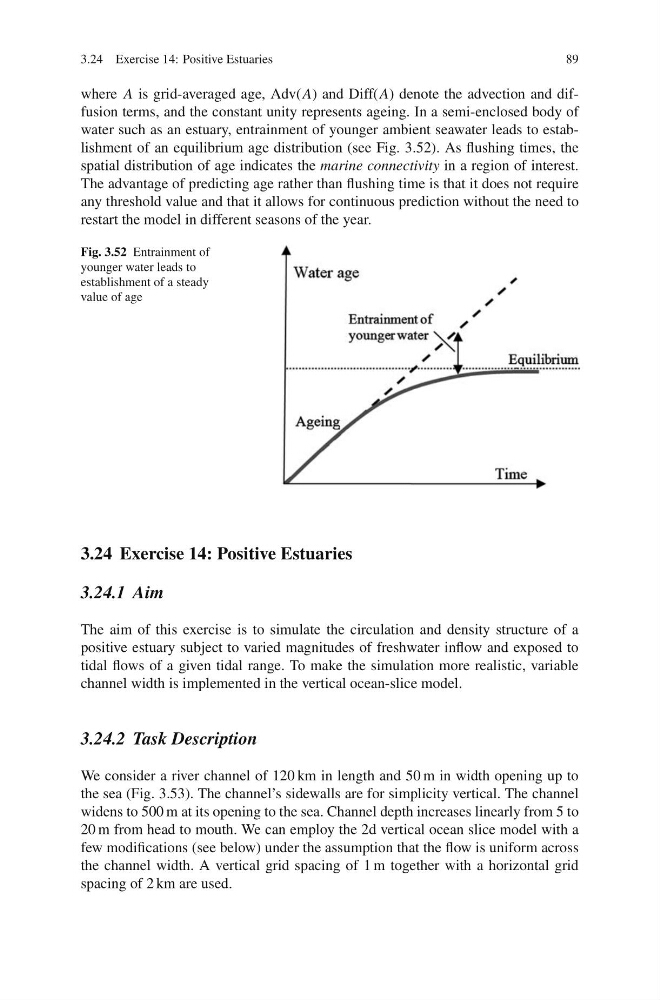
water such as an estuary, entrainment of younger ambient seawater leads to establishment of an equilibrium age distribution (see Fig. 3.52). As flushing times, the
spatial distribution of age indicates the marine connectivity in a region of interest.
The advantage of predicting age rather than flushing time is that it does not require
any threshold value and that it allows for continuous prediction without the need to
restart the model in different seasons of the year.
Fig. 3.52 Entrainment of
younger water leads to
establishment of a steady
value of age
3.24 Exercise 14: Positive Estuaries
3.24.1 Aim
The aim of this exercise is to simulate the circulation and density structure of a
positive estuary subject to varied magnitudes of freshwater inflow and exposed to
tidal flows of a given tidal range. To make the simulation more realistic, variable
channel width is implemented in the vertical ocean-slice model.
3.24.2 Task Description
We consider a river channel of 120 km in length and 50 m in width opening up to
the sea (Fig. 3.53). The channel’s sidewalls are for simplicity vertical. The channel
widens to 500 m at its opening to the sea. Channel depth increases linearly from 5 to
20 m from head to mouth. We can employ the 2d vertical ocean slice model with a
few modifications (see below) under the assumption that the flow is uniform across
the channel width. A vertical grid spacing of 1 m together with a horizontal grid
spacing of 2 km are used.
89
where A is grid-averaged age, Adv(A) and Diff(A) denote the advection and diffusion terms, and the constant unity represents ageing. In a semi-enclosed body of
water such as an estuary, entrainment of younger ambient seawater leads to establishment of an equilibrium age distribution (see Fig. 3.52). As flushing times, the
spatial distribution of age indicates the marine connectivity in a region of interest.
The advantage of predicting age rather than flushing time is that it does not require
any threshold value and that it allows for continuous prediction without the need to
restart the model in different seasons of the year.
Fig. 3.52 Entrainment of
younger water leads to
establishment of a steady
value of age
3.24 Exercise 14: Positive Estuaries
3.24.1 Aim
The aim of this exercise is to simulate the circulation and density structure of a
positive estuary subject to varied magnitudes of freshwater inflow and exposed to
tidal flows of a given tidal range. To make the simulation more realistic, variable
channel width is implemented in the vertical ocean-slice model.
3.24.2 Task Description
We consider a river channel of 120 km in length and 50 m in width opening up to
the sea (Fig. 3.53). The channel’s sidewalls are for simplicity vertical. The channel
widens to 500 m at its opening to the sea. Channel depth increases linearly from 5 to
20 m from head to mouth. We can employ the 2d vertical ocean slice model with a
few modifications (see below) under the assumption that the flow is uniform across
the channel width. A vertical grid spacing of 1 m together with a horizontal grid
spacing of 2 km are used.