

86
4 Long Waves in a Channel
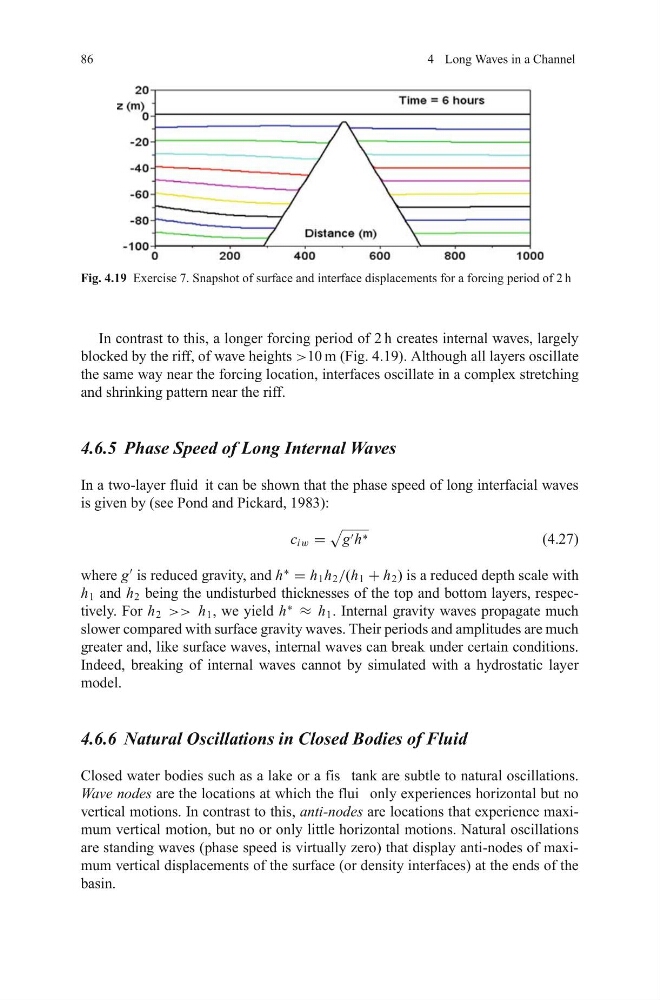
Fig. 4.19 Exercise 7. Snapshot of surface and interface displacements for a forcing period of 2 h
In contrast to this, a longer forcing period of 2 h creates internal waves, largely
blocked by the riff, of wave heights >10 m (Fig. 4.19). Although all layers oscillate
the same way near the forcing location, interfaces oscillate in a complex stretching
and shrinking pattern near the riff.
4.6.5 Phase Speed of Long Internal Waves
In a two-layer fluid it can be shown that the phase speed of long interfacial waves
is given by (see Pond and Pickard, 1983):
c iw =
g h ∗
(4.27)
where g
is reduced gravity, and h
∗
= h 1 h 2 /(h 1 + h 2 ) is a reduced depth scale with
h 1 and h 2 being the undisturbed thicknesses of the top and bottom layers, respectively. For h 2 >> h 1 , we yield h
∗
≈ h 1 . Internal gravity waves propagate much
slower compared with surface gravity waves. Their periods and amplitudes are much
greater and, like surface waves, internal waves can break under certain conditions.
Indeed, breaking of internal waves cannot by simulated with a hydrostatic layer
model.
4.6.6 Natural Oscillations in Closed Bodies of Fluid
Closed water bodies such as a lake or a fis tank are subtle to natural oscillations.
Wave nodes are the locations at which the flui only experiences horizontal but no
vertical motions. In contrast to this, anti-nodes are locations that experience maximum vertical motion, but no or only little horizontal motions. Natural oscillations
are standing waves (phase speed is virtually zero) that display anti-nodes of maximum vertical displacements of the surface (or density interfaces) at the ends of the
basin.
4 Long Waves in a Channel
Fig. 4.19 Exercise 7. Snapshot of surface and interface displacements for a forcing period of 2 h
In contrast to this, a longer forcing period of 2 h creates internal waves, largely
blocked by the riff, of wave heights >10 m (Fig. 4.19). Although all layers oscillate
the same way near the forcing location, interfaces oscillate in a complex stretching
and shrinking pattern near the riff.
4.6.5 Phase Speed of Long Internal Waves
In a two-layer fluid it can be shown that the phase speed of long interfacial waves
is given by (see Pond and Pickard, 1983):
c iw =
g h ∗
(4.27)
where g
is reduced gravity, and h
∗
= h 1 h 2 /(h 1 + h 2 ) is a reduced depth scale with
h 1 and h 2 being the undisturbed thicknesses of the top and bottom layers, respectively. For h 2 >> h 1 , we yield h
∗
≈ h 1 . Internal gravity waves propagate much
slower compared with surface gravity waves. Their periods and amplitudes are much
greater and, like surface waves, internal waves can break under certain conditions.
Indeed, breaking of internal waves cannot by simulated with a hydrostatic layer
model.
4.6.6 Natural Oscillations in Closed Bodies of Fluid
Closed water bodies such as a lake or a fis tank are subtle to natural oscillations.
Wave nodes are the locations at which the flui only experiences horizontal but no
vertical motions. In contrast to this, anti-nodes are locations that experience maximum vertical motion, but no or only little horizontal motions. Natural oscillations
are standing waves (phase speed is virtually zero) that display anti-nodes of maximum vertical displacements of the surface (or density interfaces) at the ends of the
basin.