

4.6 Exercise 7: Long Waves in a Layered Fluid
87
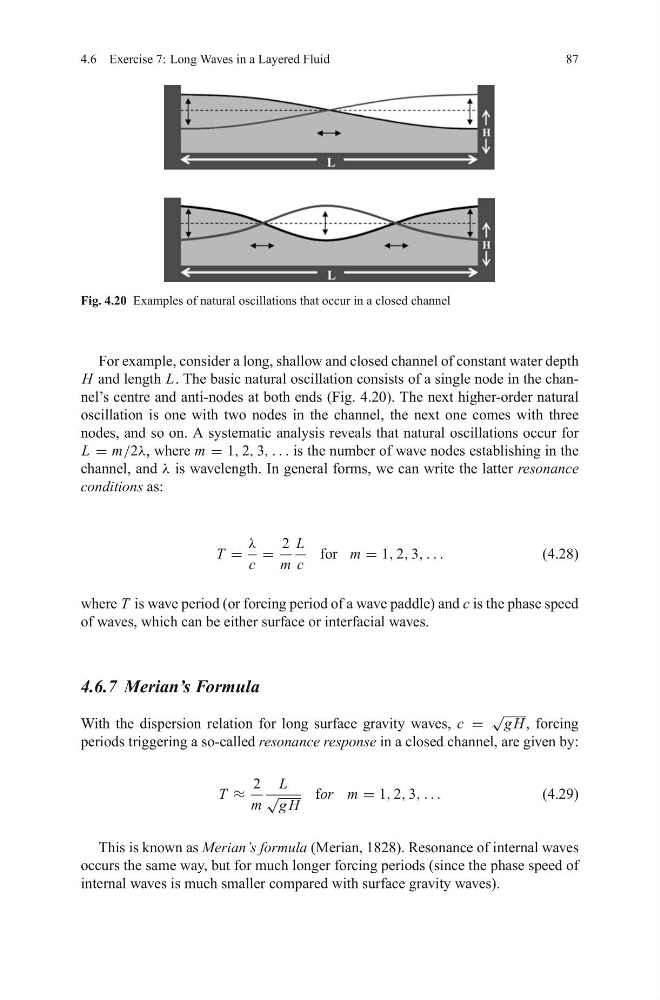
Fig. 4.20 Examples of natural oscillations that occur in a closed channel
For example, consider a long, shallow and closed channel of constant water depth
H and length L. The basic natural oscillation consists of a single node in the channel’s centre and anti-nodes at both ends (Fig. 4.20). The next higher-order natural
oscillation is one with two nodes in the channel, the next one comes with three
nodes, and so on. A systematic analysis reveals that natural oscillations occur for
L = m/2λ, where m = 1, 2, 3, . . . is the number of wave nodes establishing in the
channel, and λ is wavelength. In general forms, we can write the latter resonance
conditions as:
T =
λ
c
=
2
m
L
c
for m = 1, 2, 3, . . .
(4.28)
where T is wave period (or forcing period of a wave paddle) and c is the phase speed
of waves, which can be either surface or interfacial waves.
4.6.7 Merian’s Formula
With the dispersion relation for long surface gravity waves, c =
√ g H, forcing
periods triggering a so-called resonance response in a closed channel, are given by:
T ≈
2
m
L
√ g H
for m = 1, 2, 3, . . .
(4.29)
This is known as Merian’s formula (Merian, 1828). Resonance of internal waves
occurs the same way, but for much longer forcing periods (since the phase speed of
internal waves is much smaller compared with surface gravity waves).
87
Fig. 4.20 Examples of natural oscillations that occur in a closed channel
For example, consider a long, shallow and closed channel of constant water depth
H and length L. The basic natural oscillation consists of a single node in the channel’s centre and anti-nodes at both ends (Fig. 4.20). The next higher-order natural
oscillation is one with two nodes in the channel, the next one comes with three
nodes, and so on. A systematic analysis reveals that natural oscillations occur for
L = m/2λ, where m = 1, 2, 3, . . . is the number of wave nodes establishing in the
channel, and λ is wavelength. In general forms, we can write the latter resonance
conditions as:
T =
λ
c
=
2
m
L
c
for m = 1, 2, 3, . . .
(4.28)
where T is wave period (or forcing period of a wave paddle) and c is the phase speed
of waves, which can be either surface or interfacial waves.
4.6.7 Merian’s Formula
With the dispersion relation for long surface gravity waves, c =
√ g H, forcing
periods triggering a so-called resonance response in a closed channel, are given by:
T ≈
2
m
L
√ g H
for m = 1, 2, 3, . . .
(4.29)
This is known as Merian’s formula (Merian, 1828). Resonance of internal waves
occurs the same way, but for much longer forcing periods (since the phase speed of
internal waves is much smaller compared with surface gravity waves).