

80
4 Long Waves in a Channel
3. True layer thickness is define as the sum h = h o + η. This true layer thickness
is used for the classificatio of wet/dry grid cells on the basis of a threshold layer
thickness h min .
4.4.5 Ultimate Crash Tests
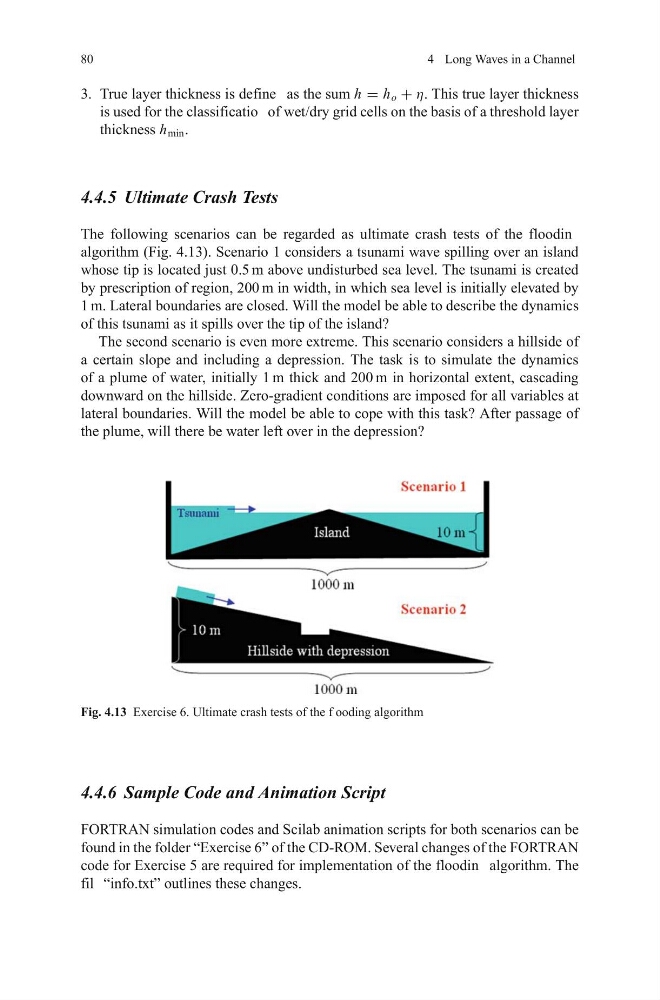
The following scenarios can be regarded as ultimate crash tests of the floodin
algorithm (Fig. 4.13). Scenario 1 considers a tsunami wave spilling over an island
whose tip is located just 0.5 m above undisturbed sea level. The tsunami is created
by prescription of region, 200 m in width, in which sea level is initially elevated by
1 m. Lateral boundaries are closed. Will the model be able to describe the dynamics
of this tsunami as it spills over the tip of the island?
The second scenario is even more extreme. This scenario considers a hillside of
a certain slope and including a depression. The task is to simulate the dynamics
of a plume of water, initially 1 m thick and 200 m in horizontal extent, cascading
downward on the hillside. Zero-gradient conditions are imposed for all variables at
lateral boundaries. Will the model be able to cope with this task? After passage of
the plume, will there be water left over in the depression?
Fig. 4.13 Exercise 6. Ultimate crash tests of the f ooding algorithm
4.4.6 Sample Code and Animation Script
FORTRAN simulation codes and Scilab animation scripts for both scenarios can be
found in the folder “Exercise 6” of the CD-ROM. Several changes of the FORTRAN
code for Exercise 5 are required for implementation of the floodin algorithm. The
fil “info.txt” outlines these changes.
4 Long Waves in a Channel
3. True layer thickness is define as the sum h = h o + η. This true layer thickness
is used for the classificatio of wet/dry grid cells on the basis of a threshold layer
thickness h min .
4.4.5 Ultimate Crash Tests
The following scenarios can be regarded as ultimate crash tests of the floodin
algorithm (Fig. 4.13). Scenario 1 considers a tsunami wave spilling over an island
whose tip is located just 0.5 m above undisturbed sea level. The tsunami is created
by prescription of region, 200 m in width, in which sea level is initially elevated by
1 m. Lateral boundaries are closed. Will the model be able to describe the dynamics
of this tsunami as it spills over the tip of the island?
The second scenario is even more extreme. This scenario considers a hillside of
a certain slope and including a depression. The task is to simulate the dynamics
of a plume of water, initially 1 m thick and 200 m in horizontal extent, cascading
downward on the hillside. Zero-gradient conditions are imposed for all variables at
lateral boundaries. Will the model be able to cope with this task? After passage of
the plume, will there be water left over in the depression?
Fig. 4.13 Exercise 6. Ultimate crash tests of the f ooding algorithm
4.4.6 Sample Code and Animation Script
FORTRAN simulation codes and Scilab animation scripts for both scenarios can be
found in the folder “Exercise 6” of the CD-ROM. Several changes of the FORTRAN
code for Exercise 5 are required for implementation of the floodin algorithm. The
fil “info.txt” outlines these changes.