

4.4 Exercise 6: The Flooding Algorithm
81
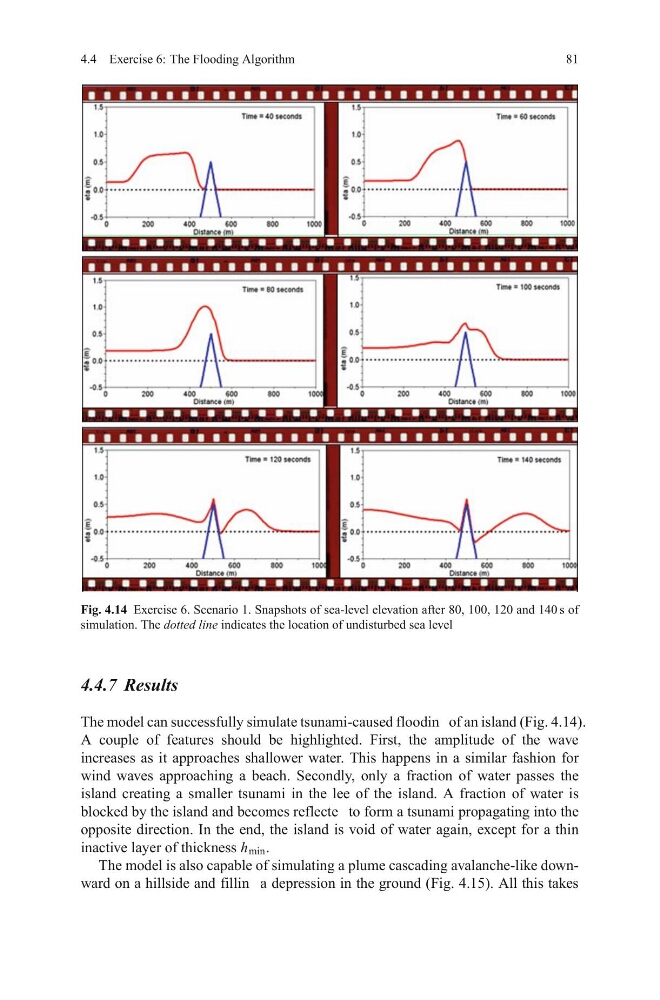
Fig. 4.14 Exercise 6. Scenario 1. Snapshots of sea-level elevation after 80, 100, 120 and 140 s of
simulation. The dotted line indicates the location of undisturbed sea level
4.4.7 Results
The model can successfully simulate tsunami-caused floodin of an island (Fig. 4.14).
A couple of features should be highlighted. First, the amplitude of the wave
increases as it approaches shallower water. This happens in a similar fashion for
wind waves approaching a beach. Secondly, only a fraction of water passes the
island creating a smaller tsunami in the lee of the island. A fraction of water is
blocked by the island and becomes reflecte to form a tsunami propagating into the
opposite direction. In the end, the island is void of water again, except for a thin
inactive layer of thickness h min .
The model is also capable of simulating a plume cascading avalanche-like downward on a hillside and fillin a depression in the ground (Fig. 4.15). All this takes
81
Fig. 4.14 Exercise 6. Scenario 1. Snapshots of sea-level elevation after 80, 100, 120 and 140 s of
simulation. The dotted line indicates the location of undisturbed sea level
4.4.7 Results
The model can successfully simulate tsunami-caused floodin of an island (Fig. 4.14).
A couple of features should be highlighted. First, the amplitude of the wave
increases as it approaches shallower water. This happens in a similar fashion for
wind waves approaching a beach. Secondly, only a fraction of water passes the
island creating a smaller tsunami in the lee of the island. A fraction of water is
blocked by the island and becomes reflecte to form a tsunami propagating into the
opposite direction. In the end, the island is void of water again, except for a thin
inactive layer of thickness h min .
The model is also capable of simulating a plume cascading avalanche-like downward on a hillside and fillin a depression in the ground (Fig. 4.15). All this takes