

58
3 Basics of Geophysical Fluid Dynamics
where ψ is a mean value and ψ
are fluctuations This approach, proposed by
Osborne Reynolds (1895), is the key ingredient in the theory of turbulence.
3.15.3 What Causes Turbulence?
There are two principle causes of turbulence in a fluid One source of turbulence are
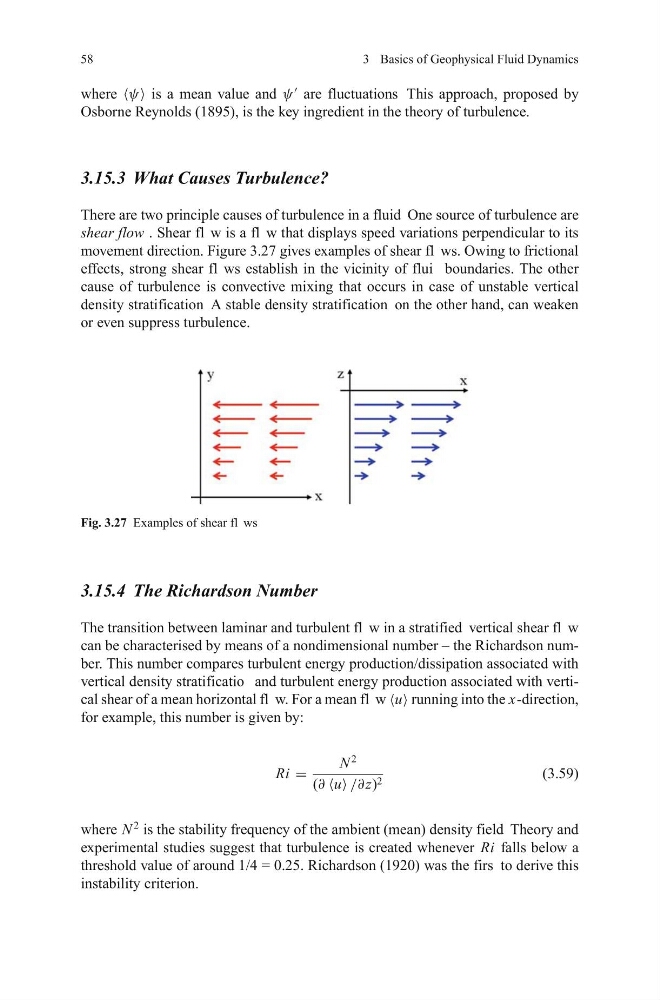
shear flow . Shear fl w is a fl w that displays speed variations perpendicular to its
movement direction. Figure 3.27 gives examples of shear fl ws. Owing to frictional
effects, strong shear fl ws establish in the vicinity of flui boundaries. The other
cause of turbulence is convective mixing that occurs in case of unstable vertical
density stratification A stable density stratification on the other hand, can weaken
or even suppress turbulence.
Fig. 3.27 Examples of shear fl ws
3.15.4 The Richardson Number
The transition between laminar and turbulent fl w in a stratified vertical shear fl w
can be characterised by means of a nondimensional number – the Richardson number. This number compares turbulent energy production/dissipation associated with
vertical density stratificatio and turbulent energy production associated with vertical shear of a mean horizontal fl w. For a mean fl w u running into the x-direction,
for example, this number is given by:
Ri =
N
2
(∂ u /∂z) 2
(3.59)
where N
2
is the stability frequency of the ambient (mean) density field Theory and
experimental studies suggest that turbulence is created whenever Ri falls below a
threshold value of around 1/4 = 0.25. Richardson (1920) was the firs to derive this
instability criterion.
3 Basics of Geophysical Fluid Dynamics
where ψ is a mean value and ψ
are fluctuations This approach, proposed by
Osborne Reynolds (1895), is the key ingredient in the theory of turbulence.
3.15.3 What Causes Turbulence?
There are two principle causes of turbulence in a fluid One source of turbulence are
shear flow . Shear fl w is a fl w that displays speed variations perpendicular to its
movement direction. Figure 3.27 gives examples of shear fl ws. Owing to frictional
effects, strong shear fl ws establish in the vicinity of flui boundaries. The other
cause of turbulence is convective mixing that occurs in case of unstable vertical
density stratification A stable density stratification on the other hand, can weaken
or even suppress turbulence.
Fig. 3.27 Examples of shear fl ws
3.15.4 The Richardson Number
The transition between laminar and turbulent fl w in a stratified vertical shear fl w
can be characterised by means of a nondimensional number – the Richardson number. This number compares turbulent energy production/dissipation associated with
vertical density stratificatio and turbulent energy production associated with vertical shear of a mean horizontal fl w. For a mean fl w u running into the x-direction,
for example, this number is given by:
Ri =
N
2
(∂ u /∂z) 2
(3.59)
where N
2
is the stability frequency of the ambient (mean) density field Theory and
experimental studies suggest that turbulence is created whenever Ri falls below a
threshold value of around 1/4 = 0.25. Richardson (1920) was the firs to derive this
instability criterion.