

32
3 Basics of Geophysical Fluid Dynamics
3.8.4 Vertically Integrated Form of the Continuity Equation
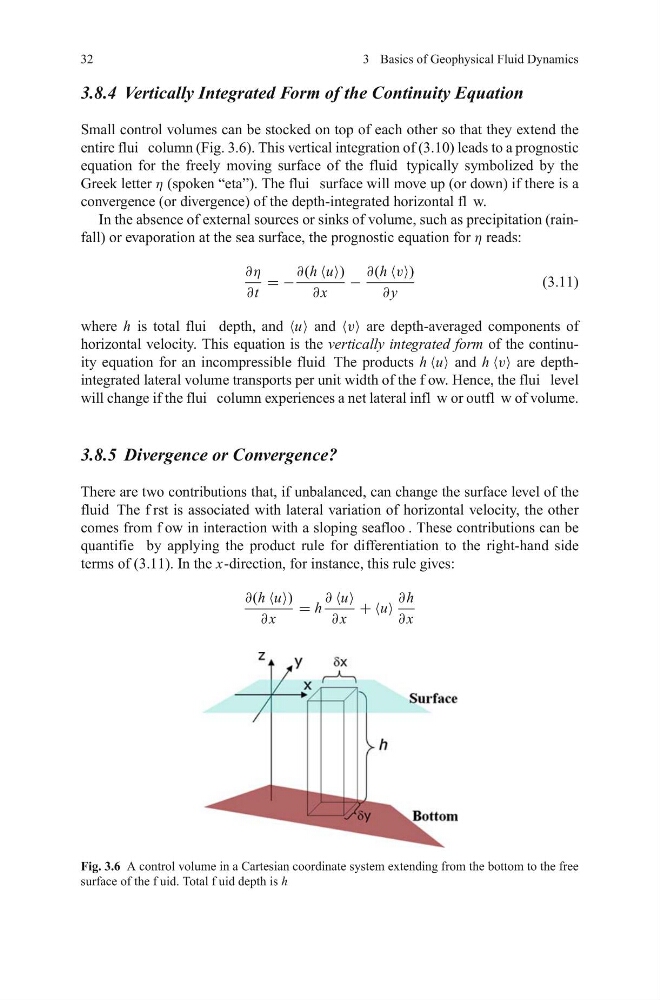
Small control volumes can be stocked on top of each other so that they extend the
entire flui column (Fig. 3.6). This vertical integration of (3.10) leads to a prognostic
equation for the freely moving surface of the fluid typically symbolized by the
Greek letter η (spoken “eta”). The flui surface will move up (or down) if there is a
convergence (or divergence) of the depth-integrated horizontal fl w.
In the absence of external sources or sinks of volume, such as precipitation (rainfall) or evaporation at the sea surface, the prognostic equation for η reads:
∂η
∂t
= −
∂(h u)
∂ x
−
∂(h v)
∂ y
(3.11)
where h is total flui depth, and u and v are depth-averaged components of
horizontal velocity. This equation is the vertically integrated form of the continuity equation for an incompressible fluid The products h u and h v are depthintegrated lateral volume transports per unit width of the f ow. Hence, the flui level
will change if the flui column experiences a net lateral infl w or outfl w of volume.
3.8.5 Divergence or Convergence?
There are two contributions that, if unbalanced, can change the surface level of the
fluid The f rst is associated with lateral variation of horizontal velocity, the other
comes from f ow in interaction with a sloping seafloo . These contributions can be
quantifie by applying the product rule for differentiation to the right-hand side
terms of (3.11). In the x-direction, for instance, this rule gives:
∂(h u)
∂ x
= h
∂ u
∂ x
+ u
∂h
∂ x
Fig. 3.6 A control volume in a Cartesian coordinate system extending from the bottom to the free
surface of the f uid. Total f uid depth is h
3 Basics of Geophysical Fluid Dynamics
3.8.4 Vertically Integrated Form of the Continuity Equation
Small control volumes can be stocked on top of each other so that they extend the
entire flui column (Fig. 3.6). This vertical integration of (3.10) leads to a prognostic
equation for the freely moving surface of the fluid typically symbolized by the
Greek letter η (spoken “eta”). The flui surface will move up (or down) if there is a
convergence (or divergence) of the depth-integrated horizontal fl w.
In the absence of external sources or sinks of volume, such as precipitation (rainfall) or evaporation at the sea surface, the prognostic equation for η reads:
∂η
∂t
= −
∂(h u)
∂ x
−
∂(h v)
∂ y
(3.11)
where h is total flui depth, and u and v are depth-averaged components of
horizontal velocity. This equation is the vertically integrated form of the continuity equation for an incompressible fluid The products h u and h v are depthintegrated lateral volume transports per unit width of the f ow. Hence, the flui level
will change if the flui column experiences a net lateral infl w or outfl w of volume.
3.8.5 Divergence or Convergence?
There are two contributions that, if unbalanced, can change the surface level of the
fluid The f rst is associated with lateral variation of horizontal velocity, the other
comes from f ow in interaction with a sloping seafloo . These contributions can be
quantifie by applying the product rule for differentiation to the right-hand side
terms of (3.11). In the x-direction, for instance, this rule gives:
∂(h u)
∂ x
= h
∂ u
∂ x
+ u
∂h
∂ x
Fig. 3.6 A control volume in a Cartesian coordinate system extending from the bottom to the free
surface of the f uid. Total f uid depth is h