

3.8 Fundamental Conservation Principles
31
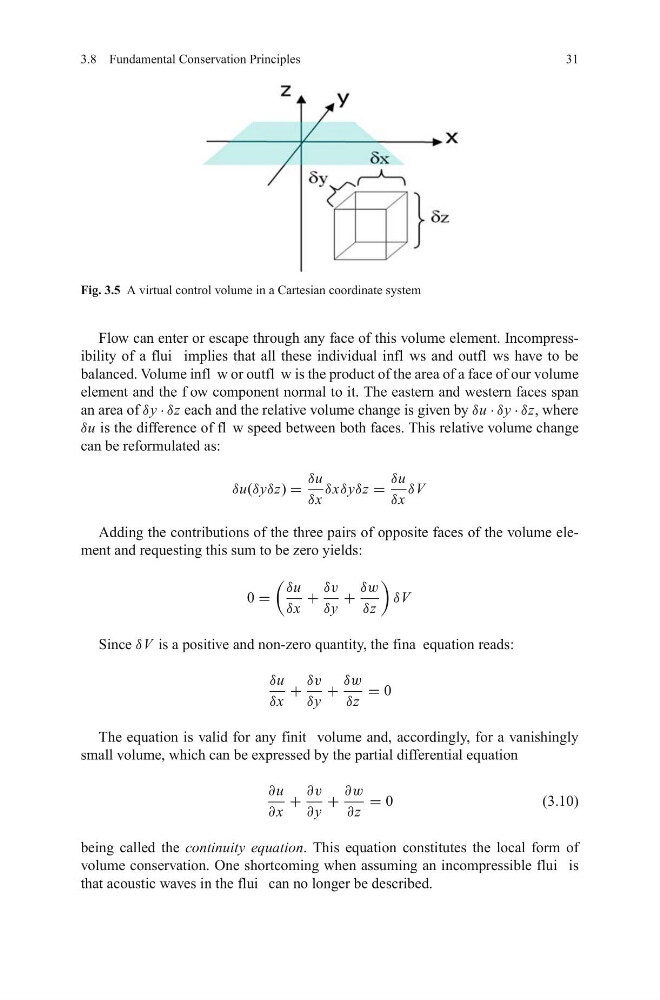
Fig. 3.5 A virtual control volume in a Cartesian coordinate system
Flow can enter or escape through any face of this volume element. Incompressibility of a flui implies that all these individual infl ws and outfl ws have to be
balanced. Volume infl w or outfl w is the product of the area of a face of our volume
element and the f ow component normal to it. The eastern and western faces span
an area of δy · δz each and the relative volume change is given by δu · δy · δz, where
δu is the difference of fl w speed between both faces. This relative volume change
can be reformulated as:
δu(δyδz) =
δu
δx
δxδyδz =
δu
δx
δV
Adding the contributions of the three pairs of opposite faces of the volume element and requesting this sum to be zero yields:
0 =
δu
δx
+
δv
δy
+
δw
δz
δV
Since δV is a positive and non-zero quantity, the fina equation reads:
δu
δx
+
δv
δy
+
δw
δz
= 0
The equation is valid for any finit volume and, accordingly, for a vanishingly
small volume, which can be expressed by the partial differential equation
∂u
∂ x
+
∂v
∂ y
+
∂w
∂z
= 0
(3.10)
being called the continuity equation. This equation constitutes the local form of
volume conservation. One shortcoming when assuming an incompressible flui is
that acoustic waves in the flui can no longer be described.
31
Fig. 3.5 A virtual control volume in a Cartesian coordinate system
Flow can enter or escape through any face of this volume element. Incompressibility of a flui implies that all these individual infl ws and outfl ws have to be
balanced. Volume infl w or outfl w is the product of the area of a face of our volume
element and the f ow component normal to it. The eastern and western faces span
an area of δy · δz each and the relative volume change is given by δu · δy · δz, where
δu is the difference of fl w speed between both faces. This relative volume change
can be reformulated as:
δu(δyδz) =
δu
δx
δxδyδz =
δu
δx
δV
Adding the contributions of the three pairs of opposite faces of the volume element and requesting this sum to be zero yields:
0 =
δu
δx
+
δv
δy
+
δw
δz
δV
Since δV is a positive and non-zero quantity, the fina equation reads:
δu
δx
+
δv
δy
+
δw
δz
= 0
The equation is valid for any finit volume and, accordingly, for a vanishingly
small volume, which can be expressed by the partial differential equation
∂u
∂ x
+
∂v
∂ y
+
∂w
∂z
= 0
(3.10)
being called the continuity equation. This equation constitutes the local form of
volume conservation. One shortcoming when assuming an incompressible flui is
that acoustic waves in the flui can no longer be described.