

3.8 Fundamental Conservation Principles
33
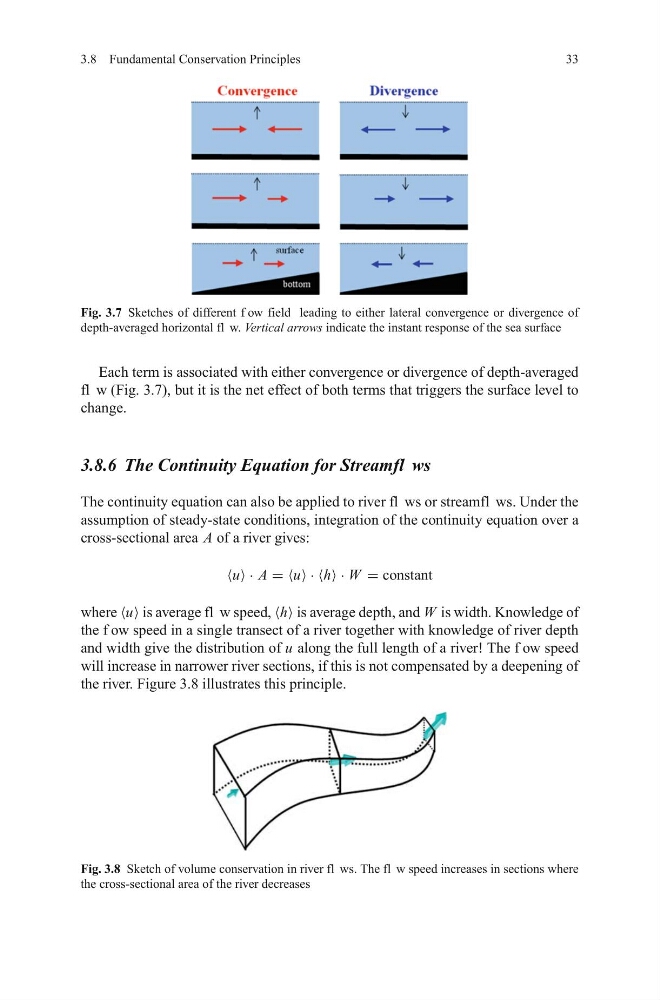
Fig. 3.7 Sketches of different f ow field leading to either lateral convergence or divergence of
depth-averaged horizontal fl w. Vertical arrows indicate the instant response of the sea surface
Each term is associated with either convergence or divergence of depth-averaged
fl w (Fig. 3.7), but it is the net effect of both terms that triggers the surface level to
change.
3.8.6 The Continuity Equation for Streamfl ws
The continuity equation can also be applied to river fl ws or streamfl ws. Under the
assumption of steady-state conditions, integration of the continuity equation over a
cross-sectional area A of a river gives:
u · A = u · h · W = constant
where u is average fl w speed, h is average depth, and W is width. Knowledge of
the f ow speed in a single transect of a river together with knowledge of river depth
and width give the distribution of u along the full length of a river! The f ow speed
will increase in narrower river sections, if this is not compensated by a deepening of
the river. Figure 3.8 illustrates this principle.
Fig. 3.8 Sketch of volume conservation in river fl ws. The fl w speed increases in sections where
the cross-sectional area of the river decreases
33
Fig. 3.7 Sketches of different f ow field leading to either lateral convergence or divergence of
depth-averaged horizontal fl w. Vertical arrows indicate the instant response of the sea surface
Each term is associated with either convergence or divergence of depth-averaged
fl w (Fig. 3.7), but it is the net effect of both terms that triggers the surface level to
change.
3.8.6 The Continuity Equation for Streamfl ws
The continuity equation can also be applied to river fl ws or streamfl ws. Under the
assumption of steady-state conditions, integration of the continuity equation over a
cross-sectional area A of a river gives:
u · A = u · h · W = constant
where u is average fl w speed, h is average depth, and W is width. Knowledge of
the f ow speed in a single transect of a river together with knowledge of river depth
and width give the distribution of u along the full length of a river! The f ow speed
will increase in narrower river sections, if this is not compensated by a deepening of
the river. Figure 3.8 illustrates this principle.
Fig. 3.8 Sketch of volume conservation in river fl ws. The fl w speed increases in sections where
the cross-sectional area of the river decreases