

144
6 Rotational Effects
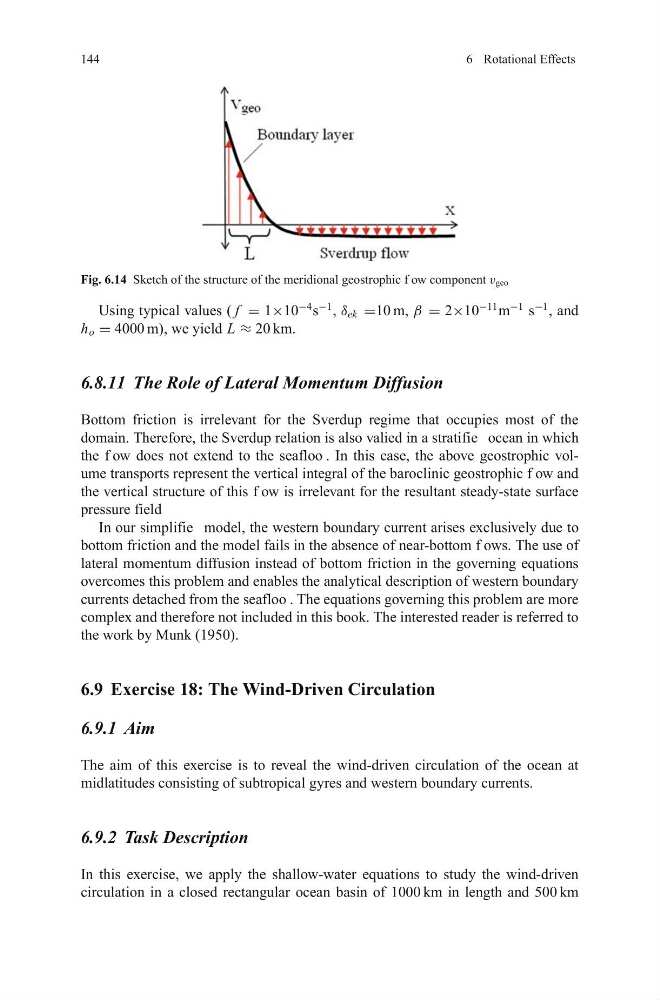
Fig. 6.14 Sketch of the structure of the meridional geostrophic f ow component v geo
Using typical values ( f = 1×10
−4
s
−1
, δ ek =10 m, β = 2×10
−11
m
−1
s
−1
, and
h o = 4000 m), we yield L ≈ 20 km.
6.8.11 The Role of Lateral Momentum Diffusion
Bottom friction is irrelevant for the Sverdup regime that occupies most of the
domain. Therefore, the Sverdup relation is also valied in a stratifie ocean in which
the f ow does not extend to the seafloo . In this case, the above geostrophic volume transports represent the vertical integral of the baroclinic geostrophic f ow and
the vertical structure of this f ow is irrelevant for the resultant steady-state surface
pressure field
In our simplifie model, the western boundary current arises exclusively due to
bottom friction and the model fails in the absence of near-bottom f ows. The use of
lateral momentum diffusion instead of bottom friction in the governing equations
overcomes this problem and enables the analytical description of western boundary
currents detached from the seafloo . The equations governing this problem are more
complex and therefore not included in this book. The interested reader is referred to
the work by Munk (1950).
6.9 Exercise 18: The Wind-Driven Circulation
6.9.1 Aim
The aim of this exercise is to reveal the wind-driven circulation of the ocean at
midlatitudes consisting of subtropical gyres and western boundary currents.
6.9.2 Task Description
In this exercise, we apply the shallow-water equations to study the wind-driven
circulation in a closed rectangular ocean basin of 1000 km in length and 500 km
6 Rotational Effects
Fig. 6.14 Sketch of the structure of the meridional geostrophic f ow component v geo
Using typical values ( f = 1×10
−4
s
−1
, δ ek =10 m, β = 2×10
−11
m
−1
s
−1
, and
h o = 4000 m), we yield L ≈ 20 km.
6.8.11 The Role of Lateral Momentum Diffusion
Bottom friction is irrelevant for the Sverdup regime that occupies most of the
domain. Therefore, the Sverdup relation is also valied in a stratifie ocean in which
the f ow does not extend to the seafloo . In this case, the above geostrophic volume transports represent the vertical integral of the baroclinic geostrophic f ow and
the vertical structure of this f ow is irrelevant for the resultant steady-state surface
pressure field
In our simplifie model, the western boundary current arises exclusively due to
bottom friction and the model fails in the absence of near-bottom f ows. The use of
lateral momentum diffusion instead of bottom friction in the governing equations
overcomes this problem and enables the analytical description of western boundary
currents detached from the seafloo . The equations governing this problem are more
complex and therefore not included in this book. The interested reader is referred to
the work by Munk (1950).
6.9 Exercise 18: The Wind-Driven Circulation
6.9.1 Aim
The aim of this exercise is to reveal the wind-driven circulation of the ocean at
midlatitudes consisting of subtropical gyres and western boundary currents.
6.9.2 Task Description
In this exercise, we apply the shallow-water equations to study the wind-driven
circulation in a closed rectangular ocean basin of 1000 km in length and 500 km