

6.8 The Wind-Driven Circulation of the Ocean
139
6.8.4 The Surface Ekman Layer
Winds impose a tangential frictional stress to the sea surface that transfers momentum into the ocean by means of vertical diffusion of momentum. This friction only
plays a role in a surface layer of finit depth, the so-called surface Ekman layer. It
can be shown (see Cushman-Roisin, 1994) that the thickness of this layer is given
by:
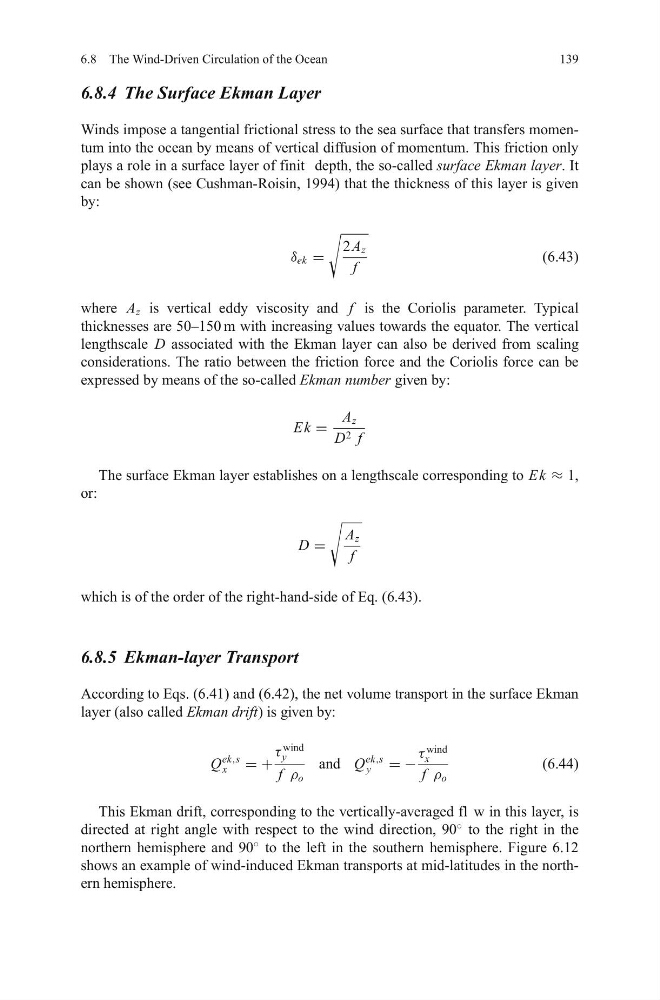
δ ek =
2A z
f
(6.43)
where A z is vertical eddy viscosity and f is the Coriolis parameter. Typical
thicknesses are 50–150 m with increasing values towards the equator. The vertical
lengthscale D associated with the Ekman layer can also be derived from scaling
considerations. The ratio between the friction force and the Coriolis force can be
expressed by means of the so-called Ekman number given by:
Ek =
A z
D 2 f
The surface Ekman layer establishes on a lengthscale corresponding to Ek ≈ 1,
or:
D =
A z
f
which is of the order of the right-hand-side of Eq. (6.43).
6.8.5 Ekman-layer Transport
According to Eqs. (6.41) and (6.42), the net volume transport in the surface Ekman
layer (also called Ekman drift) is given by:
Q
ek,s
x
= +
τ
wind
y
f ρ o
and Q
ek,s
y
= −
τ
wind
x
f ρ o
(6.44)
This Ekman drift, corresponding to the vertically-averaged fl w in this layer, is
directed at right angle with respect to the wind direction, 90
◦
to the right in the
northern hemisphere and 90
◦
to the left in the southern hemisphere. Figure 6.12
shows an example of wind-induced Ekman transports at mid-latitudes in the northern hemisphere.
139
6.8.4 The Surface Ekman Layer
Winds impose a tangential frictional stress to the sea surface that transfers momentum into the ocean by means of vertical diffusion of momentum. This friction only
plays a role in a surface layer of finit depth, the so-called surface Ekman layer. It
can be shown (see Cushman-Roisin, 1994) that the thickness of this layer is given
by:
δ ek =
2A z
f
(6.43)
where A z is vertical eddy viscosity and f is the Coriolis parameter. Typical
thicknesses are 50–150 m with increasing values towards the equator. The vertical
lengthscale D associated with the Ekman layer can also be derived from scaling
considerations. The ratio between the friction force and the Coriolis force can be
expressed by means of the so-called Ekman number given by:
Ek =
A z
D 2 f
The surface Ekman layer establishes on a lengthscale corresponding to Ek ≈ 1,
or:
D =
A z
f
which is of the order of the right-hand-side of Eq. (6.43).
6.8.5 Ekman-layer Transport
According to Eqs. (6.41) and (6.42), the net volume transport in the surface Ekman
layer (also called Ekman drift) is given by:
Q
ek,s
x
= +
τ
wind
y
f ρ o
and Q
ek,s
y
= −
τ
wind
x
f ρ o
(6.44)
This Ekman drift, corresponding to the vertically-averaged fl w in this layer, is
directed at right angle with respect to the wind direction, 90
◦
to the right in the
northern hemisphere and 90
◦
to the left in the southern hemisphere. Figure 6.12
shows an example of wind-induced Ekman transports at mid-latitudes in the northern hemisphere.