

138
6 Rotational Effects
where Q x and Q y are components of a vector called volume transport that is yielded
from vertical integration of the lateral f ow over the entire water column. Volume
transport carries units of m
3
/s per unit width of the f ow. In recognition of Harald Sverdrup’s work (e.g., Sverdrup, 1947), oceanographers often express volume
transports in units of Sverdrups (Sv) with 1 Sv being equivalent to 1×10
6
m
3
/s. The
net volume transport is composed of several contributions that compensate each
other in order to achieve a steady-state sea level. The details of this compensation is
discussed in the following.
6.8.3 A Simplifie Model of the Wind-driven Circulation
A simplifie model of the wind-driven circulation can be constructed when considering an ocean of uniform water depth h o being void of density stratification
Large-scale oceanic f ows are associated with very small Rossby numbers. The
nonlinear terms can therefore be ignored. For simplicity, we also neglect horizontal
momentum diffusion. Accordingly, the vertically integrated momentum equations
(6.1) and (6.2) can be written as:
∂ Q x
∂t
− f Q y = −gh o
∂η
∂ x
+
τ
wind
x
− τ
bot
x
ρ o
∂ Q y
∂t
+ f Q x = −gh o
∂η
∂ y
+
τ
wind
y
− τ
bot
y
ρ o
In a steady state, the latter equations turn into:
− f Q y = −gh o
∂η
∂ x
+
τ
wind
x
− τ
bot
x
ρ o
(6.41)
+ f Q x = −gh o
∂η
∂ y
+
τ
wind
y
− τ
bot
y
ρ o
(6.42)
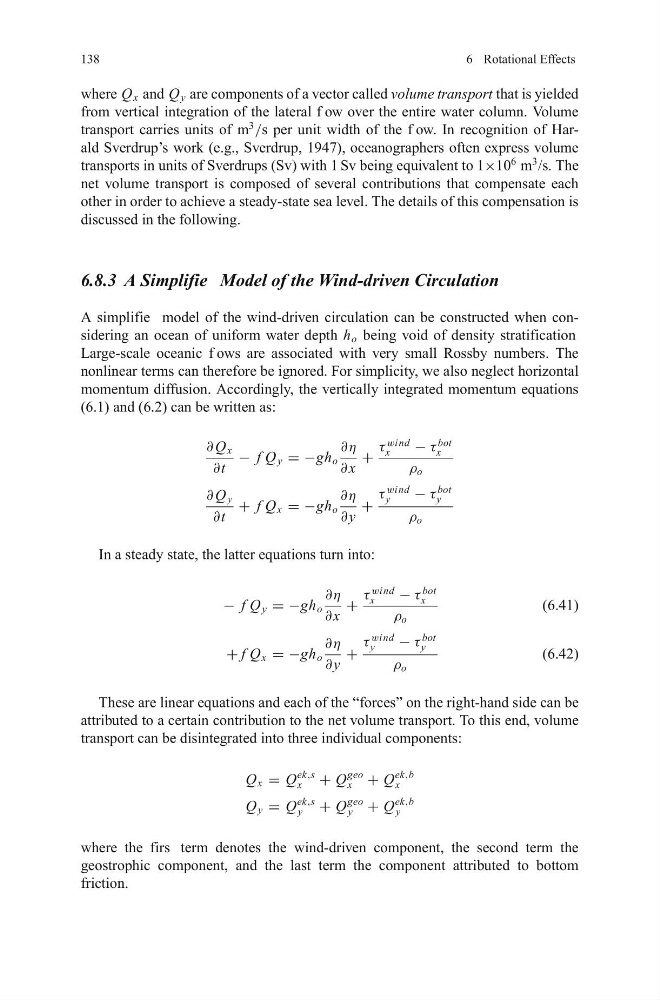
These are linear equations and each of the “forces” on the right-hand side can be
attributed to a certain contribution to the net volume transport. To this end, volume
transport can be disintegrated into three individual components:
Q x = Q
ek,s
x
+ Q
geo
x + Q
ek,b
x
Q y = Q
ek,s
y
+ Q
geo
y + Q
ek,b
y
where the firs term denotes the wind-driven component, the second term the
geostrophic component, and the last term the component attributed to bottom
friction.
6 Rotational Effects
where Q x and Q y are components of a vector called volume transport that is yielded
from vertical integration of the lateral f ow over the entire water column. Volume
transport carries units of m
3
/s per unit width of the f ow. In recognition of Harald Sverdrup’s work (e.g., Sverdrup, 1947), oceanographers often express volume
transports in units of Sverdrups (Sv) with 1 Sv being equivalent to 1×10
6
m
3
/s. The
net volume transport is composed of several contributions that compensate each
other in order to achieve a steady-state sea level. The details of this compensation is
discussed in the following.
6.8.3 A Simplifie Model of the Wind-driven Circulation
A simplifie model of the wind-driven circulation can be constructed when considering an ocean of uniform water depth h o being void of density stratification
Large-scale oceanic f ows are associated with very small Rossby numbers. The
nonlinear terms can therefore be ignored. For simplicity, we also neglect horizontal
momentum diffusion. Accordingly, the vertically integrated momentum equations
(6.1) and (6.2) can be written as:
∂ Q x
∂t
− f Q y = −gh o
∂η
∂ x
+
τ
wind
x
− τ
bot
x
ρ o
∂ Q y
∂t
+ f Q x = −gh o
∂η
∂ y
+
τ
wind
y
− τ
bot
y
ρ o
In a steady state, the latter equations turn into:
− f Q y = −gh o
∂η
∂ x
+
τ
wind
x
− τ
bot
x
ρ o
(6.41)
+ f Q x = −gh o
∂η
∂ y
+
τ
wind
y
− τ
bot
y
ρ o
(6.42)
These are linear equations and each of the “forces” on the right-hand side can be
attributed to a certain contribution to the net volume transport. To this end, volume
transport can be disintegrated into three individual components:
Q x = Q
ek,s
x
+ Q
geo
x + Q
ek,b
x
Q y = Q
ek,s
y
+ Q
geo
y + Q
ek,b
y
where the firs term denotes the wind-driven component, the second term the
geostrophic component, and the last term the component attributed to bottom
friction.