

140
6 Rotational Effects
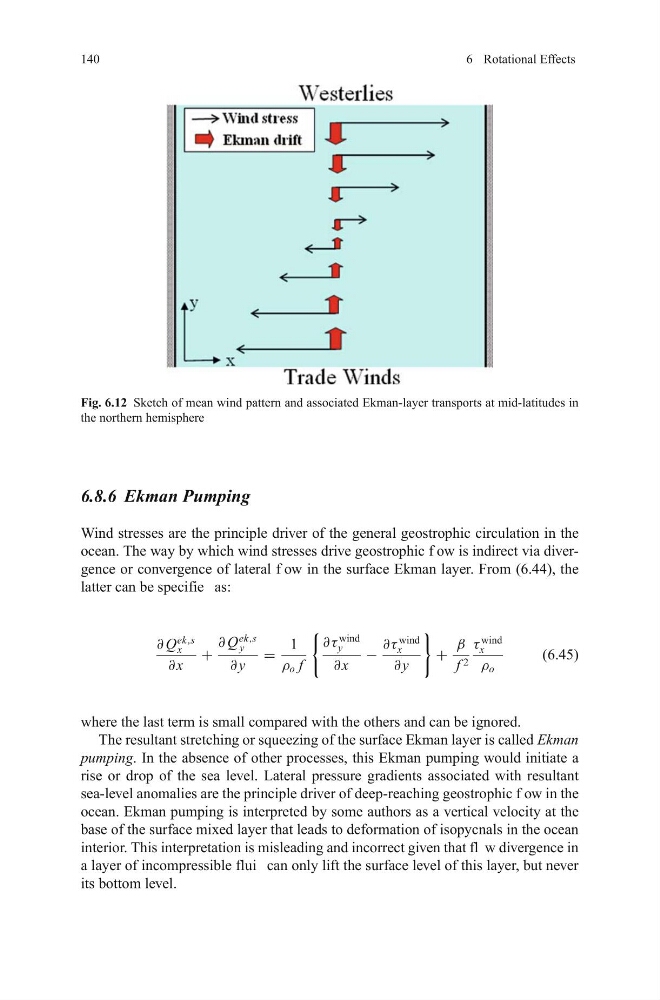
Fig. 6.12 Sketch of mean wind pattern and associated Ekman-layer transports at mid-latitudes in
the northern hemisphere
6.8.6 Ekman Pumping
Wind stresses are the principle driver of the general geostrophic circulation in the
ocean. The way by which wind stresses drive geostrophic f ow is indirect via divergence or convergence of lateral f ow in the surface Ekman layer. From (6.44), the
latter can be specifie as:
∂ Q
ek,s
x
∂ x
+
∂ Q
ek,s
y
∂ y
=
1
ρ o f
∂τ
wind
y
∂ x
−
∂τ
wind
x
∂ y
+
β
f 2
τ
wind
x
ρ o
(6.45)
where the last term is small compared with the others and can be ignored.
The resultant stretching or squeezing of the surface Ekman layer is called Ekman
pumping. In the absence of other processes, this Ekman pumping would initiate a
rise or drop of the sea level. Lateral pressure gradients associated with resultant
sea-level anomalies are the principle driver of deep-reaching geostrophic f ow in the
ocean. Ekman pumping is interpreted by some authors as a vertical velocity at the
base of the surface mixed layer that leads to deformation of isopycnals in the ocean
interior. This interpretation is misleading and incorrect given that fl w divergence in
a layer of incompressible flui can only lift the surface level of this layer, but never
its bottom level.
6 Rotational Effects
Fig. 6.12 Sketch of mean wind pattern and associated Ekman-layer transports at mid-latitudes in
the northern hemisphere
6.8.6 Ekman Pumping
Wind stresses are the principle driver of the general geostrophic circulation in the
ocean. The way by which wind stresses drive geostrophic f ow is indirect via divergence or convergence of lateral f ow in the surface Ekman layer. From (6.44), the
latter can be specifie as:
∂ Q
ek,s
x
∂ x
+
∂ Q
ek,s
y
∂ y
=
1
ρ o f
∂τ
wind
y
∂ x
−
∂τ
wind
x
∂ y
+
β
f 2
τ
wind
x
ρ o
(6.45)
where the last term is small compared with the others and can be ignored.
The resultant stretching or squeezing of the surface Ekman layer is called Ekman
pumping. In the absence of other processes, this Ekman pumping would initiate a
rise or drop of the sea level. Lateral pressure gradients associated with resultant
sea-level anomalies are the principle driver of deep-reaching geostrophic f ow in the
ocean. Ekman pumping is interpreted by some authors as a vertical velocity at the
base of the surface mixed layer that leads to deformation of isopycnals in the ocean
interior. This interpretation is misleading and incorrect given that fl w divergence in
a layer of incompressible flui can only lift the surface level of this layer, but never
its bottom level.