

126
6 Rotational Effects
d(PV )
dt
= 0
(6.23)
where the quantity PV, called potential vorticity, is define by:
PV =
f + ξ
h
(6.24)
In the context of vorticity, the Coriolis parameter (or inertial frequency) f is
called planetary vorticity, and f + ς is called absolute vorticity.
6.4.5 Conservation of Potential Vorticity
The conservation principle of potential vorticity (6.23) in the ocean is akin to that
of angular momentum for an isolated system. The best example is that of a ballerina
spinning on her toes. With her arms stretched out, she spins slowly, but with her
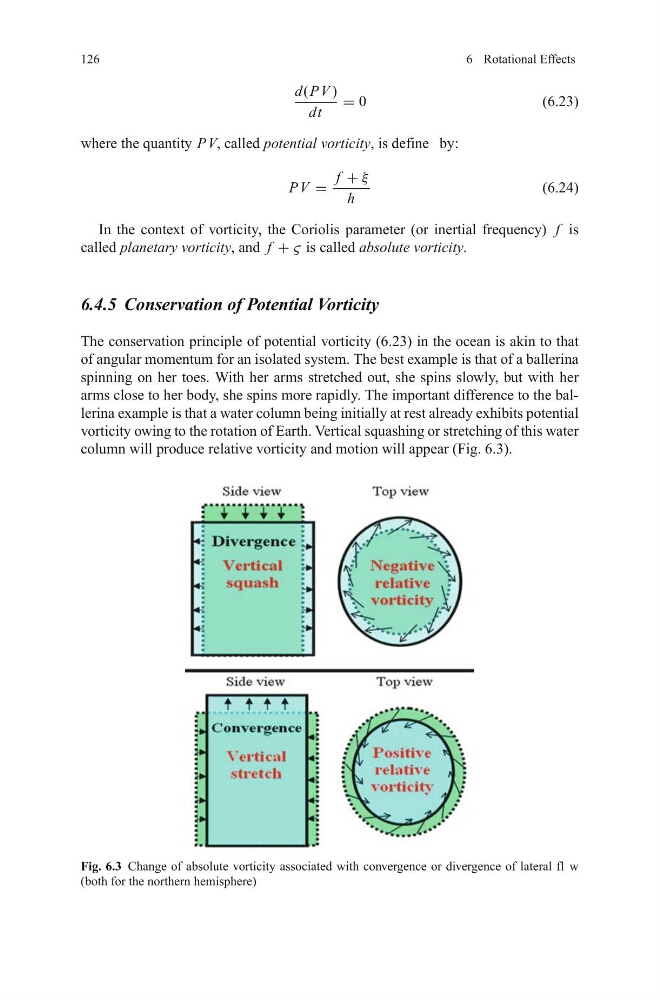
arms close to her body, she spins more rapidly. The important difference to the ballerina example is that a water column being initially at rest already exhibits potential
vorticity owing to the rotation of Earth. Vertical squashing or stretching of this water
column will produce relative vorticity and motion will appear (Fig. 6.3).
Fig. 6.3 Change of absolute vorticity associated with convergence or divergence of lateral fl w
(both for the northern hemisphere)
6 Rotational Effects
d(PV )
dt
= 0
(6.23)
where the quantity PV, called potential vorticity, is define by:
PV =
f + ξ
h
(6.24)
In the context of vorticity, the Coriolis parameter (or inertial frequency) f is
called planetary vorticity, and f + ς is called absolute vorticity.
6.4.5 Conservation of Potential Vorticity
The conservation principle of potential vorticity (6.23) in the ocean is akin to that
of angular momentum for an isolated system. The best example is that of a ballerina
spinning on her toes. With her arms stretched out, she spins slowly, but with her
arms close to her body, she spins more rapidly. The important difference to the ballerina example is that a water column being initially at rest already exhibits potential
vorticity owing to the rotation of Earth. Vertical squashing or stretching of this water
column will produce relative vorticity and motion will appear (Fig. 6.3).
Fig. 6.3 Change of absolute vorticity associated with convergence or divergence of lateral fl w
(both for the northern hemisphere)