

6.4 Geostrophic Flow
127
In a multi-layer non-frictional ocean, it can be shown (see Cushman-Roisin
(1994)) that the conservation principle of potential vorticity applies to each layer
separately; that is,
d(PV i )
dt
= 0
where i is the layer index, and:
PV i =
f + ξ i
h i
is the potential vorticity of a layer.
6.4.6 Topographic Steering
The ratio between relative vorticity and planetary vorticity scales as the Rossby
number; that is;
ξ
f
≈
U/L
f
=
U
f L
= Ro
(6.25)
Quasi-geostrophic flow are f ows characterised by a small Rossby number
Ro << 1. For such fl ws, the conservation statement for potential vorticity turns
into:
d(PV )
dt
≈
d( f / h)
dt
= 0 ⇒
f
h
= constant
(6.26)
On the f -plane, this relation suggests that steady-state f ows tend to follow bathymetric contours, a feature being referred to as topographic steering.
6.4.7 Rossby Waves
Relative vorticity is created by moving the water column to a different geographical latitude or by stretching or shrinking the water column through divergence/
convergence of lateral f ow. Waves created by disturbances of f are called planetary Rossby waves. Waves associated with disturbances of the thickness of the water
column are referred to as topographic Rossby waves.
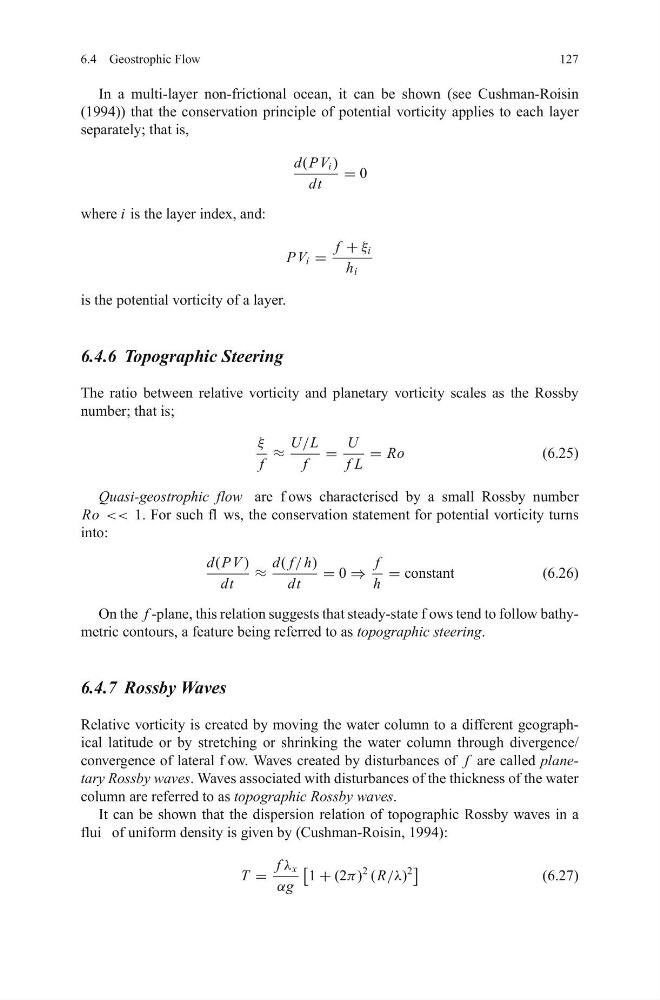
It can be shown that the dispersion relation of topographic Rossby waves in a
flui of uniform density is given by (Cushman-Roisin, 1994):
T =
f λ x
αg
1 + (2π )
2
(R/λ)
2
(6.27)
127
In a multi-layer non-frictional ocean, it can be shown (see Cushman-Roisin
(1994)) that the conservation principle of potential vorticity applies to each layer
separately; that is,
d(PV i )
dt
= 0
where i is the layer index, and:
PV i =
f + ξ i
h i
is the potential vorticity of a layer.
6.4.6 Topographic Steering
The ratio between relative vorticity and planetary vorticity scales as the Rossby
number; that is;
ξ
f
≈
U/L
f
=
U
f L
= Ro
(6.25)
Quasi-geostrophic flow are f ows characterised by a small Rossby number
Ro << 1. For such fl ws, the conservation statement for potential vorticity turns
into:
d(PV )
dt
≈
d( f / h)
dt
= 0 ⇒
f
h
= constant
(6.26)
On the f -plane, this relation suggests that steady-state f ows tend to follow bathymetric contours, a feature being referred to as topographic steering.
6.4.7 Rossby Waves
Relative vorticity is created by moving the water column to a different geographical latitude or by stretching or shrinking the water column through divergence/
convergence of lateral f ow. Waves created by disturbances of f are called planetary Rossby waves. Waves associated with disturbances of the thickness of the water
column are referred to as topographic Rossby waves.
It can be shown that the dispersion relation of topographic Rossby waves in a
flui of uniform density is given by (Cushman-Roisin, 1994):
T =
f λ x
αg
1 + (2π )
2
(R/λ)
2
(6.27)