

5.4 The Wind-Forced Shallow-Water Model
99
5.4 The Wind-Forced Shallow-Water Model
5.4.1 The Governing Equations
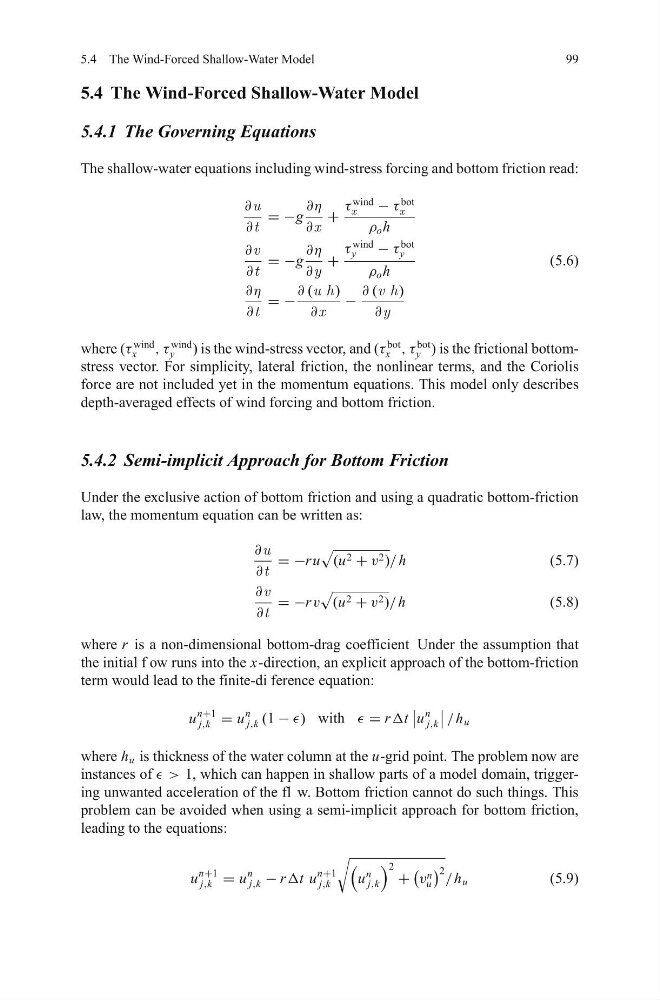
The shallow-water equations including wind-stress forcing and bottom friction read:
∂u
∂t
= −g
∂η
∂x
+
τ
wind
x
− τ
bot
x
ρ o h
∂v
∂t
= −g
∂η
∂y
+
τ
wind
y
− τ
bot
y
ρ o h
(5.6)
∂η
∂t
= −
∂ (u h)
∂x
−
∂ (v h)
∂y
where (τ
wind
x
, τ
wind
y
) is the wind-stress vector, and (τ
bot
x , τ
bot
y ) is the frictional bottomstress vector. For simplicity, lateral friction, the nonlinear terms, and the Coriolis
force are not included yet in the momentum equations. This model only describes
depth-averaged effects of wind forcing and bottom friction.
5.4.2 Semi-implicit Approach for Bottom Friction
Under the exclusive action of bottom friction and using a quadratic bottom-friction
law, the momentum equation can be written as:
∂u
∂t
= −ru
(u 2 + v 2 )/ h
(5.7)
∂v
∂t
= −r v
(u 2 + v 2 )/ h
(5.8)
where r is a non-dimensional bottom-drag coefficient Under the assumption that
the initial f ow runs into the x-direction, an explicit approach of the bottom-friction
term would lead to the finite-di ference equation:
u
n+1
j,k = u
n
j,k (1 − ) with = r Δt
u
n
j,k
/ h u
where h u is thickness of the water column at the u-grid point. The problem now are
instances of > 1, which can happen in shallow parts of a model domain, triggering unwanted acceleration of the fl w. Bottom friction cannot do such things. This
problem can be avoided when using a semi-implicit approach for bottom friction,
leading to the equations:
u
n+1
j,k = u
n
j,k − r Δt u
n+1
j,k
u
n
j,k
2 +
v n
u
2 / h u
(5.9)
99
5.4 The Wind-Forced Shallow-Water Model
5.4.1 The Governing Equations
The shallow-water equations including wind-stress forcing and bottom friction read:
∂u
∂t
= −g
∂η
∂x
+
τ
wind
x
− τ
bot
x
ρ o h
∂v
∂t
= −g
∂η
∂y
+
τ
wind
y
− τ
bot
y
ρ o h
(5.6)
∂η
∂t
= −
∂ (u h)
∂x
−
∂ (v h)
∂y
where (τ
wind
x
, τ
wind
y
) is the wind-stress vector, and (τ
bot
x , τ
bot
y ) is the frictional bottomstress vector. For simplicity, lateral friction, the nonlinear terms, and the Coriolis
force are not included yet in the momentum equations. This model only describes
depth-averaged effects of wind forcing and bottom friction.
5.4.2 Semi-implicit Approach for Bottom Friction
Under the exclusive action of bottom friction and using a quadratic bottom-friction
law, the momentum equation can be written as:
∂u
∂t
= −ru
(u 2 + v 2 )/ h
(5.7)
∂v
∂t
= −r v
(u 2 + v 2 )/ h
(5.8)
where r is a non-dimensional bottom-drag coefficient Under the assumption that
the initial f ow runs into the x-direction, an explicit approach of the bottom-friction
term would lead to the finite-di ference equation:
u
n+1
j,k = u
n
j,k (1 − ) with = r Δt
u
n
j,k
/ h u
where h u is thickness of the water column at the u-grid point. The problem now are
instances of > 1, which can happen in shallow parts of a model domain, triggering unwanted acceleration of the fl w. Bottom friction cannot do such things. This
problem can be avoided when using a semi-implicit approach for bottom friction,
leading to the equations:
u
n+1
j,k = u
n
j,k − r Δt u
n+1
j,k
u
n
j,k
2 +
v n
u
2 / h u
(5.9)