

98
5 2D Shallow-Water Modelling
where the partial derivatives are evaluated at previous time steps and from interior
values. The computed phase speed is then used in (5.5) to predict variations of the
boundary value of η. This numerical scheme, called Orlanksi radiation condition, is
widespreadly used by ocean modellers. Implementation of this scheme remains for
the advanced reader.
5.3.5 Sample Code and Animation Script
The folder “Exercise 9” of the CD-ROM contains the FORTRAN simulation code,
a SciLab animation script, and a FORTRAN code called “topo f95” that creates the
bathymetry. The f le “info.txt” gives additional information.
5.3.6 Results
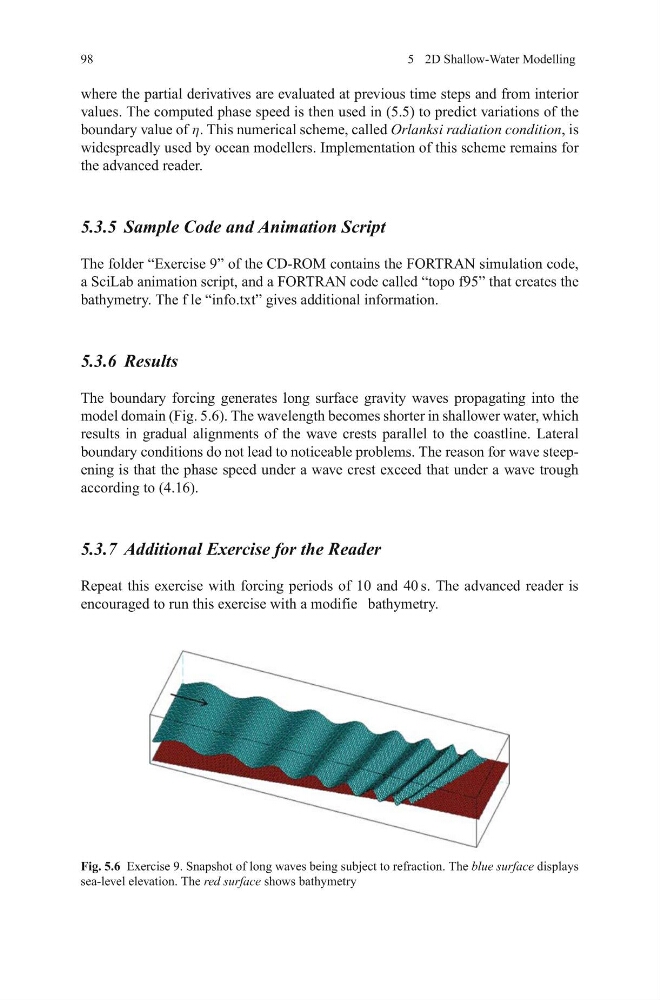
The boundary forcing generates long surface gravity waves propagating into the
model domain (Fig. 5.6). The wavelength becomes shorter in shallower water, which
results in gradual alignments of the wave crests parallel to the coastline. Lateral
boundary conditions do not lead to noticeable problems. The reason for wave steepening is that the phase speed under a wave crest exceed that under a wave trough
according to (4.16).
5.3.7 Additional Exercise for the Reader
Repeat this exercise with forcing periods of 10 and 40 s. The advanced reader is
encouraged to run this exercise with a modifie bathymetry.
Fig. 5.6 Exercise 9. Snapshot of long waves being subject to refraction. The blue surface displays
sea-level elevation. The red surface shows bathymetry
5 2D Shallow-Water Modelling
where the partial derivatives are evaluated at previous time steps and from interior
values. The computed phase speed is then used in (5.5) to predict variations of the
boundary value of η. This numerical scheme, called Orlanksi radiation condition, is
widespreadly used by ocean modellers. Implementation of this scheme remains for
the advanced reader.
5.3.5 Sample Code and Animation Script
The folder “Exercise 9” of the CD-ROM contains the FORTRAN simulation code,
a SciLab animation script, and a FORTRAN code called “topo f95” that creates the
bathymetry. The f le “info.txt” gives additional information.
5.3.6 Results
The boundary forcing generates long surface gravity waves propagating into the
model domain (Fig. 5.6). The wavelength becomes shorter in shallower water, which
results in gradual alignments of the wave crests parallel to the coastline. Lateral
boundary conditions do not lead to noticeable problems. The reason for wave steepening is that the phase speed under a wave crest exceed that under a wave trough
according to (4.16).
5.3.7 Additional Exercise for the Reader
Repeat this exercise with forcing periods of 10 and 40 s. The advanced reader is
encouraged to run this exercise with a modifie bathymetry.
Fig. 5.6 Exercise 9. Snapshot of long waves being subject to refraction. The blue surface displays
sea-level elevation. The red surface shows bathymetry