

100
5 2D Shallow-Water Modelling
v
n+1
j,k = v
n
j,k − r Δt v
n+1
j,k
u n
v
2 +
v
n
j,k
2 / h v
(5.10)
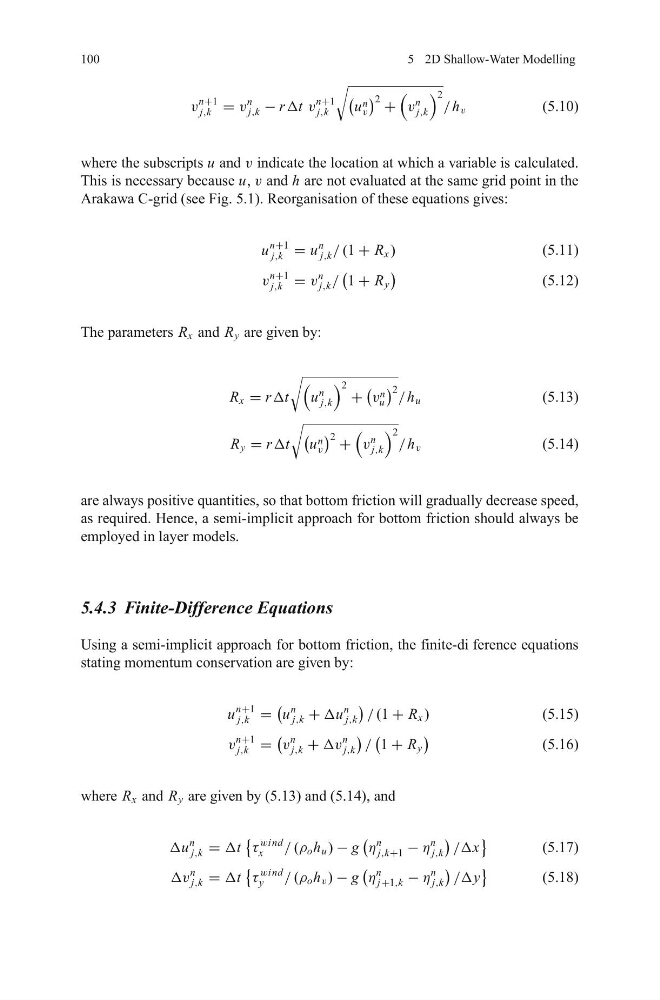
where the subscripts u and v indicate the location at which a variable is calculated.
This is necessary because u, v and h are not evaluated at the same grid point in the
Arakawa C-grid (see Fig. 5.1). Reorganisation of these equations gives:
u
n+1
j,k = u
n
j,k / (1 + R x )
(5.11)
v
n+1
j,k = v
n
j,k /
1 + R y
(5.12)
The parameters R x and R y are given by:
R x = r Δt
u
n
j,k
2 +
v n
u
2 / h u
(5.13)
R y = r Δt
u n
v
2 +
v
n
j,k
2 / h v
(5.14)
are always positive quantities, so that bottom friction will gradually decrease speed,
as required. Hence, a semi-implicit approach for bottom friction should always be
employed in layer models.
5.4.3 Finite-Difference Equations
Using a semi-implicit approach for bottom friction, the finite-di ference equations
stating momentum conservation are given by:
u
n+1
j,k =
u
n
j,k + Δu
n
j,k
/ (1 + R x )
(5.15)
v
n+1
j,k =
v
n
j,k + Δv
n
j,k
/
1 + R y
(5.16)
where R x and R y are given by (5.13) and (5.14), and
Δu
n
j,k = Δt
τ
wind
x
/ (ρ o h u ) − g
η
n
j,k+1 − η
n
j,k
/Δx
(5.17)
Δv
n
j,k = Δt
τ
wind
y
/ (ρ o h v ) − g
η
n
j+1,k − η
n
j,k
/Δy
(5.18)
5 2D Shallow-Water Modelling
v
n+1
j,k = v
n
j,k − r Δt v
n+1
j,k
u n
v
2 +
v
n
j,k
2 / h v
(5.10)
where the subscripts u and v indicate the location at which a variable is calculated.
This is necessary because u, v and h are not evaluated at the same grid point in the
Arakawa C-grid (see Fig. 5.1). Reorganisation of these equations gives:
u
n+1
j,k = u
n
j,k / (1 + R x )
(5.11)
v
n+1
j,k = v
n
j,k /
1 + R y
(5.12)
The parameters R x and R y are given by:
R x = r Δt
u
n
j,k
2 +
v n
u
2 / h u
(5.13)
R y = r Δt
u n
v
2 +
v
n
j,k
2 / h v
(5.14)
are always positive quantities, so that bottom friction will gradually decrease speed,
as required. Hence, a semi-implicit approach for bottom friction should always be
employed in layer models.
5.4.3 Finite-Difference Equations
Using a semi-implicit approach for bottom friction, the finite-di ference equations
stating momentum conservation are given by:
u
n+1
j,k =
u
n
j,k + Δu
n
j,k
/ (1 + R x )
(5.15)
v
n+1
j,k =
v
n
j,k + Δv
n
j,k
/
1 + R y
(5.16)
where R x and R y are given by (5.13) and (5.14), and
Δu
n
j,k = Δt
τ
wind
x
/ (ρ o h u ) − g
η
n
j,k+1 − η
n
j,k
/Δx
(5.17)
Δv
n
j,k = Δt
τ
wind
y
/ (ρ o h v ) − g
η
n
j+1,k − η
n
j,k
/Δy
(5.18)