

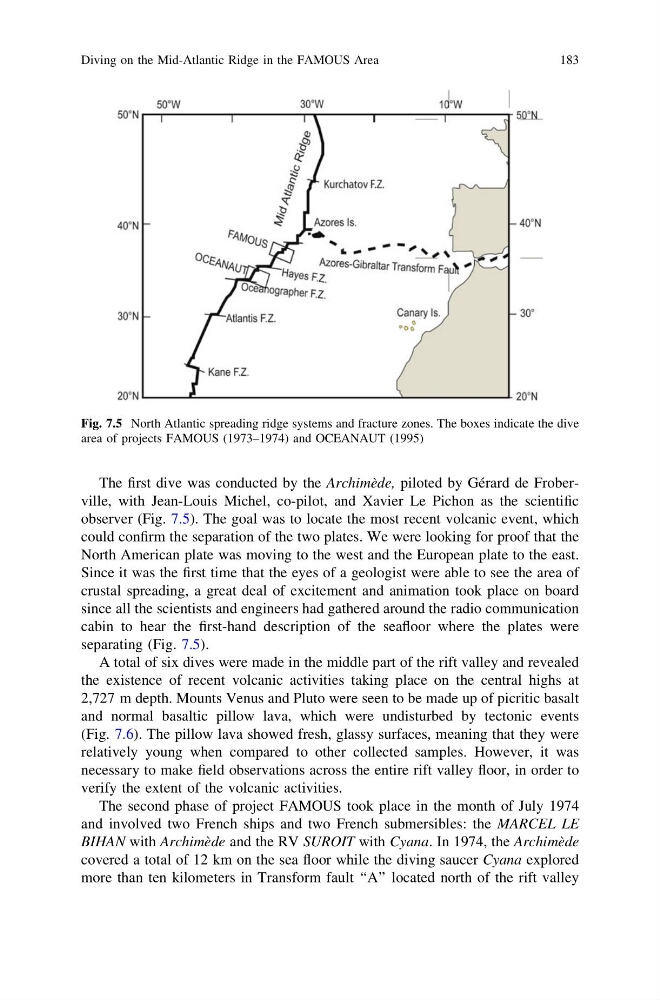
The first dive was conducted by the Archimède, piloted by Gérard de Froberville, with Jean-Louis Michel, co-pilot, and Xavier Le Pichon as the scientific
observer (Fig. 7.5). The goal was to locate the most recent volcanic event, which
could confirm the separation of the two plates. We were looking for proof that the
North American plate was moving to the west and the European plate to the east.
Since it was the first time that the eyes of a geologist were able to see the area of
crustal spreading, a great deal of excitement and animation took place on board
since all the scientists and engineers had gathered around the radio communication
cabin to hear the first-hand description of the seafloor where the plates were
separating (Fig. 7.5).
A total of six dives were made in the middle part of the rift valley and revealed
the existence of recent volcanic activities taking place on the central highs at
2,727 m depth. Mounts Venus and Pluto were seen to be made up of picritic basalt
and normal basaltic pillow lava, which were undisturbed by tectonic events
(Fig. 7.6). The pillow lava showed fresh, glassy surfaces, meaning that they were
relatively young when compared to other collected samples. However, it was
necessary to make field observations across the entire rift valley floor, in order to
verify the extent of the volcanic activities.
The second phase of project FAMOUS took place in the month of July 1974
and involved two French ships and two French submersibles: the MARCEL LE
BIHAN with Archimède and the RV SUROIT with Cyana. In 1974, the Archimède
covered a total of 12 km on the sea floor while the diving saucer Cyana explored
more than ten kilometers in Transform fault ‘‘A’’ located north of the rift valley
Fig. 7.5 North Atlantic spreading ridge systems and fracture zones. The boxes indicate the dive
area of projects FAMOUS (1973–1974) and OCEANAUT (1995)
Diving on the Mid-Atlantic Ridge in the FAMOUS Area
183
observer (Fig. 7.5). The goal was to locate the most recent volcanic event, which
could confirm the separation of the two plates. We were looking for proof that the
North American plate was moving to the west and the European plate to the east.
Since it was the first time that the eyes of a geologist were able to see the area of
crustal spreading, a great deal of excitement and animation took place on board
since all the scientists and engineers had gathered around the radio communication
cabin to hear the first-hand description of the seafloor where the plates were
separating (Fig. 7.5).
A total of six dives were made in the middle part of the rift valley and revealed
the existence of recent volcanic activities taking place on the central highs at
2,727 m depth. Mounts Venus and Pluto were seen to be made up of picritic basalt
and normal basaltic pillow lava, which were undisturbed by tectonic events
(Fig. 7.6). The pillow lava showed fresh, glassy surfaces, meaning that they were
relatively young when compared to other collected samples. However, it was
necessary to make field observations across the entire rift valley floor, in order to
verify the extent of the volcanic activities.
The second phase of project FAMOUS took place in the month of July 1974
and involved two French ships and two French submersibles: the MARCEL LE
BIHAN with Archimède and the RV SUROIT with Cyana. In 1974, the Archimède
covered a total of 12 km on the sea floor while the diving saucer Cyana explored
more than ten kilometers in Transform fault ‘‘A’’ located north of the rift valley
Fig. 7.5 North Atlantic spreading ridge systems and fracture zones. The boxes indicate the dive
area of projects FAMOUS (1973–1974) and OCEANAUT (1995)
Diving on the Mid-Atlantic Ridge in the FAMOUS Area
183