

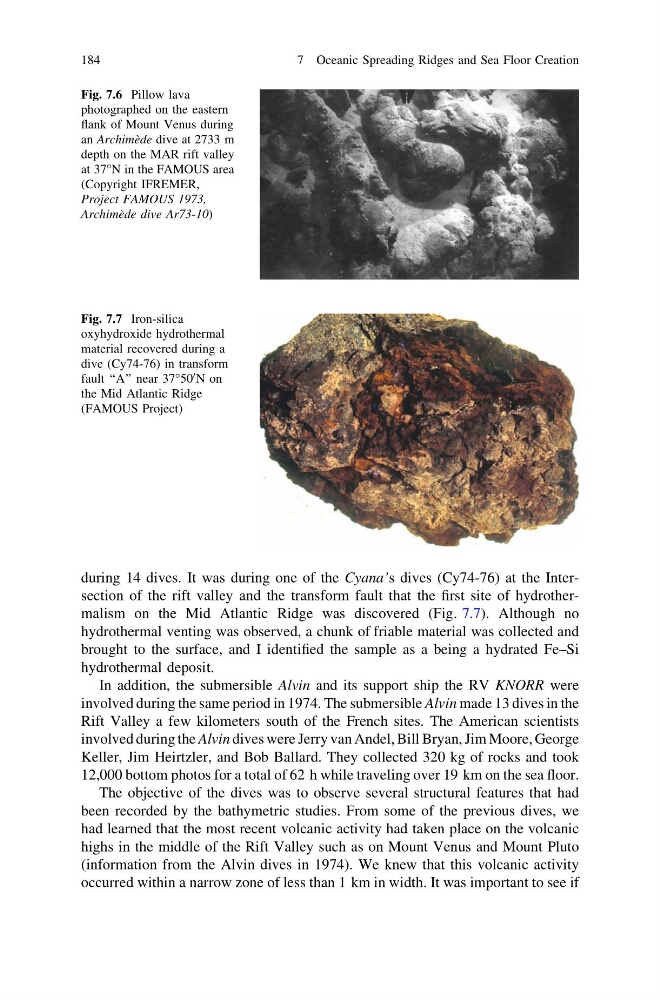
during 14 dives. It was during one of the Cyana’s dives (Cy74-76) at the Intersection of the rift valley and the transform fault that the first site of hydrothermalism on the Mid Atlantic Ridge was discovered (Fig. 7.7). Although no
hydrothermal venting was observed, a chunk of friable material was collected and
brought to the surface, and I identified the sample as a being a hydrated Fe–Si
hydrothermal deposit.
In addition, the submersible Alvin and its support ship the RV KNORR were
involved during the same period in 1974. The submersible Alvin made 13 dives in the
Rift Valley a few kilometers south of the French sites. The American scientists
involved during the Alvin dives were Jerry van Andel, Bill Bryan, Jim Moore, George
Keller, Jim Heirtzler, and Bob Ballard. They collected 320 kg of rocks and took
12,000 bottom photos for a total of 62 h while traveling over 19 km on the sea floor.
The objective of the dives was to observe several structural features that had
been recorded by the bathymetric studies. From some of the previous dives, we
had learned that the most recent volcanic activity had taken place on the volcanic
highs in the middle of the Rift Valley such as on Mount Venus and Mount Pluto
(information from the Alvin dives in 1974). We knew that this volcanic activity
occurred within a narrow zone of less than 1 km in width. It was important to see if
Fig. 7.6 Pillow lava
photographed on the eastern
flank of Mount Venus during
an Archimède dive at 2733 m
depth on the MAR rift valley
at 37°N in the FAMOUS area
(Copyright IFREMER,
Project FAMOUS 1973,
Archimède dive Ar73-10)
Fig. 7.7 Iron-silica
oxyhydroxide hydrothermal
material recovered during a
dive (Cy74-76) in transform
fault ‘‘A’’ near 37°50
0 N on
the Mid Atlantic Ridge
(FAMOUS Project)
184
7 Oceanic Spreading Ridges and Sea Floor Creation
hydrothermal venting was observed, a chunk of friable material was collected and
brought to the surface, and I identified the sample as a being a hydrated Fe–Si
hydrothermal deposit.
In addition, the submersible Alvin and its support ship the RV KNORR were
involved during the same period in 1974. The submersible Alvin made 13 dives in the
Rift Valley a few kilometers south of the French sites. The American scientists
involved during the Alvin dives were Jerry van Andel, Bill Bryan, Jim Moore, George
Keller, Jim Heirtzler, and Bob Ballard. They collected 320 kg of rocks and took
12,000 bottom photos for a total of 62 h while traveling over 19 km on the sea floor.
The objective of the dives was to observe several structural features that had
been recorded by the bathymetric studies. From some of the previous dives, we
had learned that the most recent volcanic activity had taken place on the volcanic
highs in the middle of the Rift Valley such as on Mount Venus and Mount Pluto
(information from the Alvin dives in 1974). We knew that this volcanic activity
occurred within a narrow zone of less than 1 km in width. It was important to see if
Fig. 7.6 Pillow lava
photographed on the eastern
flank of Mount Venus during
an Archimède dive at 2733 m
depth on the MAR rift valley
at 37°N in the FAMOUS area
(Copyright IFREMER,
Project FAMOUS 1973,
Archimède dive Ar73-10)
Fig. 7.7 Iron-silica
oxyhydroxide hydrothermal
material recovered during a
dive (Cy74-76) in transform
fault ‘‘A’’ near 37°50
0 N on
the Mid Atlantic Ridge
(FAMOUS Project)
184
7 Oceanic Spreading Ridges and Sea Floor Creation