

During the Famous diving expedition, the segment of the MAR was explored
by three submersibles: the French bathyscaphe Archimède and the diving saucer
Cyana and the U.S. submersible Alvin. The bathyscaphe Archimède was on the site
in 1973, and the submersibles Alvin and Cyana came to join Archimède in 1974.
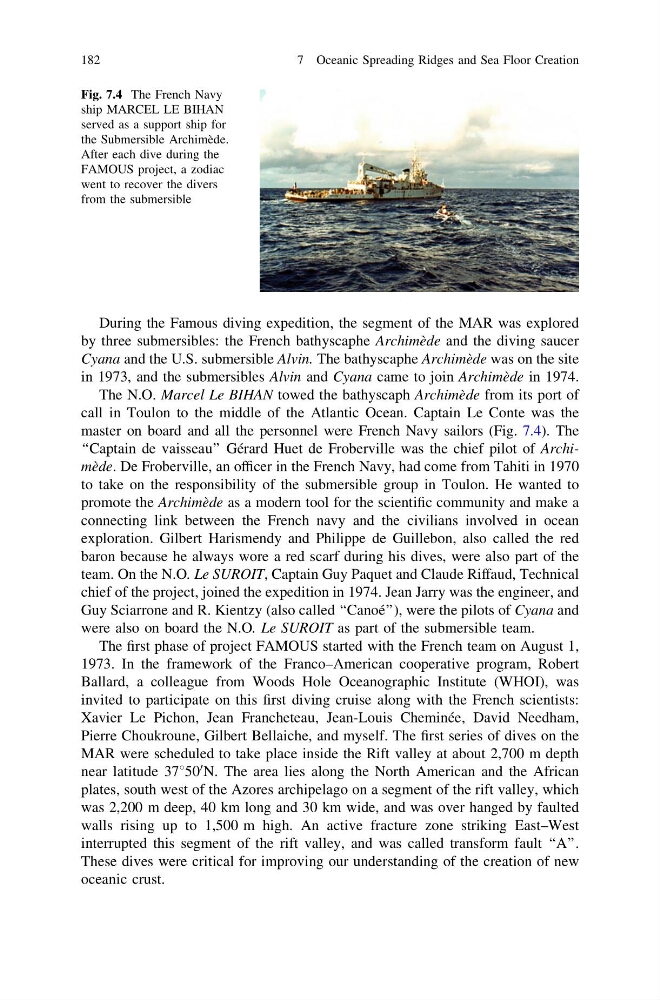
The N.O. Marcel Le BIHAN towed the bathyscaph Archimède from its port of
call in Toulon to the middle of the Atlantic Ocean. Captain Le Conte was the
master on board and all the personnel were French Navy sailors (Fig. 7.4). The
‘‘Captain de vaisseau’’ Gérard Huet de Froberville was the chief pilot of Archimède. De Froberville, an officer in the French Navy, had come from Tahiti in 1970
to take on the responsibility of the submersible group in Toulon. He wanted to
promote the Archimède as a modern tool for the scientific community and make a
connecting link between the French navy and the civilians involved in ocean
exploration. Gilbert Harismendy and Philippe de Guillebon, also called the red
baron because he always wore a red scarf during his dives, were also part of the
team. On the N.O. Le SUROIT, Captain Guy Paquet and Claude Riffaud, Technical
chief of the project, joined the expedition in 1974. Jean Jarry was the engineer, and
Guy Sciarrone and R. Kientzy (also called ‘‘Canoé’’), were the pilots of Cyana and
were also on board the N.O. Le SUROIT as part of the submersible team.
The first phase of project FAMOUS started with the French team on August 1,
1973. In the framework of the Franco–American cooperative program, Robert
Ballard, a colleague from Woods Hole Oceanographic Institute (WHOI), was
invited to participate on this first diving cruise along with the French scientists:
Xavier Le Pichon, Jean Francheteau, Jean-Louis Cheminée, David Needham,
Pierre Choukroune, Gilbert Bellaiche, and myself. The first series of dives on the
MAR were scheduled to take place inside the Rift valley at about 2,700 m depth
near latitude 37850
0 N. The area lies along the North American and the African
plates, south west of the Azores archipelago on a segment of the rift valley, which
was 2,200 m deep, 40 km long and 30 km wide, and was over hanged by faulted
walls rising up to 1,500 m high. An active fracture zone striking East–West
interrupted this segment of the rift valley, and was called transform fault ‘‘A’’.
These dives were critical for improving our understanding of the creation of new
oceanic crust.
Fig. 7.4 The French Navy
ship MARCEL LE BIHAN
served as a support ship for
the Submersible Archimède.
After each dive during the
FAMOUS project, a zodiac
went to recover the divers
from the submersible
182
7 Oceanic Spreading Ridges and Sea Floor Creation
by three submersibles: the French bathyscaphe Archimède and the diving saucer
Cyana and the U.S. submersible Alvin. The bathyscaphe Archimède was on the site
in 1973, and the submersibles Alvin and Cyana came to join Archimède in 1974.
The N.O. Marcel Le BIHAN towed the bathyscaph Archimède from its port of
call in Toulon to the middle of the Atlantic Ocean. Captain Le Conte was the
master on board and all the personnel were French Navy sailors (Fig. 7.4). The
‘‘Captain de vaisseau’’ Gérard Huet de Froberville was the chief pilot of Archimède. De Froberville, an officer in the French Navy, had come from Tahiti in 1970
to take on the responsibility of the submersible group in Toulon. He wanted to
promote the Archimède as a modern tool for the scientific community and make a
connecting link between the French navy and the civilians involved in ocean
exploration. Gilbert Harismendy and Philippe de Guillebon, also called the red
baron because he always wore a red scarf during his dives, were also part of the
team. On the N.O. Le SUROIT, Captain Guy Paquet and Claude Riffaud, Technical
chief of the project, joined the expedition in 1974. Jean Jarry was the engineer, and
Guy Sciarrone and R. Kientzy (also called ‘‘Canoé’’), were the pilots of Cyana and
were also on board the N.O. Le SUROIT as part of the submersible team.
The first phase of project FAMOUS started with the French team on August 1,
1973. In the framework of the Franco–American cooperative program, Robert
Ballard, a colleague from Woods Hole Oceanographic Institute (WHOI), was
invited to participate on this first diving cruise along with the French scientists:
Xavier Le Pichon, Jean Francheteau, Jean-Louis Cheminée, David Needham,
Pierre Choukroune, Gilbert Bellaiche, and myself. The first series of dives on the
MAR were scheduled to take place inside the Rift valley at about 2,700 m depth
near latitude 37850
0 N. The area lies along the North American and the African
plates, south west of the Azores archipelago on a segment of the rift valley, which
was 2,200 m deep, 40 km long and 30 km wide, and was over hanged by faulted
walls rising up to 1,500 m high. An active fracture zone striking East–West
interrupted this segment of the rift valley, and was called transform fault ‘‘A’’.
These dives were critical for improving our understanding of the creation of new
oceanic crust.
Fig. 7.4 The French Navy
ship MARCEL LE BIHAN
served as a support ship for
the Submersible Archimède.
After each dive during the
FAMOUS project, a zodiac
went to recover the divers
from the submersible
182
7 Oceanic Spreading Ridges and Sea Floor Creation