

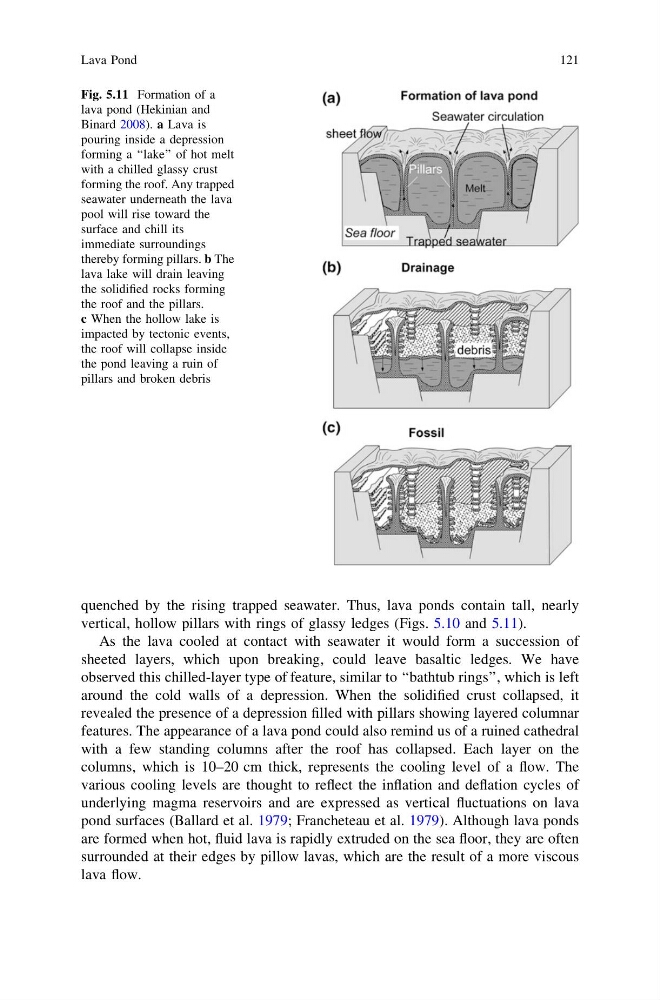
quenched by the rising trapped seawater. Thus, lava ponds contain tall, nearly
vertical, hollow pillars with rings of glassy ledges (Figs. 5.10 and 5.11).
As the lava cooled at contact with seawater it would form a succession of
sheeted layers, which upon breaking, could leave basaltic ledges. We have
observed this chilled-layer type of feature, similar to ‘‘bathtub rings’’, which is left
around the cold walls of a depression. When the solidified crust collapsed, it
revealed the presence of a depression filled with pillars showing layered columnar
features. The appearance of a lava pond could also remind us of a ruined cathedral
with a few standing columns after the roof has collapsed. Each layer on the
columns, which is 10–20 cm thick, represents the cooling level of a flow. The
various cooling levels are thought to reflect the inflation and deflation cycles of
underlying magma reservoirs and are expressed as vertical fluctuations on lava
pond surfaces (Ballard et al. 1979; Francheteau et al. 1979). Although lava ponds
are formed when hot, fluid lava is rapidly extruded on the sea floor, they are often
surrounded at their edges by pillow lavas, which are the result of a more viscous
lava flow.
Fig. 5.11 Formation of a
lava pond (Hekinian and
Binard 2008). a Lava is
pouring inside a depression
forming a ‘‘lake’’ of hot melt
with a chilled glassy crust
forming the roof. Any trapped
seawater underneath the lava
pool will rise toward the
surface and chill its
immediate surroundings
thereby forming pillars. b The
lava lake will drain leaving
the solidified rocks forming
the roof and the pillars.
c When the hollow lake is
impacted by tectonic events,
the roof will collapse inside
the pond leaving a ruin of
pillars and broken debris
Lava Pond
121
vertical, hollow pillars with rings of glassy ledges (Figs. 5.10 and 5.11).
As the lava cooled at contact with seawater it would form a succession of
sheeted layers, which upon breaking, could leave basaltic ledges. We have
observed this chilled-layer type of feature, similar to ‘‘bathtub rings’’, which is left
around the cold walls of a depression. When the solidified crust collapsed, it
revealed the presence of a depression filled with pillars showing layered columnar
features. The appearance of a lava pond could also remind us of a ruined cathedral
with a few standing columns after the roof has collapsed. Each layer on the
columns, which is 10–20 cm thick, represents the cooling level of a flow. The
various cooling levels are thought to reflect the inflation and deflation cycles of
underlying magma reservoirs and are expressed as vertical fluctuations on lava
pond surfaces (Ballard et al. 1979; Francheteau et al. 1979). Although lava ponds
are formed when hot, fluid lava is rapidly extruded on the sea floor, they are often
surrounded at their edges by pillow lavas, which are the result of a more viscous
lava flow.
Fig. 5.11 Formation of a
lava pond (Hekinian and
Binard 2008). a Lava is
pouring inside a depression
forming a ‘‘lake’’ of hot melt
with a chilled glassy crust
forming the roof. Any trapped
seawater underneath the lava
pool will rise toward the
surface and chill its
immediate surroundings
thereby forming pillars. b The
lava lake will drain leaving
the solidified rocks forming
the roof and the pillars.
c When the hollow lake is
impacted by tectonic events,
the roof will collapse inside
the pond leaving a ruin of
pillars and broken debris
Lava Pond
121