

Volcanic Eruption and Distribution
More than 80 % of Earth’s volcanic activity takes place on the sea floor. The
number of active volcanoes in sub-aerial regions is limited to less than 1,500 active
sites when compared to the more than hundreds of thousands of volcanoes existing
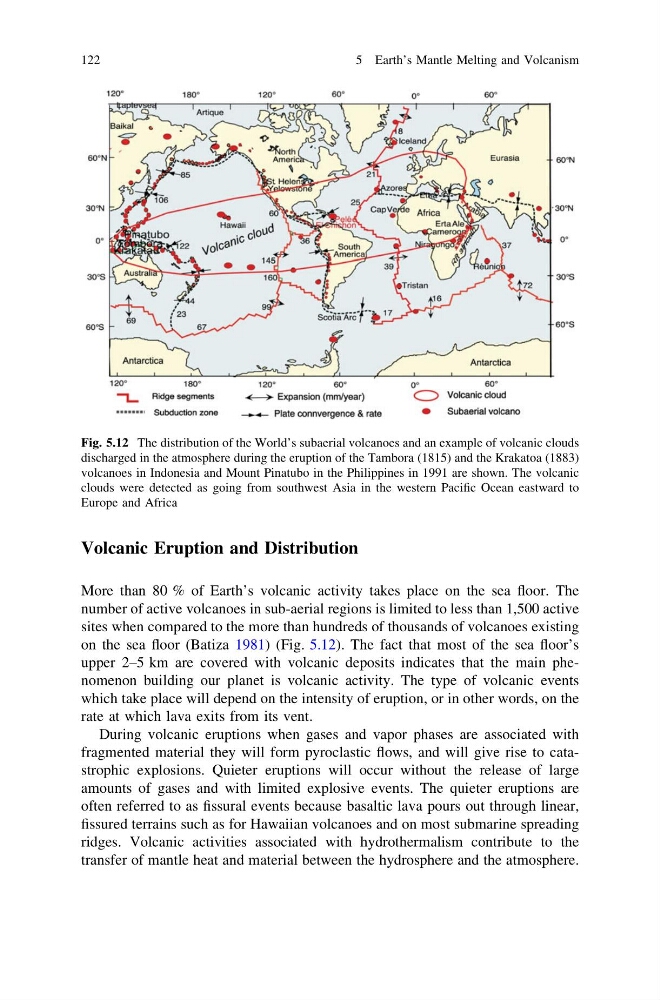
on the sea floor (Batiza 1981) (Fig. 5.12). The fact that most of the sea floor’s
upper 2–5 km are covered with volcanic deposits indicates that the main phenomenon building our planet is volcanic activity. The type of volcanic events
which take place will depend on the intensity of eruption, or in other words, on the
rate at which lava exits from its vent.
During volcanic eruptions when gases and vapor phases are associated with
fragmented material they will form pyroclastic flows, and will give rise to catastrophic explosions. Quieter eruptions will occur without the release of large
amounts of gases and with limited explosive events. The quieter eruptions are
often referred to as fissural events because basaltic lava pours out through linear,
fissured terrains such as for Hawaiian volcanoes and on most submarine spreading
ridges. Volcanic activities associated with hydrothermalism contribute to the
transfer of mantle heat and material between the hydrosphere and the atmosphere.
Fig. 5.12 The distribution of the World’s subaerial volcanoes and an example of volcanic clouds
discharged in the atmosphere during the eruption of the Tambora (1815) and the Krakatoa (1883)
volcanoes in Indonesia and Mount Pinatubo in the Philippines in 1991 are shown. The volcanic
clouds were detected as going from southwest Asia in the western Pacific Ocean eastward to
Europe and Africa
122
5 Earth’s Mantle Melting and Volcanism
More than 80 % of Earth’s volcanic activity takes place on the sea floor. The
number of active volcanoes in sub-aerial regions is limited to less than 1,500 active
sites when compared to the more than hundreds of thousands of volcanoes existing
on the sea floor (Batiza 1981) (Fig. 5.12). The fact that most of the sea floor’s
upper 2–5 km are covered with volcanic deposits indicates that the main phenomenon building our planet is volcanic activity. The type of volcanic events
which take place will depend on the intensity of eruption, or in other words, on the
rate at which lava exits from its vent.
During volcanic eruptions when gases and vapor phases are associated with
fragmented material they will form pyroclastic flows, and will give rise to catastrophic explosions. Quieter eruptions will occur without the release of large
amounts of gases and with limited explosive events. The quieter eruptions are
often referred to as fissural events because basaltic lava pours out through linear,
fissured terrains such as for Hawaiian volcanoes and on most submarine spreading
ridges. Volcanic activities associated with hydrothermalism contribute to the
transfer of mantle heat and material between the hydrosphere and the atmosphere.
Fig. 5.12 The distribution of the World’s subaerial volcanoes and an example of volcanic clouds
discharged in the atmosphere during the eruption of the Tambora (1815) and the Krakatoa (1883)
volcanoes in Indonesia and Mount Pinatubo in the Philippines in 1991 are shown. The volcanic
clouds were detected as going from southwest Asia in the western Pacific Ocean eastward to
Europe and Africa
122
5 Earth’s Mantle Melting and Volcanism