

Lava Pond
A specific type of volcanic feature called a lava pond or a lava-lake is the result of
an extensive extrusion of very fluid lava that flows within a confined depression or
graben-like structure. R. Ballard on the Galapagos spreading center in 1977
observed the first ‘‘lava ponds’’ or ‘‘lava lakes’’. However, it was on the EPR axis
near 21°N during the Cyamex cruise conducted by Jean Francheteau in 1978
(Francheteau et al. 1979) that the first comprehensive description of these structures was made. Later that year, Jean Francheteau and Pierre Choukroune sat up
overnight in a hotel room in Nicosia, Cyprus, in order to write a paper describing
how these lava ponds could have been formed and their report was published in
1979.
It appears that lava ponds are the result of collapsed, elongated lava conduits,
about 10–200 m wide and up to 200–300 m in length, which are parallel to the
ridge axis and form en-echelon arrangements. They were built by a very fast
extrusion of hot lava which poured into a depression or fissure formed during
crustal extension. These lakes are the collapsed features of submarine flows after
magmatic drainage and subsidence took place when lateral spreading out-paced
the rate of magma effusion. Lava ponds are usually bounded by normal faults and
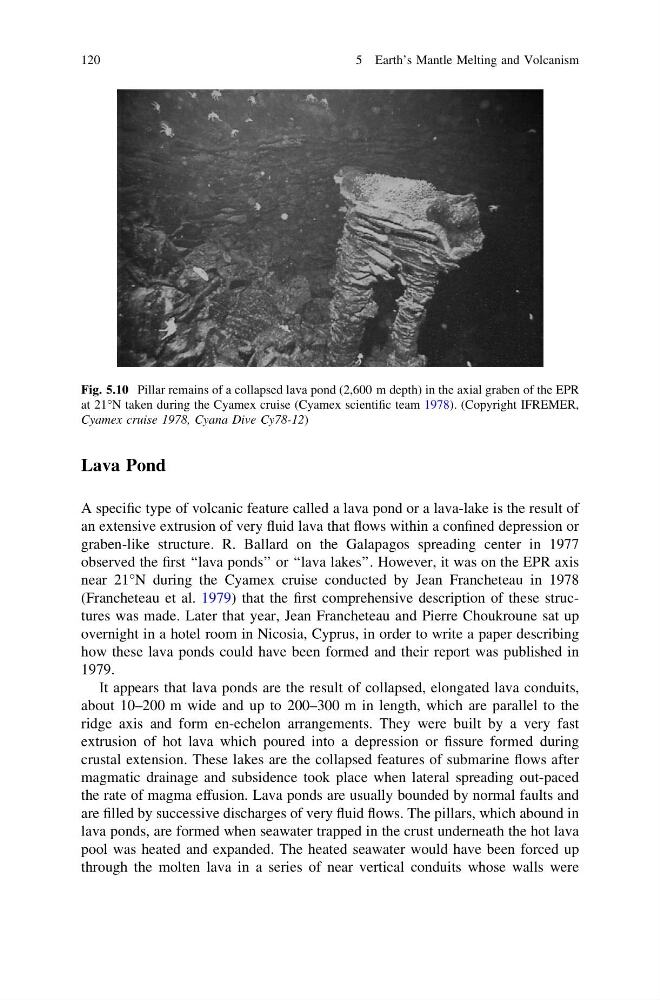
are filled by successive discharges of very fluid flows. The pillars, which abound in
lava ponds, are formed when seawater trapped in the crust underneath the hot lava
pool was heated and expanded. The heated seawater would have been forced up
through the molten lava in a series of near vertical conduits whose walls were
Fig. 5.10 Pillar remains of a collapsed lava pond (2,600 m depth) in the axial graben of the EPR
at 21°N taken during the Cyamex cruise (Cyamex scientific team 1978). (Copyright IFREMER,
Cyamex cruise 1978, Cyana Dive Cy78-12)
120
5 Earth’s Mantle Melting and Volcanism
A specific type of volcanic feature called a lava pond or a lava-lake is the result of
an extensive extrusion of very fluid lava that flows within a confined depression or
graben-like structure. R. Ballard on the Galapagos spreading center in 1977
observed the first ‘‘lava ponds’’ or ‘‘lava lakes’’. However, it was on the EPR axis
near 21°N during the Cyamex cruise conducted by Jean Francheteau in 1978
(Francheteau et al. 1979) that the first comprehensive description of these structures was made. Later that year, Jean Francheteau and Pierre Choukroune sat up
overnight in a hotel room in Nicosia, Cyprus, in order to write a paper describing
how these lava ponds could have been formed and their report was published in
1979.
It appears that lava ponds are the result of collapsed, elongated lava conduits,
about 10–200 m wide and up to 200–300 m in length, which are parallel to the
ridge axis and form en-echelon arrangements. They were built by a very fast
extrusion of hot lava which poured into a depression or fissure formed during
crustal extension. These lakes are the collapsed features of submarine flows after
magmatic drainage and subsidence took place when lateral spreading out-paced
the rate of magma effusion. Lava ponds are usually bounded by normal faults and
are filled by successive discharges of very fluid flows. The pillars, which abound in
lava ponds, are formed when seawater trapped in the crust underneath the hot lava
pool was heated and expanded. The heated seawater would have been forced up
through the molten lava in a series of near vertical conduits whose walls were
Fig. 5.10 Pillar remains of a collapsed lava pond (2,600 m depth) in the axial graben of the EPR
at 21°N taken during the Cyamex cruise (Cyamex scientific team 1978). (Copyright IFREMER,
Cyamex cruise 1978, Cyana Dive Cy78-12)
120
5 Earth’s Mantle Melting and Volcanism