

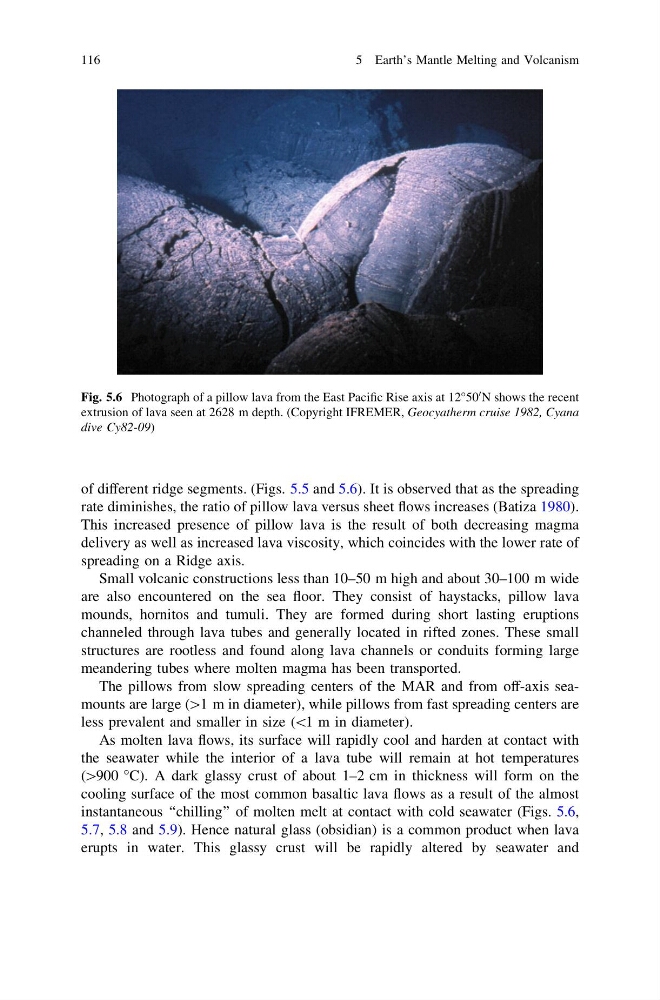
of different ridge segments. (Figs. 5.5 and 5.6). It is observed that as the spreading
rate diminishes, the ratio of pillow lava versus sheet flows increases (Batiza 1980).
This increased presence of pillow lava is the result of both decreasing magma
delivery as well as increased lava viscosity, which coincides with the lower rate of
spreading on a Ridge axis.
Small volcanic constructions less than 10–50 m high and about 30–100 m wide
are also encountered on the sea floor. They consist of haystacks, pillow lava
mounds, hornitos and tumuli. They are formed during short lasting eruptions
channeled through lava tubes and generally located in rifted zones. These small
structures are rootless and found along lava channels or conduits forming large
meandering tubes where molten magma has been transported.
The pillows from slow spreading centers of the MAR and from off-axis seamounts are large ([1 m in diameter), while pillows from fast spreading centers are
less prevalent and smaller in size (\1 m in diameter).
As molten lava flows, its surface will rapidly cool and harden at contact with
the seawater while the interior of a lava tube will remain at hot temperatures
([900 °C). A dark glassy crust of about 1–2 cm in thickness will form on the
cooling surface of the most common basaltic lava flows as a result of the almost
instantaneous ‘‘chilling’’ of molten melt at contact with cold seawater (Figs. 5.6,
5.7, 5.8 and 5.9). Hence natural glass (obsidian) is a common product when lava
erupts in water. This glassy crust will be rapidly altered by seawater and
Fig. 5.6 Photograph of a pillow lava from the East Pacific Rise axis at 12°50
0 N shows the recent
extrusion of lava seen at 2628 m depth. (Copyright IFREMER, Geocyatherm cruise 1982, Cyana
dive Cy82-09)
116
5 Earth’s Mantle Melting and Volcanism
rate diminishes, the ratio of pillow lava versus sheet flows increases (Batiza 1980).
This increased presence of pillow lava is the result of both decreasing magma
delivery as well as increased lava viscosity, which coincides with the lower rate of
spreading on a Ridge axis.
Small volcanic constructions less than 10–50 m high and about 30–100 m wide
are also encountered on the sea floor. They consist of haystacks, pillow lava
mounds, hornitos and tumuli. They are formed during short lasting eruptions
channeled through lava tubes and generally located in rifted zones. These small
structures are rootless and found along lava channels or conduits forming large
meandering tubes where molten magma has been transported.
The pillows from slow spreading centers of the MAR and from off-axis seamounts are large ([1 m in diameter), while pillows from fast spreading centers are
less prevalent and smaller in size (\1 m in diameter).
As molten lava flows, its surface will rapidly cool and harden at contact with
the seawater while the interior of a lava tube will remain at hot temperatures
([900 °C). A dark glassy crust of about 1–2 cm in thickness will form on the
cooling surface of the most common basaltic lava flows as a result of the almost
instantaneous ‘‘chilling’’ of molten melt at contact with cold seawater (Figs. 5.6,
5.7, 5.8 and 5.9). Hence natural glass (obsidian) is a common product when lava
erupts in water. This glassy crust will be rapidly altered by seawater and
Fig. 5.6 Photograph of a pillow lava from the East Pacific Rise axis at 12°50
0 N shows the recent
extrusion of lava seen at 2628 m depth. (Copyright IFREMER, Geocyatherm cruise 1982, Cyana
dive Cy82-09)
116
5 Earth’s Mantle Melting and Volcanism