

transformed into a hydrated clay-like material called palagonite (Nayudu 1962).
After drainage of the lava flow, when molten material is no longer being fed into a
lava tube, if the roof of these channels collapses they will form cavities, which
could vary in size from a few centimeters to several meters (up to 3–4 m) in
diameter.
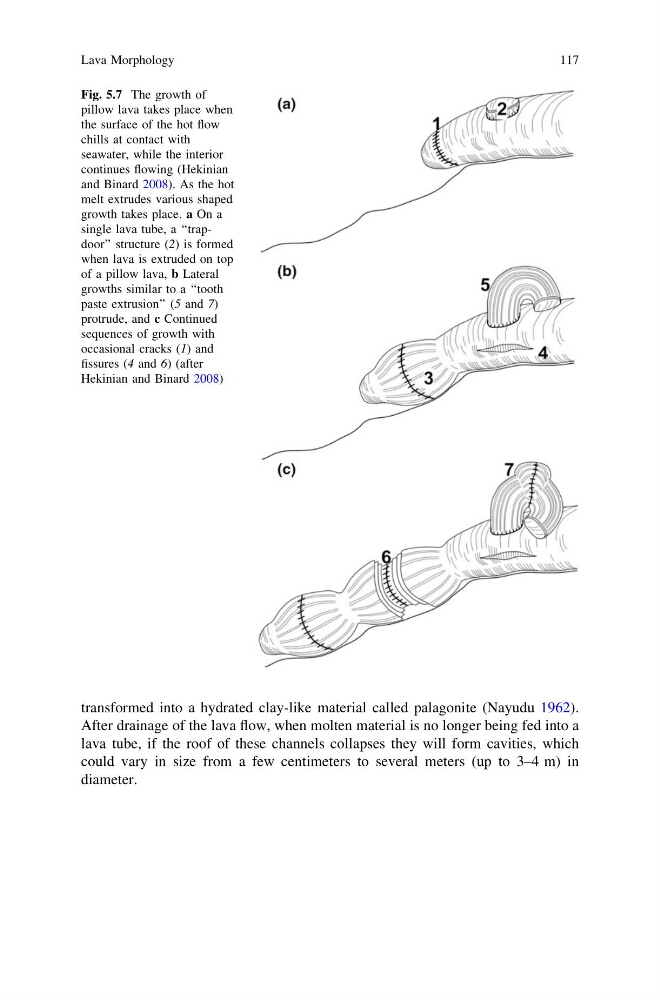
Fig. 5.7 The growth of
pillow lava takes place when
the surface of the hot flow
chills at contact with
seawater, while the interior
continues flowing (Hekinian
and Binard 2008). As the hot
melt extrudes various shaped
growth takes place. a On a
single lava tube, a ‘‘trapdoor’’ structure (2) is formed
when lava is extruded on top
of a pillow lava, b Lateral
growths similar to a ‘‘tooth
paste extrusion’’ (5 and 7)
protrude, and c Continued
sequences of growth with
occasional cracks (1) and
fissures (4 and 6) (after
Hekinian and Binard 2008)
Lava Morphology
117
After drainage of the lava flow, when molten material is no longer being fed into a
lava tube, if the roof of these channels collapses they will form cavities, which
could vary in size from a few centimeters to several meters (up to 3–4 m) in
diameter.
Fig. 5.7 The growth of
pillow lava takes place when
the surface of the hot flow
chills at contact with
seawater, while the interior
continues flowing (Hekinian
and Binard 2008). As the hot
melt extrudes various shaped
growth takes place. a On a
single lava tube, a ‘‘trapdoor’’ structure (2) is formed
when lava is extruded on top
of a pillow lava, b Lateral
growths similar to a ‘‘tooth
paste extrusion’’ (5 and 7)
protrude, and c Continued
sequences of growth with
occasional cracks (1) and
fissures (4 and 6) (after
Hekinian and Binard 2008)
Lava Morphology
117