

The lava flows pouring out on the ocean floor will solidify in a variety of
shapes, which, in addition to the physical parameters involved such as viscosity,
rate of extrusion and cooling, will also depend on the morphology of the landscape
where they are released. The advancing front of a lava flow is discontinuous. When
lava is extruded on the sea floor a thin surface of the flow (only a few mm thick) is
rapidly quenched and will form a solid glassy crust of obsidian that serves to
insulate the hot interior of flowing lava. Frequently, the fragile, chilled glassy crust
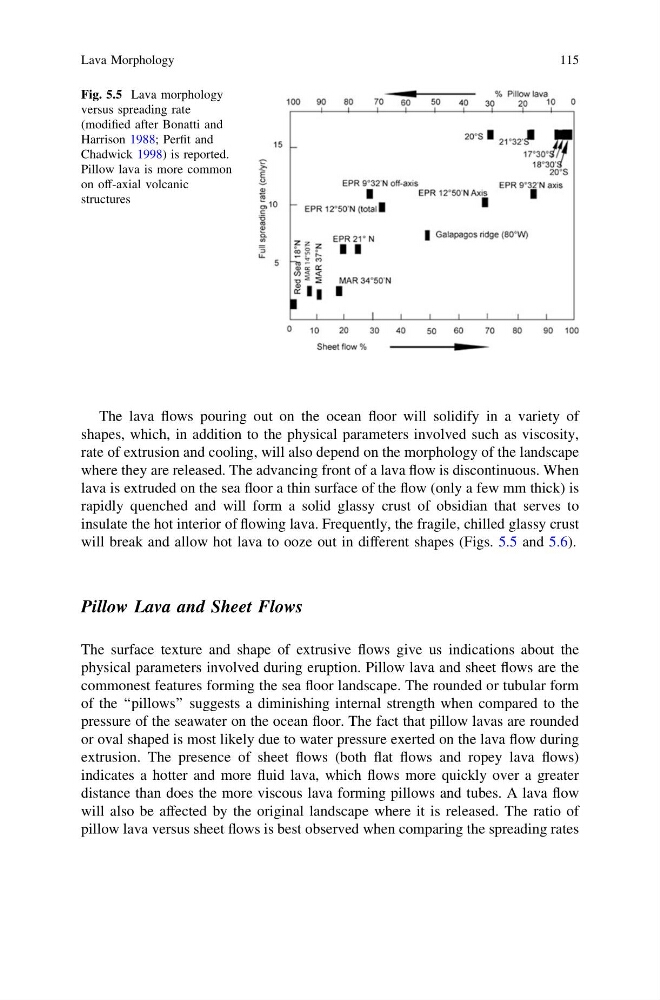
will break and allow hot lava to ooze out in different shapes (Figs. 5.5 and 5.6).
Pillow Lava and Sheet Flows
The surface texture and shape of extrusive flows give us indications about the
physical parameters involved during eruption. Pillow lava and sheet flows are the
commonest features forming the sea floor landscape. The rounded or tubular form
of the ‘‘pillows’’ suggests a diminishing internal strength when compared to the
pressure of the seawater on the ocean floor. The fact that pillow lavas are rounded
or oval shaped is most likely due to water pressure exerted on the lava flow during
extrusion. The presence of sheet flows (both flat flows and ropey lava flows)
indicates a hotter and more fluid lava, which flows more quickly over a greater
distance than does the more viscous lava forming pillows and tubes. A lava flow
will also be affected by the original landscape where it is released. The ratio of
pillow lava versus sheet flows is best observed when comparing the spreading rates
Fig. 5.5 Lava morphology
versus spreading rate
(modified after Bonatti and
Harrison 1988; Perfit and
Chadwick 1998) is reported.
Pillow lava is more common
on off-axial volcanic
structures
Lava Morphology
115
shapes, which, in addition to the physical parameters involved such as viscosity,
rate of extrusion and cooling, will also depend on the morphology of the landscape
where they are released. The advancing front of a lava flow is discontinuous. When
lava is extruded on the sea floor a thin surface of the flow (only a few mm thick) is
rapidly quenched and will form a solid glassy crust of obsidian that serves to
insulate the hot interior of flowing lava. Frequently, the fragile, chilled glassy crust
will break and allow hot lava to ooze out in different shapes (Figs. 5.5 and 5.6).
Pillow Lava and Sheet Flows
The surface texture and shape of extrusive flows give us indications about the
physical parameters involved during eruption. Pillow lava and sheet flows are the
commonest features forming the sea floor landscape. The rounded or tubular form
of the ‘‘pillows’’ suggests a diminishing internal strength when compared to the
pressure of the seawater on the ocean floor. The fact that pillow lavas are rounded
or oval shaped is most likely due to water pressure exerted on the lava flow during
extrusion. The presence of sheet flows (both flat flows and ropey lava flows)
indicates a hotter and more fluid lava, which flows more quickly over a greater
distance than does the more viscous lava forming pillows and tubes. A lava flow
will also be affected by the original landscape where it is released. The ratio of
pillow lava versus sheet flows is best observed when comparing the spreading rates
Fig. 5.5 Lava morphology
versus spreading rate
(modified after Bonatti and
Harrison 1988; Perfit and
Chadwick 1998) is reported.
Pillow lava is more common
on off-axial volcanic
structures
Lava Morphology
115