

82
R. Romeiser et al.
the equatorial currents and counter currents are predicted and measured at the same
latitudes, while the range of SAR-derived radial currents agrees with the surface
current predictions and the independent measurements.
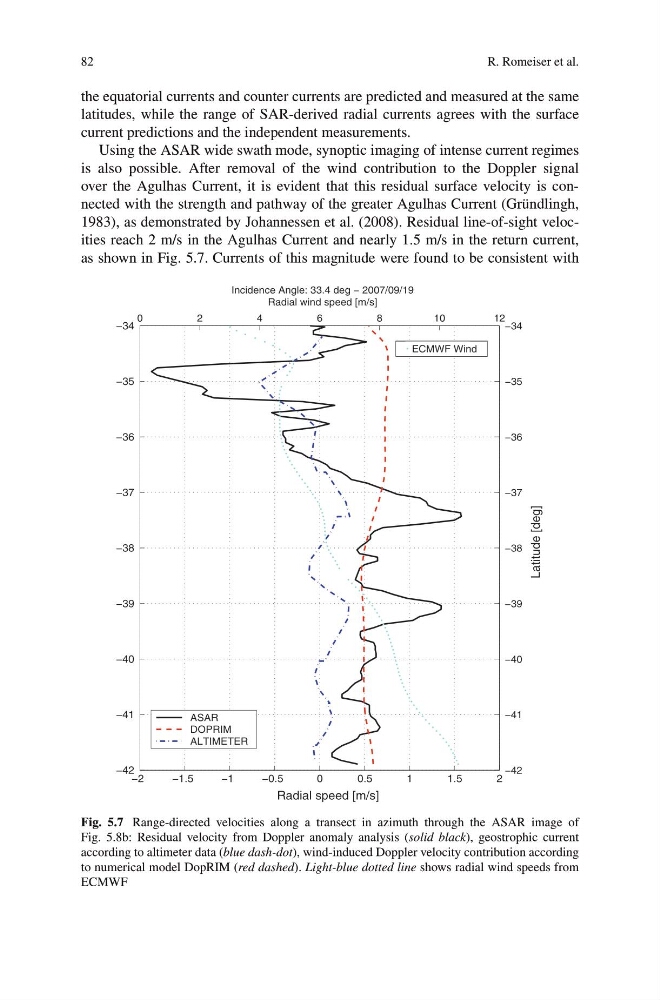
Using the ASAR wide swath mode, synoptic imaging of intense current regimes
is also possible. After removal of the wind contribution to the Doppler signal
over the Agulhas Current, it is evident that this residual surface velocity is connected with the strength and pathway of the greater Agulhas Current (Gründlingh,
1983), as demonstrated by Johannessen et al. (2008). Residual line-of-sight velocities reach 2 m/s in the Agulhas Current and nearly 1.5 m/s in the return current,
as shown in Fig. 5.7. Currents of this magnitude were found to be consistent with
−2
−1.5
−1
−0.5
0
0.5
1
1.5
2
−42
−41
−40
−39
−38
−37
−36
−35
−34
Radial speed [m/s]
0
2
4
6
8
10
12
−42
−41
−40
−39
−38
−37
−36
−35
−34
Latitude [deg]
Incidence Angle: 33.4 deg − 2007/09/19
Radial wind speed [m/s]
ECMWF Wind
ASAR
DOPRIM
ALTIMETER
Fig. 5.7 Range-directed velocities along a transect in azimuth through the ASAR image of
Fig. 5.8b: Residual velocity from Doppler anomaly analysis (solid black), geostrophic current
according to altimeter data (blue dash-dot), wind-induced Doppler velocity contribution according
to numerical model DopRIM (red dashed). Light-blue dotted line shows radial wind speeds from
ECMWF
R. Romeiser et al.
the equatorial currents and counter currents are predicted and measured at the same
latitudes, while the range of SAR-derived radial currents agrees with the surface
current predictions and the independent measurements.
Using the ASAR wide swath mode, synoptic imaging of intense current regimes
is also possible. After removal of the wind contribution to the Doppler signal
over the Agulhas Current, it is evident that this residual surface velocity is connected with the strength and pathway of the greater Agulhas Current (Gründlingh,
1983), as demonstrated by Johannessen et al. (2008). Residual line-of-sight velocities reach 2 m/s in the Agulhas Current and nearly 1.5 m/s in the return current,
as shown in Fig. 5.7. Currents of this magnitude were found to be consistent with
−2
−1.5
−1
−0.5
0
0.5
1
1.5
2
−42
−41
−40
−39
−38
−37
−36
−35
−34
Radial speed [m/s]
0
2
4
6
8
10
12
−42
−41
−40
−39
−38
−37
−36
−35
−34
Latitude [deg]
Incidence Angle: 33.4 deg − 2007/09/19
Radial wind speed [m/s]
ECMWF Wind
ASAR
DOPRIM
ALTIMETER
Fig. 5.7 Range-directed velocities along a transect in azimuth through the ASAR image of
Fig. 5.8b: Residual velocity from Doppler anomaly analysis (solid black), geostrophic current
according to altimeter data (blue dash-dot), wind-induced Doppler velocity contribution according
to numerical model DopRIM (red dashed). Light-blue dotted line shows radial wind speeds from
ECMWF