

5 Direct Surface Current Field Imaging from Space
81
output is the wind-dependent contribution to Doppler velocities. Later, using the
Doppler grid now available for each Wide Swath product, the CDOP model was
extended to incidence angles from 17 ◦ to 42 ◦ (Collard et al., 2008).
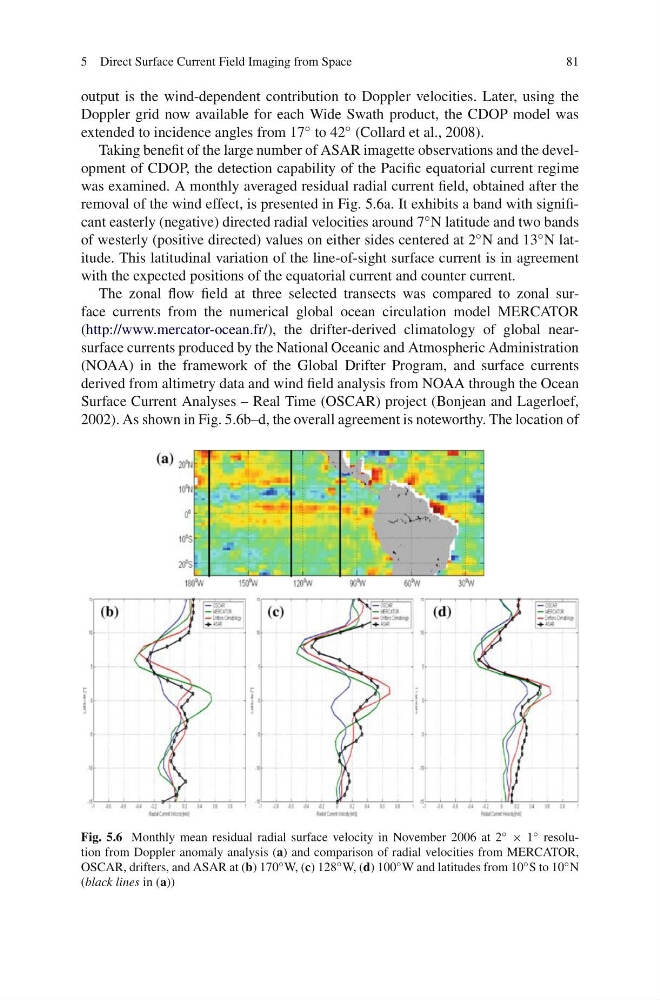
Taking benefit of the large number of ASAR imagette observations and the development of CDOP, the detection capability of the Pacific equatorial current regime
was examined. A monthly averaged residual radial current field, obtained after the
removal of the wind effect, is presented in Fig. 5.6a. It exhibits a band with significant easterly (negative) directed radial velocities around 7 ◦ N latitude and two bands
of westerly (positive directed) values on either sides centered at 2 ◦ N and 13 ◦ N latitude. This latitudinal variation of the line-of-sight surface current is in agreement
with the expected positions of the equatorial current and counter current.
The zonal flow field at three selected transects was compared to zonal surface currents from the numerical global ocean circulation model MERCATOR
(http://www.mercator-ocean.fr/), the drifter-derived climatology of global nearsurface currents produced by the National Oceanic and Atmospheric Administration
(NOAA) in the framework of the Global Drifter Program, and surface currents
derived from altimetry data and wind field analysis from NOAA through the Ocean
Surface Current Analyses – Real Time (OSCAR) project (Bonjean and Lagerloef,
2002). As shown in Fig. 5.6b–d, the overall agreement is noteworthy. The location of
Fig. 5.6 Monthly mean residual radial surface velocity in November 2006 at 2 ◦ × 1 ◦ resolution from Doppler anomaly analysis (a) and comparison of radial velocities from MERCATOR,
OSCAR, drifters, and ASAR at (b) 170 ◦ W, (c) 128 ◦ W, (d) 100 ◦ W and latitudes from 10 ◦ S to 10 ◦ N
(black lines in (a))
81
output is the wind-dependent contribution to Doppler velocities. Later, using the
Doppler grid now available for each Wide Swath product, the CDOP model was
extended to incidence angles from 17 ◦ to 42 ◦ (Collard et al., 2008).
Taking benefit of the large number of ASAR imagette observations and the development of CDOP, the detection capability of the Pacific equatorial current regime
was examined. A monthly averaged residual radial current field, obtained after the
removal of the wind effect, is presented in Fig. 5.6a. It exhibits a band with significant easterly (negative) directed radial velocities around 7 ◦ N latitude and two bands
of westerly (positive directed) values on either sides centered at 2 ◦ N and 13 ◦ N latitude. This latitudinal variation of the line-of-sight surface current is in agreement
with the expected positions of the equatorial current and counter current.
The zonal flow field at three selected transects was compared to zonal surface currents from the numerical global ocean circulation model MERCATOR
(http://www.mercator-ocean.fr/), the drifter-derived climatology of global nearsurface currents produced by the National Oceanic and Atmospheric Administration
(NOAA) in the framework of the Global Drifter Program, and surface currents
derived from altimetry data and wind field analysis from NOAA through the Ocean
Surface Current Analyses – Real Time (OSCAR) project (Bonjean and Lagerloef,
2002). As shown in Fig. 5.6b–d, the overall agreement is noteworthy. The location of
Fig. 5.6 Monthly mean residual radial surface velocity in November 2006 at 2 ◦ × 1 ◦ resolution from Doppler anomaly analysis (a) and comparison of radial velocities from MERCATOR,
OSCAR, drifters, and ASAR at (b) 170 ◦ W, (c) 128 ◦ W, (d) 100 ◦ W and latitudes from 10 ◦ S to 10 ◦ N
(black lines in (a))