

5 Direct Surface Current Field Imaging from Space
83
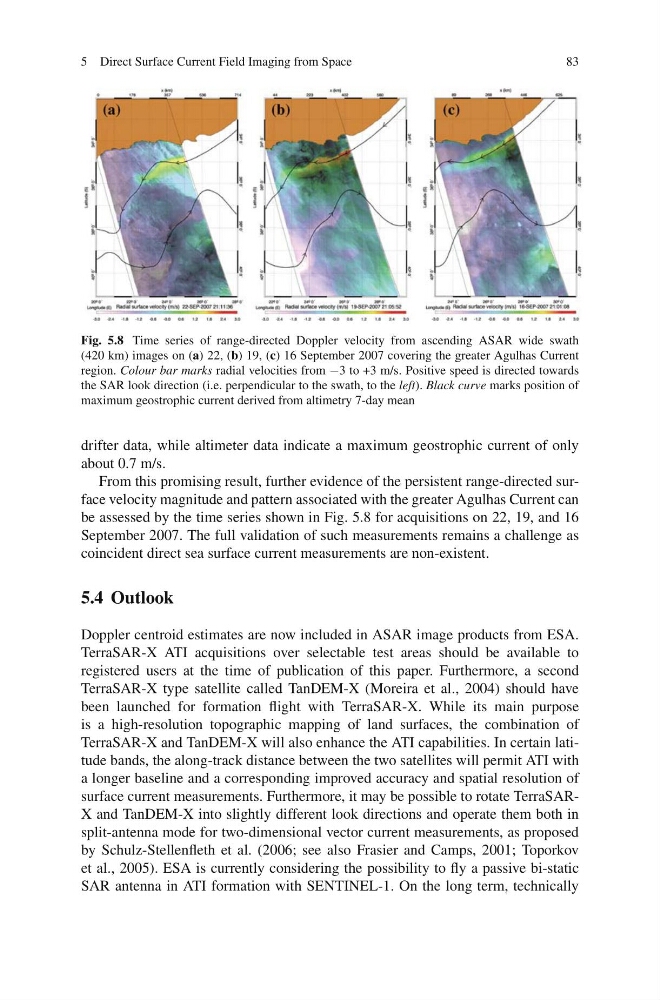
Fig. 5.8 Time series of range-directed Doppler velocity from ascending ASAR wide swath
(420 km) images on (a) 22, (b) 19, (c) 16 September 2007 covering the greater Agulhas Current
region. Colour bar marks radial velocities from −3 to +3 m/s. Positive speed is directed towards
the SAR look direction (i.e. perpendicular to the swath, to the left). Black curve marks position of
maximum geostrophic current derived from altimetry 7-day mean
drifter data, while altimeter data indicate a maximum geostrophic current of only
about 0.7 m/s.
From this promising result, further evidence of the persistent range-directed surface velocity magnitude and pattern associated with the greater Agulhas Current can
be assessed by the time series shown in Fig. 5.8 for acquisitions on 22, 19, and 16
September 2007. The full validation of such measurements remains a challenge as
coincident direct sea surface current measurements are non-existent.
5.4 Outlook
Doppler centroid estimates are now included in ASAR image products from ESA.
TerraSAR-X ATI acquisitions over selectable test areas should be available to
registered users at the time of publication of this paper. Furthermore, a second
TerraSAR-X type satellite called TanDEM-X (Moreira et al., 2004) should have
been launched for formation flight with TerraSAR-X. While its main purpose
is a high-resolution topographic mapping of land surfaces, the combination of
TerraSAR-X and TanDEM-X will also enhance the ATI capabilities. In certain latitude bands, the along-track distance between the two satellites will permit ATI with
a longer baseline and a corresponding improved accuracy and spatial resolution of
surface current measurements. Furthermore, it may be possible to rotate TerraSARX and TanDEM-X into slightly different look directions and operate them both in
split-antenna mode for two-dimensional vector current measurements, as proposed
by Schulz-Stellenfleth et al. (2006; see also Frasier and Camps, 2001; Toporkov
et al., 2005). ESA is currently considering the possibility to fly a passive bi-static
SAR antenna in ATI formation with SENTINEL-1. On the long term, technically
83
Fig. 5.8 Time series of range-directed Doppler velocity from ascending ASAR wide swath
(420 km) images on (a) 22, (b) 19, (c) 16 September 2007 covering the greater Agulhas Current
region. Colour bar marks radial velocities from −3 to +3 m/s. Positive speed is directed towards
the SAR look direction (i.e. perpendicular to the swath, to the left). Black curve marks position of
maximum geostrophic current derived from altimetry 7-day mean
drifter data, while altimeter data indicate a maximum geostrophic current of only
about 0.7 m/s.
From this promising result, further evidence of the persistent range-directed surface velocity magnitude and pattern associated with the greater Agulhas Current can
be assessed by the time series shown in Fig. 5.8 for acquisitions on 22, 19, and 16
September 2007. The full validation of such measurements remains a challenge as
coincident direct sea surface current measurements are non-existent.
5.4 Outlook
Doppler centroid estimates are now included in ASAR image products from ESA.
TerraSAR-X ATI acquisitions over selectable test areas should be available to
registered users at the time of publication of this paper. Furthermore, a second
TerraSAR-X type satellite called TanDEM-X (Moreira et al., 2004) should have
been launched for formation flight with TerraSAR-X. While its main purpose
is a high-resolution topographic mapping of land surfaces, the combination of
TerraSAR-X and TanDEM-X will also enhance the ATI capabilities. In certain latitude bands, the along-track distance between the two satellites will permit ATI with
a longer baseline and a corresponding improved accuracy and spatial resolution of
surface current measurements. Furthermore, it may be possible to rotate TerraSARX and TanDEM-X into slightly different look directions and operate them both in
split-antenna mode for two-dimensional vector current measurements, as proposed
by Schulz-Stellenfleth et al. (2006; see also Frasier and Camps, 2001; Toporkov
et al., 2005). ESA is currently considering the possibility to fly a passive bi-static
SAR antenna in ATI formation with SENTINEL-1. On the long term, technically