

2 Passive Microwave Remote Sensing of the Ocean
27
rain rate. Occasionally, sub-pixel rain cells contaminate these retrievals but are not
flagged as rain. These can be seen as anomalously warm or cold SSTs or anomalously high wind values, usually only affecting 1–2 pixels in a region where other
data nearby has been flagged as rain contaminated. In working with PMW data,
area-rain flagging is necessary to remove these anomalously affected cells near rain.
Only then can climatological results be trusted.
2.6.2 Near Land Emission
Near land, the lobes to the side of the main beam can result in side-lobe contamination. This contamination results in geographic dependent retrieval errors unless
the data are flagged as erroneous. This contamination impacts all the geophysical retrievals from PMW radiometers to differing extents depending on the land
emission signal at the frequencies included in the various retrieval algorithms. For
example, because the 10.7 GHz channels is affected more by land emissions, the
land contamination at 10.7 GHz is larger than at 6.9 GHz, resulting in a warm bias
and small increase in standard deviation for both TMI and AMSR-E measurements
near land, but the effect is larger in the TMI retrievals.
To estimate the side-lobe contamination in the TMI PMW SST retrievals we have
compared contemporaneous Visible Infrared Radiometer Scanner (VIRS) IR SST
retrievals in coastal regions, using data from January 1998 to December 1998. VIRS
is an infrared radiometer carried on the TRMM satellite alongside TMI. VIRS SSTs
were determined to have a standard deviation of 0.7 ◦ C when compared to Reynolds
Optimal Interpolated SSTs (Ricciardulli and Wentz, 2004).
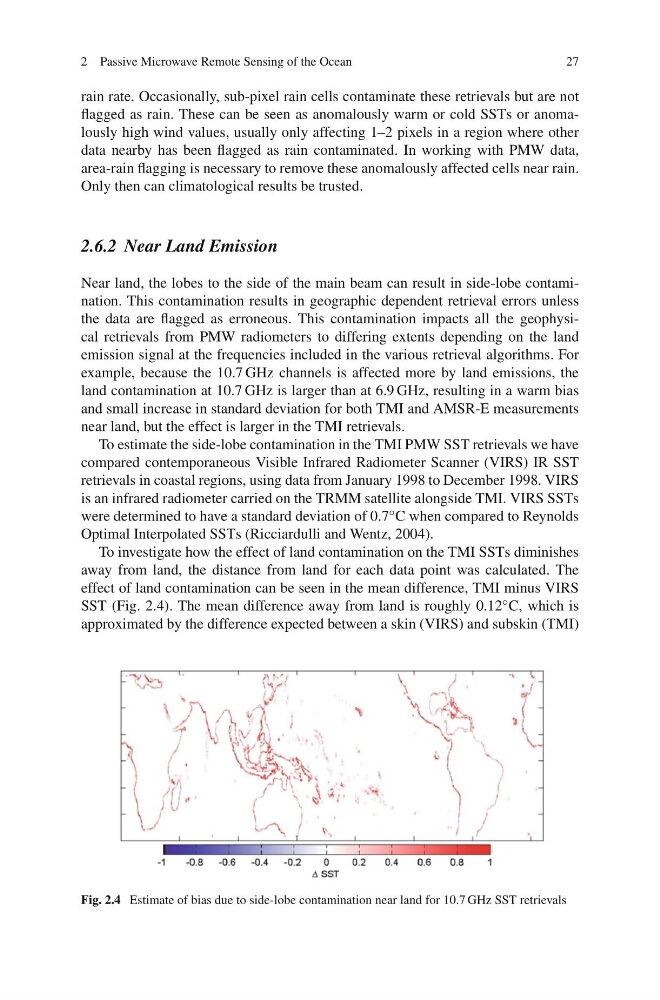
To investigate how the effect of land contamination on the TMI SSTs diminishes
away from land, the distance from land for each data point was calculated. The
effect of land contamination can be seen in the mean difference, TMI minus VIRS
SST (Fig. 2.4). The mean difference away from land is roughly 0.12 ◦ C, which is
approximated by the difference expected between a skin (VIRS) and subskin (TMI)
Fig. 2.4 Estimate of bias due to side-lobe contamination near land for 10.7 GHz SST retrievals
27
rain rate. Occasionally, sub-pixel rain cells contaminate these retrievals but are not
flagged as rain. These can be seen as anomalously warm or cold SSTs or anomalously high wind values, usually only affecting 1–2 pixels in a region where other
data nearby has been flagged as rain contaminated. In working with PMW data,
area-rain flagging is necessary to remove these anomalously affected cells near rain.
Only then can climatological results be trusted.
2.6.2 Near Land Emission
Near land, the lobes to the side of the main beam can result in side-lobe contamination. This contamination results in geographic dependent retrieval errors unless
the data are flagged as erroneous. This contamination impacts all the geophysical retrievals from PMW radiometers to differing extents depending on the land
emission signal at the frequencies included in the various retrieval algorithms. For
example, because the 10.7 GHz channels is affected more by land emissions, the
land contamination at 10.7 GHz is larger than at 6.9 GHz, resulting in a warm bias
and small increase in standard deviation for both TMI and AMSR-E measurements
near land, but the effect is larger in the TMI retrievals.
To estimate the side-lobe contamination in the TMI PMW SST retrievals we have
compared contemporaneous Visible Infrared Radiometer Scanner (VIRS) IR SST
retrievals in coastal regions, using data from January 1998 to December 1998. VIRS
is an infrared radiometer carried on the TRMM satellite alongside TMI. VIRS SSTs
were determined to have a standard deviation of 0.7 ◦ C when compared to Reynolds
Optimal Interpolated SSTs (Ricciardulli and Wentz, 2004).
To investigate how the effect of land contamination on the TMI SSTs diminishes
away from land, the distance from land for each data point was calculated. The
effect of land contamination can be seen in the mean difference, TMI minus VIRS
SST (Fig. 2.4). The mean difference away from land is roughly 0.12 ◦ C, which is
approximated by the difference expected between a skin (VIRS) and subskin (TMI)
Fig. 2.4 Estimate of bias due to side-lobe contamination near land for 10.7 GHz SST retrievals