

26
C.L. Gentemann et al.
Table 2.3 Nighttime satellite – buoy SST errors, bias and standard deviation (STD)
TOGA TAO/TRITON
PIRATA
Satellite
Collocations
Bias
STD
Collocations
Bias
STD
TMI
84,072
−0.09
0.67
11,669
−0.09
0.60
AMSR-E
21,461
−0.03
0.41
2,837
−0.00
0.35
water vapor, cloud liquid water, and rain rate (Wentz and Meissner, 2000). SST
retrieval is prevented only in regions with sun-glitter, rain, and near land. Since only
a small number of retrievals are unsuccessful, almost complete global coverage is
achieved daily. Any errors in retrieved wind speed, water vapor, or cloud liquid
water can result in errors in retrieved SST.
Buoy measurements from the Tropical Atmosphere Ocean/Triangle Trans-Ocean
Buoy Network (TAO/TRITON) and the Pilot Research Moored Array in the
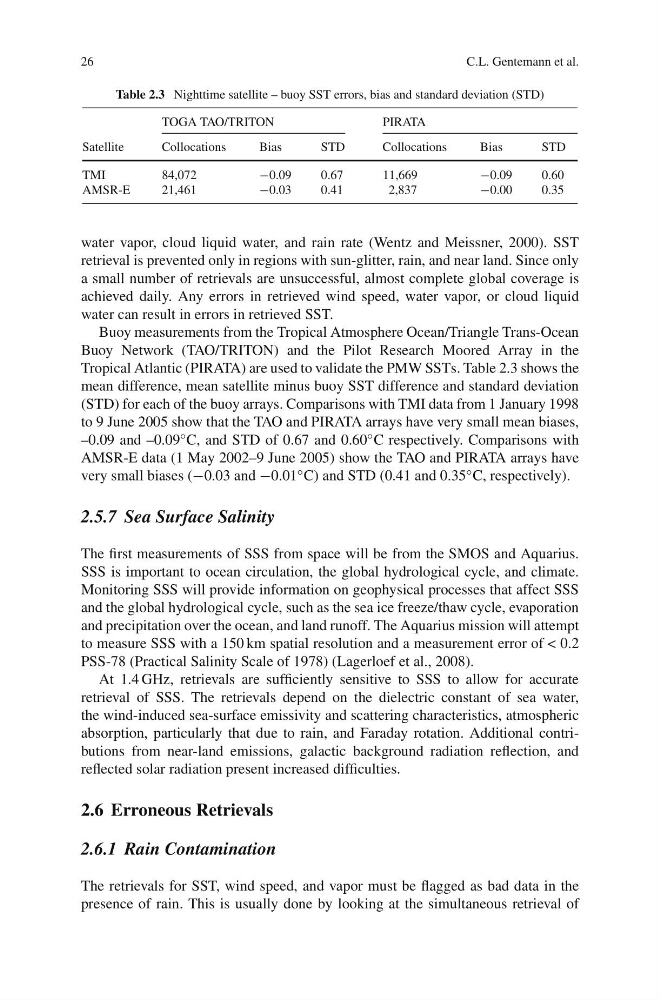
Tropical Atlantic (PIRATA) are used to validate the PMW SSTs. Table 2.3 shows the
mean difference, mean satellite minus buoy SST difference and standard deviation
(STD) for each of the buoy arrays. Comparisons with TMI data from 1 January 1998
to 9 June 2005 show that the TAO and PIRATA arrays have very small mean biases,
–0.09 and –0.09 ◦ C, and STD of 0.67 and 0.60 ◦ C respectively. Comparisons with
AMSR-E data (1 May 2002–9 June 2005) show the TAO and PIRATA arrays have
very small biases (−0.03 and −0.01 ◦ C) and STD (0.41 and 0.35 ◦ C, respectively).
2.5.7 Sea Surface Salinity
The first measurements of SSS from space will be from the SMOS and Aquarius.
SSS is important to ocean circulation, the global hydrological cycle, and climate.
Monitoring SSS will provide information on geophysical processes that affect SSS
and the global hydrological cycle, such as the sea ice freeze/thaw cycle, evaporation
and precipitation over the ocean, and land runoff. The Aquarius mission will attempt
to measure SSS with a 150 km spatial resolution and a measurement error of < 0.2
PSS-78 (Practical Salinity Scale of 1978) (Lagerloef et al., 2008).
At 1.4 GHz, retrievals are sufficiently sensitive to SSS to allow for accurate
retrieval of SSS. The retrievals depend on the dielectric constant of sea water,
the wind-induced sea-surface emissivity and scattering characteristics, atmospheric
absorption, particularly that due to rain, and Faraday rotation. Additional contributions from near-land emissions, galactic background radiation reflection, and
reflected solar radiation present increased difficulties.
2.6 Erroneous Retrievals
2.6.1 Rain Contamination
The retrievals for SST, wind speed, and vapor must be flagged as bad data in the
presence of rain. This is usually done by looking at the simultaneous retrieval of
C.L. Gentemann et al.
Table 2.3 Nighttime satellite – buoy SST errors, bias and standard deviation (STD)
TOGA TAO/TRITON
PIRATA
Satellite
Collocations
Bias
STD
Collocations
Bias
STD
TMI
84,072
−0.09
0.67
11,669
−0.09
0.60
AMSR-E
21,461
−0.03
0.41
2,837
−0.00
0.35
water vapor, cloud liquid water, and rain rate (Wentz and Meissner, 2000). SST
retrieval is prevented only in regions with sun-glitter, rain, and near land. Since only
a small number of retrievals are unsuccessful, almost complete global coverage is
achieved daily. Any errors in retrieved wind speed, water vapor, or cloud liquid
water can result in errors in retrieved SST.
Buoy measurements from the Tropical Atmosphere Ocean/Triangle Trans-Ocean
Buoy Network (TAO/TRITON) and the Pilot Research Moored Array in the
Tropical Atlantic (PIRATA) are used to validate the PMW SSTs. Table 2.3 shows the
mean difference, mean satellite minus buoy SST difference and standard deviation
(STD) for each of the buoy arrays. Comparisons with TMI data from 1 January 1998
to 9 June 2005 show that the TAO and PIRATA arrays have very small mean biases,
–0.09 and –0.09 ◦ C, and STD of 0.67 and 0.60 ◦ C respectively. Comparisons with
AMSR-E data (1 May 2002–9 June 2005) show the TAO and PIRATA arrays have
very small biases (−0.03 and −0.01 ◦ C) and STD (0.41 and 0.35 ◦ C, respectively).
2.5.7 Sea Surface Salinity
The first measurements of SSS from space will be from the SMOS and Aquarius.
SSS is important to ocean circulation, the global hydrological cycle, and climate.
Monitoring SSS will provide information on geophysical processes that affect SSS
and the global hydrological cycle, such as the sea ice freeze/thaw cycle, evaporation
and precipitation over the ocean, and land runoff. The Aquarius mission will attempt
to measure SSS with a 150 km spatial resolution and a measurement error of < 0.2
PSS-78 (Practical Salinity Scale of 1978) (Lagerloef et al., 2008).
At 1.4 GHz, retrievals are sufficiently sensitive to SSS to allow for accurate
retrieval of SSS. The retrievals depend on the dielectric constant of sea water,
the wind-induced sea-surface emissivity and scattering characteristics, atmospheric
absorption, particularly that due to rain, and Faraday rotation. Additional contributions from near-land emissions, galactic background radiation reflection, and
reflected solar radiation present increased difficulties.
2.6 Erroneous Retrievals
2.6.1 Rain Contamination
The retrievals for SST, wind speed, and vapor must be flagged as bad data in the
presence of rain. This is usually done by looking at the simultaneous retrieval of