

18 Field Radiometry and Ocean Color Remote Sensing
327
Table 18.2 Uncertainties (in percent) for L WN determined from above-water radiometric data
collected in coastal waters
Source of uncertainty
443
555
670
Absolute calibration
2.7
2.7
2.7
Viewing angle & f/Q corrections
2.0
2.9
1.9
t d (λ)
1.5
1.5
1.5
ρ(θ ,φ,θ 0 ,W)
1.5
0.7
2.5
Environmental variability
2.1
2.1
6.4
Quadrature sum
4.5
4.8
7.8
uncertainty in the determination of the sea surface reflectance ρ(θ ,φ,θ 0 ,W) as a
result of uncertainties in the wind speed and of the filtering applied to L T (θ ,φ,λ)
to minimize the wave effects; (v) environmental variability resulting from the combination of wave induced perturbations with changes in seawater optical properties
and illumination conditions during measurements (this latter perturbation source is
implicitly assumed to include uncertainties in the determination of L i (θ ,φ,λ) and
polarization effects of the sea surface). Estimates for the identified uncertainties are
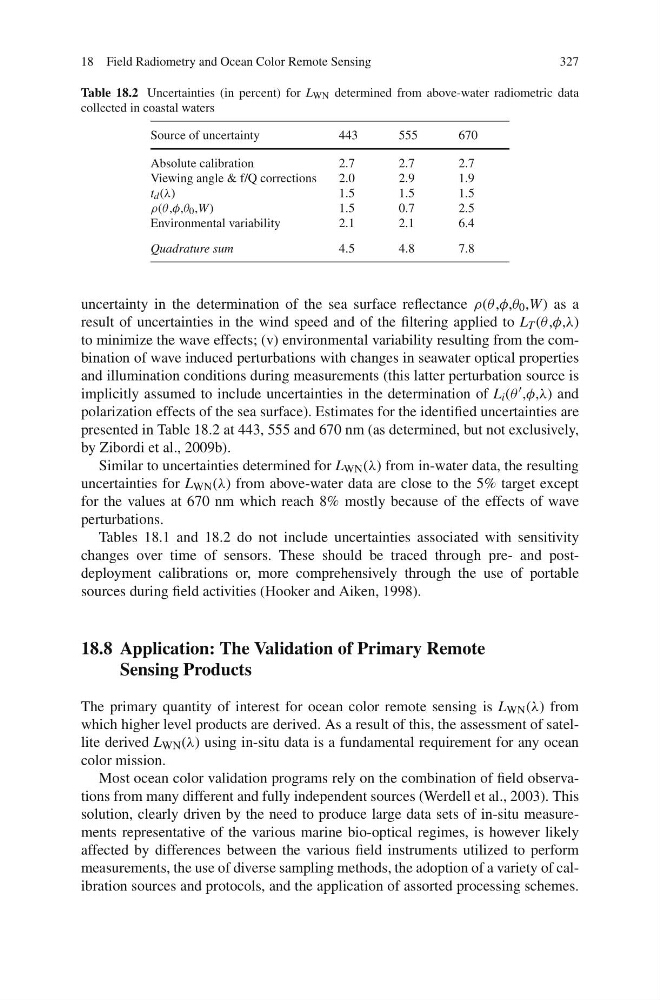
presented in Table 18.2 at 443, 555 and 670 nm (as determined, but not exclusively,
by Zibordi et al., 2009b).
Similar to uncertainties determined for L WN (λ) from in-water data, the resulting
uncertainties for L WN (λ) from above-water data are close to the 5% target except
for the values at 670 nm which reach 8% mostly because of the effects of wave
perturbations.
Tables 18.1 and 18.2 do not include uncertainties associated with sensitivity
changes over time of sensors. These should be traced through pre- and postdeployment calibrations or, more comprehensively through the use of portable
sources during field activities (Hooker and Aiken, 1998).
18.8 Application: The Validation of Primary Remote
Sensing Products
The primary quantity of interest for ocean color remote sensing is L WN (λ) from
which higher level products are derived. As a result of this, the assessment of satellite derived L WN (λ) using in-situ data is a fundamental requirement for any ocean
color mission.
Most ocean color validation programs rely on the combination of field observations from many different and fully independent sources (Werdell et al., 2003). This
solution, clearly driven by the need to produce large data sets of in-situ measurements representative of the various marine bio-optical regimes, is however likely
affected by differences between the various field instruments utilized to perform
measurements, the use of diverse sampling methods, the adoption of a variety of calibration sources and protocols, and the application of assorted processing schemes.
327
Table 18.2 Uncertainties (in percent) for L WN determined from above-water radiometric data
collected in coastal waters
Source of uncertainty
443
555
670
Absolute calibration
2.7
2.7
2.7
Viewing angle & f/Q corrections
2.0
2.9
1.9
t d (λ)
1.5
1.5
1.5
ρ(θ ,φ,θ 0 ,W)
1.5
0.7
2.5
Environmental variability
2.1
2.1
6.4
Quadrature sum
4.5
4.8
7.8
uncertainty in the determination of the sea surface reflectance ρ(θ ,φ,θ 0 ,W) as a
result of uncertainties in the wind speed and of the filtering applied to L T (θ ,φ,λ)
to minimize the wave effects; (v) environmental variability resulting from the combination of wave induced perturbations with changes in seawater optical properties
and illumination conditions during measurements (this latter perturbation source is
implicitly assumed to include uncertainties in the determination of L i (θ ,φ,λ) and
polarization effects of the sea surface). Estimates for the identified uncertainties are
presented in Table 18.2 at 443, 555 and 670 nm (as determined, but not exclusively,
by Zibordi et al., 2009b).
Similar to uncertainties determined for L WN (λ) from in-water data, the resulting
uncertainties for L WN (λ) from above-water data are close to the 5% target except
for the values at 670 nm which reach 8% mostly because of the effects of wave
perturbations.
Tables 18.1 and 18.2 do not include uncertainties associated with sensitivity
changes over time of sensors. These should be traced through pre- and postdeployment calibrations or, more comprehensively through the use of portable
sources during field activities (Hooker and Aiken, 1998).
18.8 Application: The Validation of Primary Remote
Sensing Products
The primary quantity of interest for ocean color remote sensing is L WN (λ) from
which higher level products are derived. As a result of this, the assessment of satellite derived L WN (λ) using in-situ data is a fundamental requirement for any ocean
color mission.
Most ocean color validation programs rely on the combination of field observations from many different and fully independent sources (Werdell et al., 2003). This
solution, clearly driven by the need to produce large data sets of in-situ measurements representative of the various marine bio-optical regimes, is however likely
affected by differences between the various field instruments utilized to perform
measurements, the use of diverse sampling methods, the adoption of a variety of calibration sources and protocols, and the application of assorted processing schemes.