

328
G. Zibordi and K.J. Voss
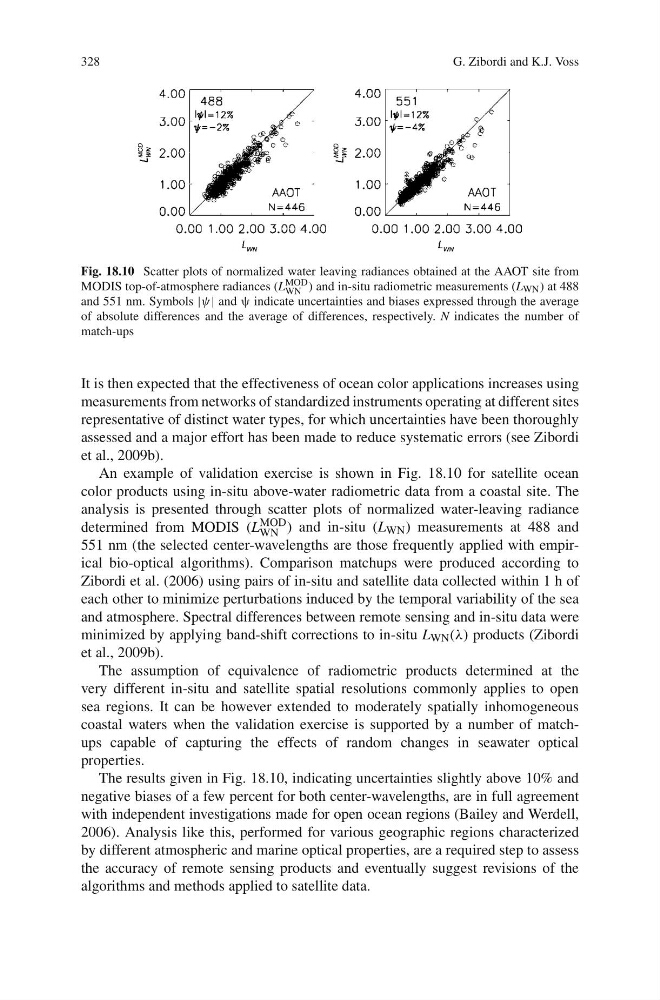
Fig. 18.10 Scatter plots of normalized water leaving radiances obtained at the AAOT site from
MODIS top-of-atmosphere radiances (L MOD
WN ) and in-situ radiometric measurements (L WN ) at 488
and 551 nm. Symbols |ψ| and ψ indicate uncertainties and biases expressed through the average
of absolute differences and the average of differences, respectively. N indicates the number of
match-ups
It is then expected that the effectiveness of ocean color applications increases using
measurements from networks of standardized instruments operating at different sites
representative of distinct water types, for which uncertainties have been thoroughly
assessed and a major effort has been made to reduce systematic errors (see Zibordi
et al., 2009b).
An example of validation exercise is shown in Fig. 18.10 for satellite ocean
color products using in-situ above-water radiometric data from a coastal site. The
analysis is presented through scatter plots of normalized water-leaving radiance
determined from MODIS (L MOD
WN ) and in-situ (L WN ) measurements at 488 and
551 nm (the selected center-wavelengths are those frequently applied with empirical bio-optical algorithms). Comparison matchups were produced according to
Zibordi et al. (2006) using pairs of in-situ and satellite data collected within 1 h of
each other to minimize perturbations induced by the temporal variability of the sea
and atmosphere. Spectral differences between remote sensing and in-situ data were
minimized by applying band-shift corrections to in-situ L WN (λ) products (Zibordi
et al., 2009b).
The assumption of equivalence of radiometric products determined at the
very different in-situ and satellite spatial resolutions commonly applies to open
sea regions. It can be however extended to moderately spatially inhomogeneous
coastal waters when the validation exercise is supported by a number of matchups capable of capturing the effects of random changes in seawater optical
properties.
The results given in Fig. 18.10, indicating uncertainties slightly above 10% and
negative biases of a few percent for both center-wavelengths, are in full agreement
with independent investigations made for open ocean regions (Bailey and Werdell,
2006). Analysis like this, performed for various geographic regions characterized
by different atmospheric and marine optical properties, are a required step to assess
the accuracy of remote sensing products and eventually suggest revisions of the
algorithms and methods applied to satellite data.
G. Zibordi and K.J. Voss
Fig. 18.10 Scatter plots of normalized water leaving radiances obtained at the AAOT site from
MODIS top-of-atmosphere radiances (L MOD
WN ) and in-situ radiometric measurements (L WN ) at 488
and 551 nm. Symbols |ψ| and ψ indicate uncertainties and biases expressed through the average
of absolute differences and the average of differences, respectively. N indicates the number of
match-ups
It is then expected that the effectiveness of ocean color applications increases using
measurements from networks of standardized instruments operating at different sites
representative of distinct water types, for which uncertainties have been thoroughly
assessed and a major effort has been made to reduce systematic errors (see Zibordi
et al., 2009b).
An example of validation exercise is shown in Fig. 18.10 for satellite ocean
color products using in-situ above-water radiometric data from a coastal site. The
analysis is presented through scatter plots of normalized water-leaving radiance
determined from MODIS (L MOD
WN ) and in-situ (L WN ) measurements at 488 and
551 nm (the selected center-wavelengths are those frequently applied with empirical bio-optical algorithms). Comparison matchups were produced according to
Zibordi et al. (2006) using pairs of in-situ and satellite data collected within 1 h of
each other to minimize perturbations induced by the temporal variability of the sea
and atmosphere. Spectral differences between remote sensing and in-situ data were
minimized by applying band-shift corrections to in-situ L WN (λ) products (Zibordi
et al., 2009b).
The assumption of equivalence of radiometric products determined at the
very different in-situ and satellite spatial resolutions commonly applies to open
sea regions. It can be however extended to moderately spatially inhomogeneous
coastal waters when the validation exercise is supported by a number of matchups capable of capturing the effects of random changes in seawater optical
properties.
The results given in Fig. 18.10, indicating uncertainties slightly above 10% and
negative biases of a few percent for both center-wavelengths, are in full agreement
with independent investigations made for open ocean regions (Bailey and Werdell,
2006). Analysis like this, performed for various geographic regions characterized
by different atmospheric and marine optical properties, are a required step to assess
the accuracy of remote sensing products and eventually suggest revisions of the
algorithms and methods applied to satellite data.