

326
G. Zibordi and K.J. Voss
weighed against the specific need for each application. Because of this, on the basis
of target accuracies in derived products (i.e., 35% for Chla in open ocean), a maximum uncertainty of 5% has been specified for L WN (λ) determined from space in
the blue spectral region over oligotrophic waters (Gordon, 1997). This requirement
has been streamlined through the so called 1% radiometry concept (McClain et al.,
2004): each major and independent uncertainty affecting the determination of insitu L WN (λ) should be lower than 1–2% to ensure the overall uncertainty budget of
L WN (λ) does not exceed the 5% threshold.
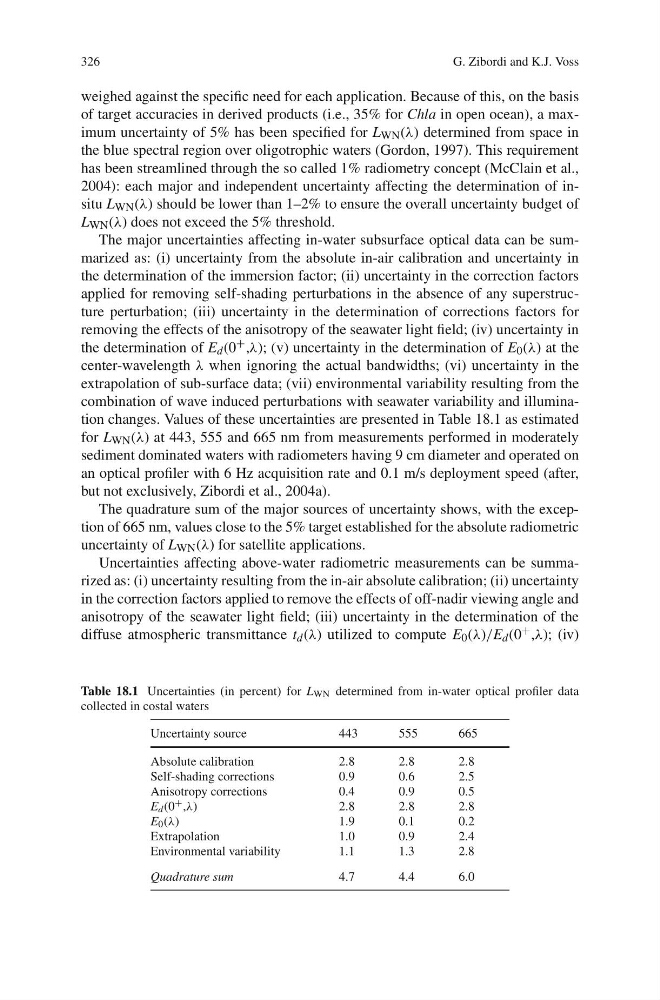
The major uncertainties affecting in-water subsurface optical data can be summarized as: (i) uncertainty from the absolute in-air calibration and uncertainty in
the determination of the immersion factor; (ii) uncertainty in the correction factors
applied for removing self-shading perturbations in the absence of any superstructure perturbation; (iii) uncertainty in the determination of corrections factors for
removing the effects of the anisotropy of the seawater light field; (iv) uncertainty in
the determination of E d (0 + ,λ); (v) uncertainty in the determination of E 0 (λ) at the
center-wavelength λ when ignoring the actual bandwidths; (vi) uncertainty in the
extrapolation of sub-surface data; (vii) environmental variability resulting from the
combination of wave induced perturbations with seawater variability and illumination changes. Values of these uncertainties are presented in Table 18.1 as estimated
for L WN (λ) at 443, 555 and 665 nm from measurements performed in moderately
sediment dominated waters with radiometers having 9 cm diameter and operated on
an optical profiler with 6 Hz acquisition rate and 0.1 m/s deployment speed (after,
but not exclusively, Zibordi et al., 2004a).
The quadrature sum of the major sources of uncertainty shows, with the exception of 665 nm, values close to the 5% target established for the absolute radiometric
uncertainty of L WN (λ) for satellite applications.
Uncertainties affecting above-water radiometric measurements can be summarized as: (i) uncertainty resulting from the in-air absolute calibration; (ii) uncertainty
in the correction factors applied to remove the effects of off-nadir viewing angle and
anisotropy of the seawater light field; (iii) uncertainty in the determination of the
diffuse atmospheric transmittance t d (λ) utilized to compute E 0 (λ)/E d (0 + ,λ); (iv)
Table 18.1 Uncertainties (in percent) for L WN determined from in-water optical profiler data
collected in costal waters
Uncertainty source
443
555
665
Absolute calibration
2.8
2.8
2.8
Self-shading corrections
0.9
0.6
2.5
Anisotropy corrections
0.4
0.9
0.5
E d (0 + ,λ)
2.8
2.8
2.8
E 0 (λ)
1.9
0.1
0.2
Extrapolation
1.0
0.9
2.4
Environmental variability
1.1
1.3
2.8
Quadrature sum
4.7
4.4
6.0
G. Zibordi and K.J. Voss
weighed against the specific need for each application. Because of this, on the basis
of target accuracies in derived products (i.e., 35% for Chla in open ocean), a maximum uncertainty of 5% has been specified for L WN (λ) determined from space in
the blue spectral region over oligotrophic waters (Gordon, 1997). This requirement
has been streamlined through the so called 1% radiometry concept (McClain et al.,
2004): each major and independent uncertainty affecting the determination of insitu L WN (λ) should be lower than 1–2% to ensure the overall uncertainty budget of
L WN (λ) does not exceed the 5% threshold.
The major uncertainties affecting in-water subsurface optical data can be summarized as: (i) uncertainty from the absolute in-air calibration and uncertainty in
the determination of the immersion factor; (ii) uncertainty in the correction factors
applied for removing self-shading perturbations in the absence of any superstructure perturbation; (iii) uncertainty in the determination of corrections factors for
removing the effects of the anisotropy of the seawater light field; (iv) uncertainty in
the determination of E d (0 + ,λ); (v) uncertainty in the determination of E 0 (λ) at the
center-wavelength λ when ignoring the actual bandwidths; (vi) uncertainty in the
extrapolation of sub-surface data; (vii) environmental variability resulting from the
combination of wave induced perturbations with seawater variability and illumination changes. Values of these uncertainties are presented in Table 18.1 as estimated
for L WN (λ) at 443, 555 and 665 nm from measurements performed in moderately
sediment dominated waters with radiometers having 9 cm diameter and operated on
an optical profiler with 6 Hz acquisition rate and 0.1 m/s deployment speed (after,
but not exclusively, Zibordi et al., 2004a).
The quadrature sum of the major sources of uncertainty shows, with the exception of 665 nm, values close to the 5% target established for the absolute radiometric
uncertainty of L WN (λ) for satellite applications.
Uncertainties affecting above-water radiometric measurements can be summarized as: (i) uncertainty resulting from the in-air absolute calibration; (ii) uncertainty
in the correction factors applied to remove the effects of off-nadir viewing angle and
anisotropy of the seawater light field; (iii) uncertainty in the determination of the
diffuse atmospheric transmittance t d (λ) utilized to compute E 0 (λ)/E d (0 + ,λ); (iv)
Table 18.1 Uncertainties (in percent) for L WN determined from in-water optical profiler data
collected in costal waters
Uncertainty source
443
555
665
Absolute calibration
2.8
2.8
2.8
Self-shading corrections
0.9
0.6
2.5
Anisotropy corrections
0.4
0.9
0.5
E d (0 + ,λ)
2.8
2.8
2.8
E 0 (λ)
1.9
0.1
0.2
Extrapolation
1.0
0.9
2.4
Environmental variability
1.1
1.3
2.8
Quadrature sum
4.7
4.4
6.0