

18 Field Radiometry and Ocean Color Remote Sensing
325
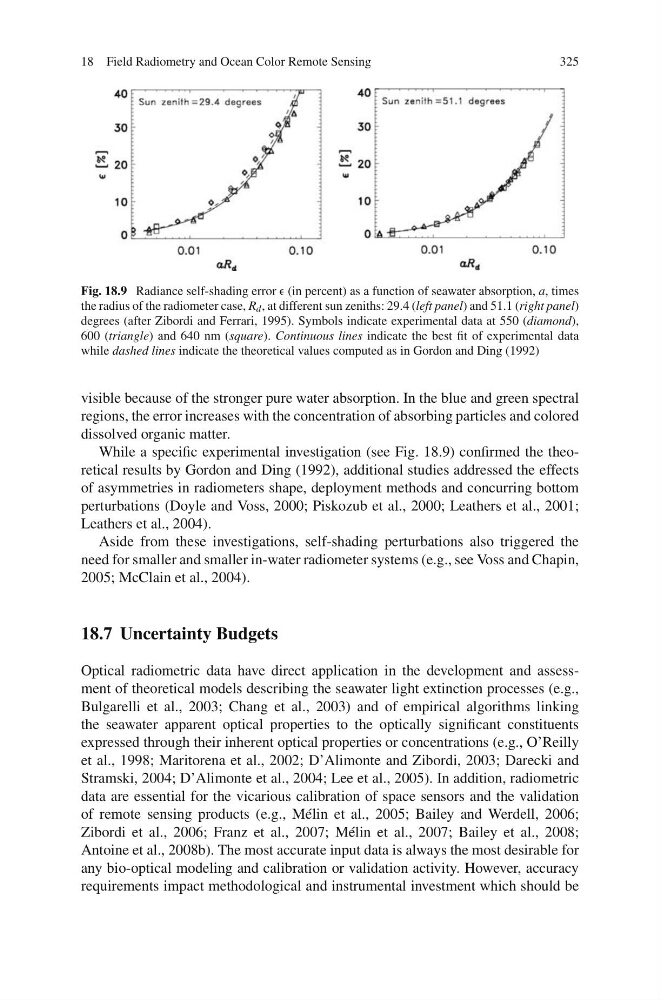
Fig. 18.9 Radiance self-shading error (in percent) as a function of seawater absorption, a, times
the radius of the radiometer case, R d , at different sun zeniths: 29.4 (left panel) and 51.1 (right panel)
degrees (after Zibordi and Ferrari, 1995). Symbols indicate experimental data at 550 (diamond),
600 (triangle) and 640 nm (square). Continuous lines indicate the best fit of experimental data
while dashed lines indicate the theoretical values computed as in Gordon and Ding (1992)
visible because of the stronger pure water absorption. In the blue and green spectral
regions, the error increases with the concentration of absorbing particles and colored
dissolved organic matter.
While a specific experimental investigation (see Fig. 18.9) confirmed the theoretical results by Gordon and Ding (1992), additional studies addressed the effects
of asymmetries in radiometers shape, deployment methods and concurring bottom
perturbations (Doyle and Voss, 2000; Piskozub et al., 2000; Leathers et al., 2001;
Leathers et al., 2004).
Aside from these investigations, self-shading perturbations also triggered the
need for smaller and smaller in-water radiometer systems (e.g., see Voss and Chapin,
2005; McClain et al., 2004).
18.7 Uncertainty Budgets
Optical radiometric data have direct application in the development and assessment of theoretical models describing the seawater light extinction processes (e.g.,
Bulgarelli et al., 2003; Chang et al., 2003) and of empirical algorithms linking
the seawater apparent optical properties to the optically significant constituents
expressed through their inherent optical properties or concentrations (e.g., O’Reilly
et al., 1998; Maritorena et al., 2002; D’Alimonte and Zibordi, 2003; Darecki and
Stramski, 2004; D’Alimonte et al., 2004; Lee et al., 2005). In addition, radiometric
data are essential for the vicarious calibration of space sensors and the validation
of remote sensing products (e.g., Mélin et al., 2005; Bailey and Werdell, 2006;
Zibordi et al., 2006; Franz et al., 2007; Mélin et al., 2007; Bailey et al., 2008;
Antoine et al., 2008b). The most accurate input data is always the most desirable for
any bio-optical modeling and calibration or validation activity. However, accuracy
requirements impact methodological and instrumental investment which should be
325
Fig. 18.9 Radiance self-shading error (in percent) as a function of seawater absorption, a, times
the radius of the radiometer case, R d , at different sun zeniths: 29.4 (left panel) and 51.1 (right panel)
degrees (after Zibordi and Ferrari, 1995). Symbols indicate experimental data at 550 (diamond),
600 (triangle) and 640 nm (square). Continuous lines indicate the best fit of experimental data
while dashed lines indicate the theoretical values computed as in Gordon and Ding (1992)
visible because of the stronger pure water absorption. In the blue and green spectral
regions, the error increases with the concentration of absorbing particles and colored
dissolved organic matter.
While a specific experimental investigation (see Fig. 18.9) confirmed the theoretical results by Gordon and Ding (1992), additional studies addressed the effects
of asymmetries in radiometers shape, deployment methods and concurring bottom
perturbations (Doyle and Voss, 2000; Piskozub et al., 2000; Leathers et al., 2001;
Leathers et al., 2004).
Aside from these investigations, self-shading perturbations also triggered the
need for smaller and smaller in-water radiometer systems (e.g., see Voss and Chapin,
2005; McClain et al., 2004).
18.7 Uncertainty Budgets
Optical radiometric data have direct application in the development and assessment of theoretical models describing the seawater light extinction processes (e.g.,
Bulgarelli et al., 2003; Chang et al., 2003) and of empirical algorithms linking
the seawater apparent optical properties to the optically significant constituents
expressed through their inherent optical properties or concentrations (e.g., O’Reilly
et al., 1998; Maritorena et al., 2002; D’Alimonte and Zibordi, 2003; Darecki and
Stramski, 2004; D’Alimonte et al., 2004; Lee et al., 2005). In addition, radiometric
data are essential for the vicarious calibration of space sensors and the validation
of remote sensing products (e.g., Mélin et al., 2005; Bailey and Werdell, 2006;
Zibordi et al., 2006; Franz et al., 2007; Mélin et al., 2007; Bailey et al., 2008;
Antoine et al., 2008b). The most accurate input data is always the most desirable for
any bio-optical modeling and calibration or validation activity. However, accuracy
requirements impact methodological and instrumental investment which should be