

312
G. Zibordi and K.J. Voss
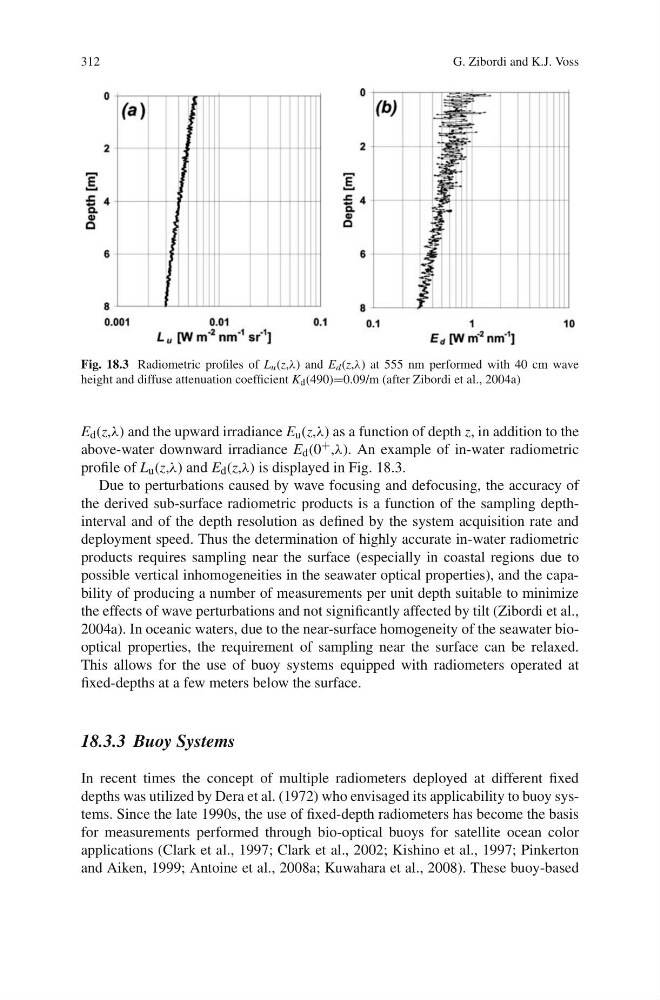
Fig. 18.3 Radiometric profiles of L u (z,λ) and E d (z,λ) at 555 nm performed with 40 cm wave
height and diffuse attenuation coefficient K d (490)=0.09/m (after Zibordi et al., 2004a)
E d (z,λ) and the upward irradiance E u (z,λ) as a function of depth z, in addition to the
above-water downward irradiance E d (0 + ,λ). An example of in-water radiometric
profile of L u (z,λ) and E d (z,λ) is displayed in Fig. 18.3.
Due to perturbations caused by wave focusing and defocusing, the accuracy of
the derived sub-surface radiometric products is a function of the sampling depthinterval and of the depth resolution as defined by the system acquisition rate and
deployment speed. Thus the determination of highly accurate in-water radiometric
products requires sampling near the surface (especially in coastal regions due to
possible vertical inhomogeneities in the seawater optical properties), and the capability of producing a number of measurements per unit depth suitable to minimize
the effects of wave perturbations and not significantly affected by tilt (Zibordi et al.,
2004a). In oceanic waters, due to the near-surface homogeneity of the seawater biooptical properties, the requirement of sampling near the surface can be relaxed.
This allows for the use of buoy systems equipped with radiometers operated at
fixed-depths at a few meters below the surface.
18.3.3 Buoy Systems
In recent times the concept of multiple radiometers deployed at different fixed
depths was utilized by Dera et al. (1972) who envisaged its applicability to buoy systems. Since the late 1990s, the use of fixed-depth radiometers has become the basis
for measurements performed through bio-optical buoys for satellite ocean color
applications (Clark et al., 1997; Clark et al., 2002; Kishino et al., 1997; Pinkerton
and Aiken, 1999; Antoine et al., 2008a; Kuwahara et al., 2008). These buoy-based
G. Zibordi and K.J. Voss
Fig. 18.3 Radiometric profiles of L u (z,λ) and E d (z,λ) at 555 nm performed with 40 cm wave
height and diffuse attenuation coefficient K d (490)=0.09/m (after Zibordi et al., 2004a)
E d (z,λ) and the upward irradiance E u (z,λ) as a function of depth z, in addition to the
above-water downward irradiance E d (0 + ,λ). An example of in-water radiometric
profile of L u (z,λ) and E d (z,λ) is displayed in Fig. 18.3.
Due to perturbations caused by wave focusing and defocusing, the accuracy of
the derived sub-surface radiometric products is a function of the sampling depthinterval and of the depth resolution as defined by the system acquisition rate and
deployment speed. Thus the determination of highly accurate in-water radiometric
products requires sampling near the surface (especially in coastal regions due to
possible vertical inhomogeneities in the seawater optical properties), and the capability of producing a number of measurements per unit depth suitable to minimize
the effects of wave perturbations and not significantly affected by tilt (Zibordi et al.,
2004a). In oceanic waters, due to the near-surface homogeneity of the seawater biooptical properties, the requirement of sampling near the surface can be relaxed.
This allows for the use of buoy systems equipped with radiometers operated at
fixed-depths at a few meters below the surface.
18.3.3 Buoy Systems
In recent times the concept of multiple radiometers deployed at different fixed
depths was utilized by Dera et al. (1972) who envisaged its applicability to buoy systems. Since the late 1990s, the use of fixed-depth radiometers has become the basis
for measurements performed through bio-optical buoys for satellite ocean color
applications (Clark et al., 1997; Clark et al., 2002; Kishino et al., 1997; Pinkerton
and Aiken, 1999; Antoine et al., 2008a; Kuwahara et al., 2008). These buoy-based