

242
P.J. Minnett
and Minnett, 2008). The day-night differences in the scatter are much smaller in the
radiometer comparisons. The nighttime 4 μm SST retrievals show markedly smaller
scatter than the 11–12 μm SST, which reflects not only the radiometric advantage
of measurements in the shorter wavelength atmospheric window, which is a consequence of being on the short-wavelength side of the peak of the Planck Function, but
also the better instrument performance. The dual-sided paddle-wheel scan mirror
has a multi-layer interference coating that introduces a dependence of the reflectivity on the scan angle for wavelengths greater than about 8 μm (Guenther et al.,
2002), and imperfect corrections for this effect introduce an additional uncertainty
in the 11–12 μm SST retrievals.
The uncertainty characteristics in the Aqua MODIS retrievals are better than for
the Terra MODIS and this presumably results from improvements in the instrument
construction and pre-launch characterization of the second instrument, as some of
the lessons learned in the development of the Terra MODIS could be applied to the
MODIS on Aqua (Xiong et al., 2008, 2009).
14.5.3 AATSR
The advantage of an atmospheric correction algorithm based on dual views through
different atmospheric path lengths, as used by the (A)ATSRs (Prata et al., 1990;
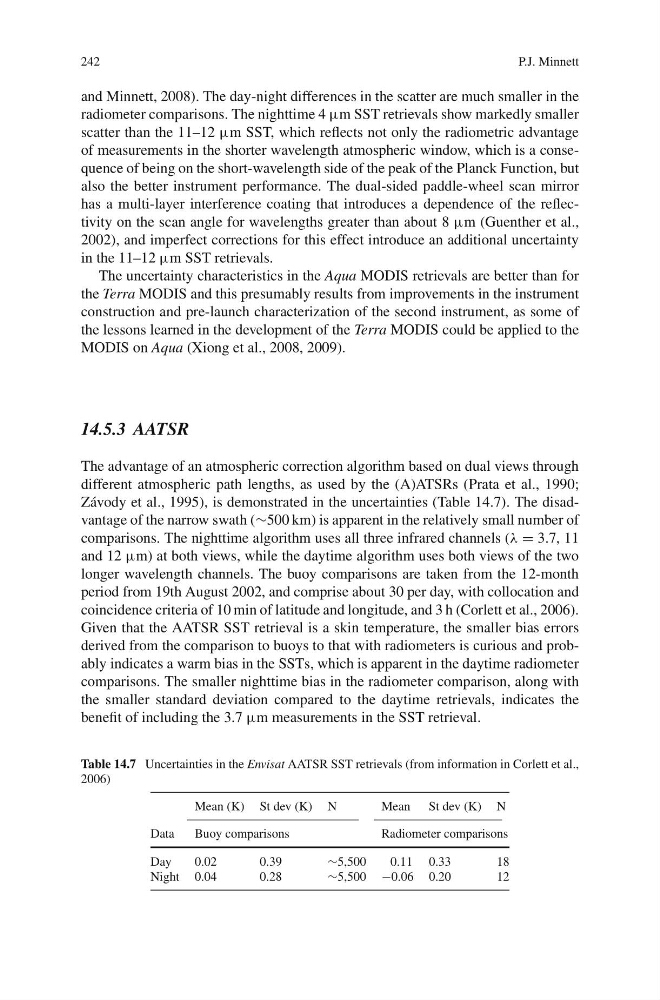
Závody et al., 1995), is demonstrated in the uncertainties (Table 14.7). The disadvantage of the narrow swath (∼500 km) is apparent in the relatively small number of
comparisons. The nighttime algorithm uses all three infrared channels (λ = 3.7, 11
and 12 μm) at both views, while the daytime algorithm uses both views of the two
longer wavelength channels. The buoy comparisons are taken from the 12-month
period from 19th August 2002, and comprise about 30 per day, with collocation and
coincidence criteria of 10 min of latitude and longitude, and 3 h (Corlett et al., 2006).
Given that the AATSR SST retrieval is a skin temperature, the smaller bias errors
derived from the comparison to buoys to that with radiometers is curious and probably indicates a warm bias in the SSTs, which is apparent in the daytime radiometer
comparisons. The smaller nighttime bias in the radiometer comparison, along with
the smaller standard deviation compared to the daytime retrievals, indicates the
benefit of including the 3.7 μm measurements in the SST retrieval.
Table 14.7 Uncertainties in the Envisat AATSR SST retrievals (from information in Corlett et al.,
2006)
Mean (K) St dev (K) N
Mean St dev (K) N
Data
Buoy comparisons
Radiometer comparisons
Day
0.02
0.39
∼5,500
0.11 0.33
18
Night 0.04
0.28
∼5,500 −0.06 0.20
12
P.J. Minnett
and Minnett, 2008). The day-night differences in the scatter are much smaller in the
radiometer comparisons. The nighttime 4 μm SST retrievals show markedly smaller
scatter than the 11–12 μm SST, which reflects not only the radiometric advantage
of measurements in the shorter wavelength atmospheric window, which is a consequence of being on the short-wavelength side of the peak of the Planck Function, but
also the better instrument performance. The dual-sided paddle-wheel scan mirror
has a multi-layer interference coating that introduces a dependence of the reflectivity on the scan angle for wavelengths greater than about 8 μm (Guenther et al.,
2002), and imperfect corrections for this effect introduce an additional uncertainty
in the 11–12 μm SST retrievals.
The uncertainty characteristics in the Aqua MODIS retrievals are better than for
the Terra MODIS and this presumably results from improvements in the instrument
construction and pre-launch characterization of the second instrument, as some of
the lessons learned in the development of the Terra MODIS could be applied to the
MODIS on Aqua (Xiong et al., 2008, 2009).
14.5.3 AATSR
The advantage of an atmospheric correction algorithm based on dual views through
different atmospheric path lengths, as used by the (A)ATSRs (Prata et al., 1990;
Závody et al., 1995), is demonstrated in the uncertainties (Table 14.7). The disadvantage of the narrow swath (∼500 km) is apparent in the relatively small number of
comparisons. The nighttime algorithm uses all three infrared channels (λ = 3.7, 11
and 12 μm) at both views, while the daytime algorithm uses both views of the two
longer wavelength channels. The buoy comparisons are taken from the 12-month
period from 19th August 2002, and comprise about 30 per day, with collocation and
coincidence criteria of 10 min of latitude and longitude, and 3 h (Corlett et al., 2006).
Given that the AATSR SST retrieval is a skin temperature, the smaller bias errors
derived from the comparison to buoys to that with radiometers is curious and probably indicates a warm bias in the SSTs, which is apparent in the daytime radiometer
comparisons. The smaller nighttime bias in the radiometer comparison, along with
the smaller standard deviation compared to the daytime retrievals, indicates the
benefit of including the 3.7 μm measurements in the SST retrieval.
Table 14.7 Uncertainties in the Envisat AATSR SST retrievals (from information in Corlett et al.,
2006)
Mean (K) St dev (K) N
Mean St dev (K) N
Data
Buoy comparisons
Radiometer comparisons
Day
0.02
0.39
∼5,500
0.11 0.33
18
Night 0.04
0.28
∼5,500 −0.06 0.20
12