

14 The Validation of Sea Surface Temperature Retrievals
243
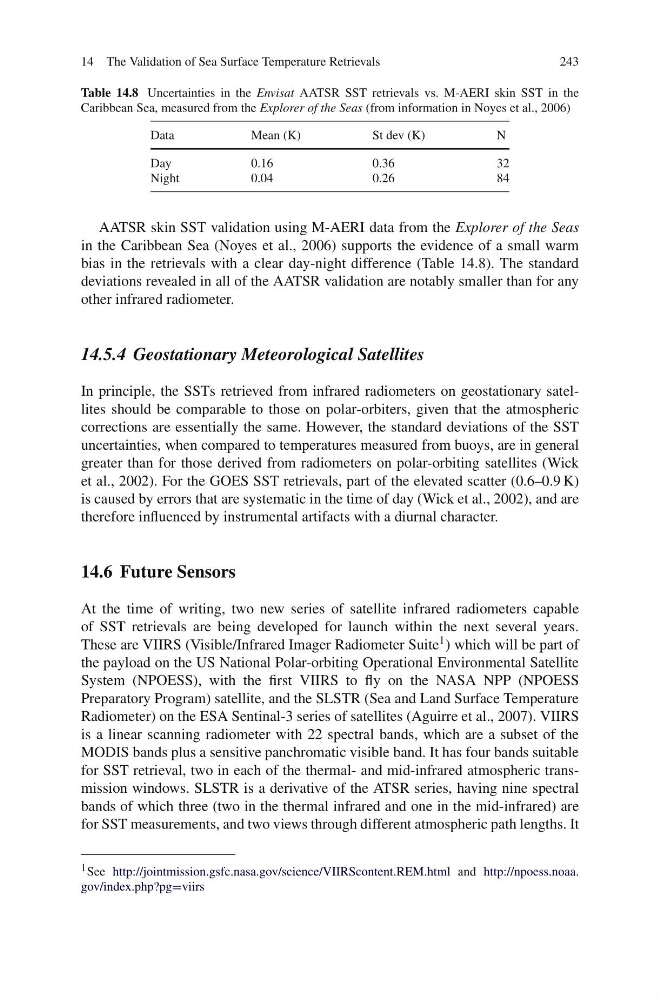
Table 14.8 Uncertainties in the Envisat AATSR SST retrievals vs. M-AERI skin SST in the
Caribbean Sea, measured from the Explorer of the Seas (from information in Noyes et al., 2006)
Data
Mean (K)
St dev (K)
N
Day
0.16
0.36
32
Night
0.04
0.26
84
AATSR skin SST validation using M-AERI data from the Explorer of the Seas
in the Caribbean Sea (Noyes et al., 2006) supports the evidence of a small warm
bias in the retrievals with a clear day-night difference (Table 14.8). The standard
deviations revealed in all of the AATSR validation are notably smaller than for any
other infrared radiometer.
14.5.4 Geostationary Meteorological Satellites
In principle, the SSTs retrieved from infrared radiometers on geostationary satellites should be comparable to those on polar-orbiters, given that the atmospheric
corrections are essentially the same. However, the standard deviations of the SST
uncertainties, when compared to temperatures measured from buoys, are in general
greater than for those derived from radiometers on polar-orbiting satellites (Wick
et al., 2002). For the GOES SST retrievals, part of the elevated scatter (0.6–0.9 K)
is caused by errors that are systematic in the time of day (Wick et al., 2002), and are
therefore influenced by instrumental artifacts with a diurnal character.
14.6 Future Sensors
At the time of writing, two new series of satellite infrared radiometers capable
of SST retrievals are being developed for launch within the next several years.
These are VIIRS (Visible/Infrared Imager Radiometer Suite 1 ) which will be part of
the payload on the US National Polar-orbiting Operational Environmental Satellite
System (NPOESS), with the first VIIRS to fly on the NASA NPP (NPOESS
Preparatory Program) satellite, and the SLSTR (Sea and Land Surface Temperature
Radiometer) on the ESA Sentinal-3 series of satellites (Aguirre et al., 2007). VIIRS
is a linear scanning radiometer with 22 spectral bands, which are a subset of the
MODIS bands plus a sensitive panchromatic visible band. It has four bands suitable
for SST retrieval, two in each of the thermal- and mid-infrared atmospheric transmission windows. SLSTR is a derivative of the ATSR series, having nine spectral
bands of which three (two in the thermal infrared and one in the mid-infrared) are
for SST measurements, and two views through different atmospheric path lengths. It
1 See http://jointmission.gsfc.nasa.gov/science/VIIRScontent.REM.html and http://npoess.noaa.
gov/index.php?pg=viirs
243
Table 14.8 Uncertainties in the Envisat AATSR SST retrievals vs. M-AERI skin SST in the
Caribbean Sea, measured from the Explorer of the Seas (from information in Noyes et al., 2006)
Data
Mean (K)
St dev (K)
N
Day
0.16
0.36
32
Night
0.04
0.26
84
AATSR skin SST validation using M-AERI data from the Explorer of the Seas
in the Caribbean Sea (Noyes et al., 2006) supports the evidence of a small warm
bias in the retrievals with a clear day-night difference (Table 14.8). The standard
deviations revealed in all of the AATSR validation are notably smaller than for any
other infrared radiometer.
14.5.4 Geostationary Meteorological Satellites
In principle, the SSTs retrieved from infrared radiometers on geostationary satellites should be comparable to those on polar-orbiters, given that the atmospheric
corrections are essentially the same. However, the standard deviations of the SST
uncertainties, when compared to temperatures measured from buoys, are in general
greater than for those derived from radiometers on polar-orbiting satellites (Wick
et al., 2002). For the GOES SST retrievals, part of the elevated scatter (0.6–0.9 K)
is caused by errors that are systematic in the time of day (Wick et al., 2002), and are
therefore influenced by instrumental artifacts with a diurnal character.
14.6 Future Sensors
At the time of writing, two new series of satellite infrared radiometers capable
of SST retrievals are being developed for launch within the next several years.
These are VIIRS (Visible/Infrared Imager Radiometer Suite 1 ) which will be part of
the payload on the US National Polar-orbiting Operational Environmental Satellite
System (NPOESS), with the first VIIRS to fly on the NASA NPP (NPOESS
Preparatory Program) satellite, and the SLSTR (Sea and Land Surface Temperature
Radiometer) on the ESA Sentinal-3 series of satellites (Aguirre et al., 2007). VIIRS
is a linear scanning radiometer with 22 spectral bands, which are a subset of the
MODIS bands plus a sensitive panchromatic visible band. It has four bands suitable
for SST retrieval, two in each of the thermal- and mid-infrared atmospheric transmission windows. SLSTR is a derivative of the ATSR series, having nine spectral
bands of which three (two in the thermal infrared and one in the mid-infrared) are
for SST measurements, and two views through different atmospheric path lengths. It
1 See http://jointmission.gsfc.nasa.gov/science/VIIRScontent.REM.html and http://npoess.noaa.
gov/index.php?pg=viirs