

14 The Validation of Sea Surface Temperature Retrievals
241
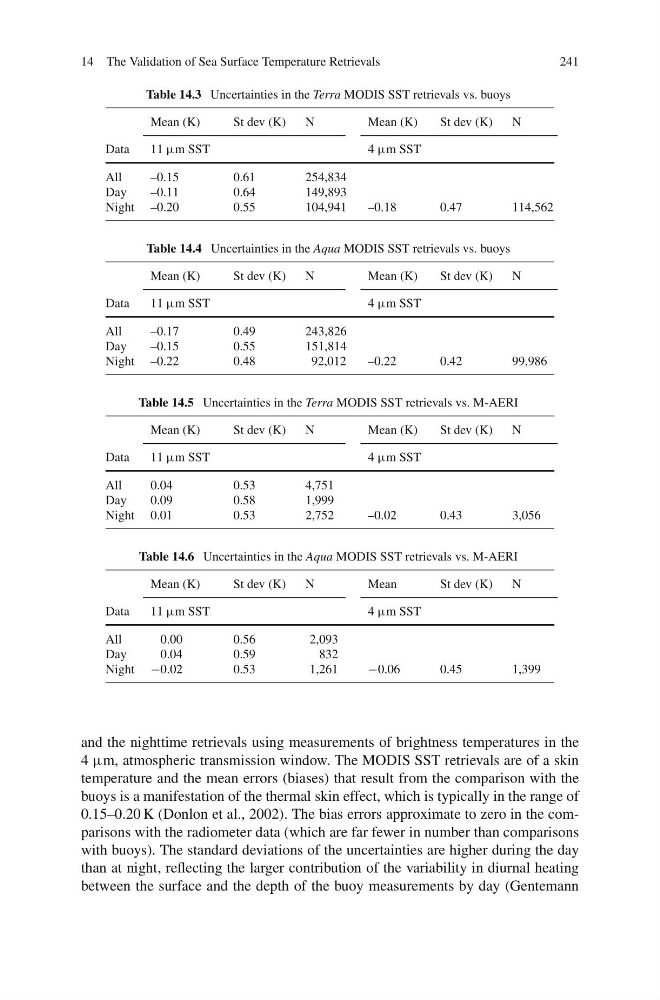
Table 14.3 Uncertainties in the Terra MODIS SST retrievals vs. buoys
Mean (K)
St dev (K)
N
Mean (K)
St dev (K)
N
Data
11 μm SST
4 μm SST
All
–0.15
0.61
254,834
Day
–0.11
0.64
149,893
Night –0.20
0.55
104,941
–0.18
0.47
114,562
Table 14.4 Uncertainties in the Aqua MODIS SST retrievals vs. buoys
Mean (K)
St dev (K)
N
Mean (K)
St dev (K)
N
Data
11 μm SST
4 μm SST
All
–0.17
0.49
243,826
Day
–0.15
0.55
151,814
Night –0.22
0.48
92,012
–0.22
0.42
99,986
Table 14.5 Uncertainties in the Terra MODIS SST retrievals vs. M-AERI
Mean (K)
St dev (K)
N
Mean (K)
St dev (K)
N
Data
11 μm SST
4 μm SST
All
0.04
0.53
4,751
Day
0.09
0.58
1,999
Night 0.01
0.53
2,752
–0.02
0.43
3,056
Table 14.6 Uncertainties in the Aqua MODIS SST retrievals vs. M-AERI
Mean (K)
St dev (K)
N
Mean
St dev (K)
N
Data
11 μm SST
4 μm SST
All
0.00
0.56
2,093
Day
0.04
0.59
832
Night −0.02
0.53
1,261
−0.06
0.45
1,399
and the nighttime retrievals using measurements of brightness temperatures in the
4 μm, atmospheric transmission window. The MODIS SST retrievals are of a skin
temperature and the mean errors (biases) that result from the comparison with the
buoys is a manifestation of the thermal skin effect, which is typically in the range of
0.15–0.20 K (Donlon et al., 2002). The bias errors approximate to zero in the comparisons with the radiometer data (which are far fewer in number than comparisons
with buoys). The standard deviations of the uncertainties are higher during the day
than at night, reflecting the larger contribution of the variability in diurnal heating
between the surface and the depth of the buoy measurements by day (Gentemann
241
Table 14.3 Uncertainties in the Terra MODIS SST retrievals vs. buoys
Mean (K)
St dev (K)
N
Mean (K)
St dev (K)
N
Data
11 μm SST
4 μm SST
All
–0.15
0.61
254,834
Day
–0.11
0.64
149,893
Night –0.20
0.55
104,941
–0.18
0.47
114,562
Table 14.4 Uncertainties in the Aqua MODIS SST retrievals vs. buoys
Mean (K)
St dev (K)
N
Mean (K)
St dev (K)
N
Data
11 μm SST
4 μm SST
All
–0.17
0.49
243,826
Day
–0.15
0.55
151,814
Night –0.22
0.48
92,012
–0.22
0.42
99,986
Table 14.5 Uncertainties in the Terra MODIS SST retrievals vs. M-AERI
Mean (K)
St dev (K)
N
Mean (K)
St dev (K)
N
Data
11 μm SST
4 μm SST
All
0.04
0.53
4,751
Day
0.09
0.58
1,999
Night 0.01
0.53
2,752
–0.02
0.43
3,056
Table 14.6 Uncertainties in the Aqua MODIS SST retrievals vs. M-AERI
Mean (K)
St dev (K)
N
Mean
St dev (K)
N
Data
11 μm SST
4 μm SST
All
0.00
0.56
2,093
Day
0.04
0.59
832
Night −0.02
0.53
1,261
−0.06
0.45
1,399
and the nighttime retrievals using measurements of brightness temperatures in the
4 μm, atmospheric transmission window. The MODIS SST retrievals are of a skin
temperature and the mean errors (biases) that result from the comparison with the
buoys is a manifestation of the thermal skin effect, which is typically in the range of
0.15–0.20 K (Donlon et al., 2002). The bias errors approximate to zero in the comparisons with the radiometer data (which are far fewer in number than comparisons
with buoys). The standard deviations of the uncertainties are higher during the day
than at night, reflecting the larger contribution of the variability in diurnal heating
between the surface and the depth of the buoy measurements by day (Gentemann