

9 Determining Ocean Circulation and Sea Level from Satellite Altimetry
157
For example, Lapeyre and Klein (2006) illustrated that up to 50% of the oceanic
tracer content is found at scales shorter than 100 km. Analyzing simulations by a
high-resolution ocean general circulation model, Klein et al. (2009) showed that the
vertical velocity of upper ocean currents can be estimated from sea surface height
at the sub-mesoscales (wavelengths shorter than 100 km). Therefore, a significant
part of ocean circulation and variability that has a fundamental role in the vertical
exchange process for transporting nutrients, CO 2 , and heat has been missed in the
current altimetry observations.
To extend altimetry observation to higher resolution over a wide swath, radar
interferometry has been developed since the early 1990s (Rodriguez and Martin,
1992). An instrument called Wide-Swath Ocean Altimeter (WSOA) was developed
for flight on the Ocean Surface Topography Mission/Jason-2 in the early 2000s (Fu
and Rodriguez, 2004).
Because of funding problems, WSOA was cancelled after substantial development had been conducted. A new mission concept called Surface Water and Ocean
Topography (SWOT) was recommended by the US National Research Council
Decadal Survey for addressing the need of high-resolution observation of water elevation in both the oceans and land surface water (Alsdorf et al., 2007). SWOT is
currently being developed by NASA and CNES for flight in the late 2010s.
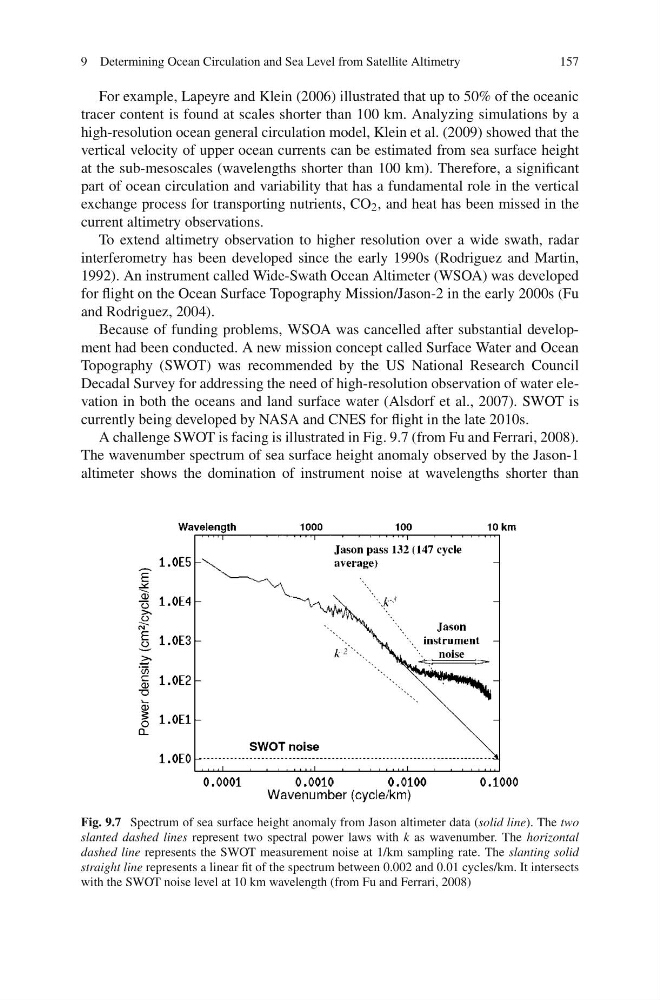
A challenge SWOT is facing is illustrated in Fig. 9.7 (from Fu and Ferrari, 2008).
The wavenumber spectrum of sea surface height anomaly observed by the Jason-1
altimeter shows the domination of instrument noise at wavelengths shorter than
Fig. 9.7 Spectrum of sea surface height anomaly from Jason altimeter data (solid line). The two
slanted dashed lines represent two spectral power laws with k as wavenumber. The horizontal
dashed line represents the SWOT measurement noise at 1/km sampling rate. The slanting solid
straight line represents a linear fit of the spectrum between 0.002 and 0.01 cycles/km. It intersects
with the SWOT noise level at 10 km wavelength (from Fu and Ferrari, 2008)
157
For example, Lapeyre and Klein (2006) illustrated that up to 50% of the oceanic
tracer content is found at scales shorter than 100 km. Analyzing simulations by a
high-resolution ocean general circulation model, Klein et al. (2009) showed that the
vertical velocity of upper ocean currents can be estimated from sea surface height
at the sub-mesoscales (wavelengths shorter than 100 km). Therefore, a significant
part of ocean circulation and variability that has a fundamental role in the vertical
exchange process for transporting nutrients, CO 2 , and heat has been missed in the
current altimetry observations.
To extend altimetry observation to higher resolution over a wide swath, radar
interferometry has been developed since the early 1990s (Rodriguez and Martin,
1992). An instrument called Wide-Swath Ocean Altimeter (WSOA) was developed
for flight on the Ocean Surface Topography Mission/Jason-2 in the early 2000s (Fu
and Rodriguez, 2004).
Because of funding problems, WSOA was cancelled after substantial development had been conducted. A new mission concept called Surface Water and Ocean
Topography (SWOT) was recommended by the US National Research Council
Decadal Survey for addressing the need of high-resolution observation of water elevation in both the oceans and land surface water (Alsdorf et al., 2007). SWOT is
currently being developed by NASA and CNES for flight in the late 2010s.
A challenge SWOT is facing is illustrated in Fig. 9.7 (from Fu and Ferrari, 2008).
The wavenumber spectrum of sea surface height anomaly observed by the Jason-1
altimeter shows the domination of instrument noise at wavelengths shorter than
Fig. 9.7 Spectrum of sea surface height anomaly from Jason altimeter data (solid line). The two
slanted dashed lines represent two spectral power laws with k as wavenumber. The horizontal
dashed line represents the SWOT measurement noise at 1/km sampling rate. The slanting solid
straight line represents a linear fit of the spectrum between 0.002 and 0.01 cycles/km. It intersects
with the SWOT noise level at 10 km wavelength (from Fu and Ferrari, 2008)